
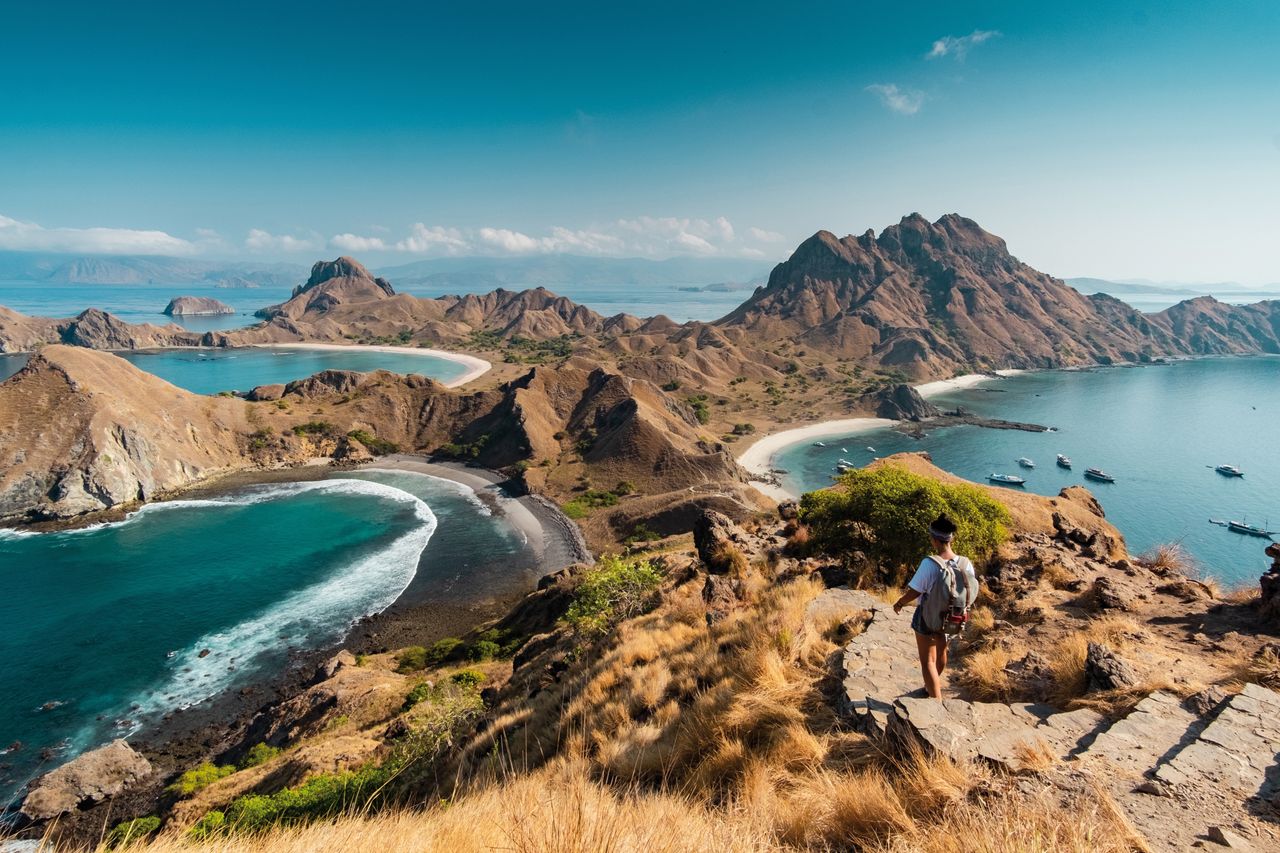
Komodo National Park has become one of Southeast Asia’s most sought-after wildlife destinations. Visitors arrive in Indonesia’s East Nusa Tenggara province to see the Komodo dragon, hike across the dramatic hills of Padar Island, dive among coral reefs and spend nights aboard traditional-style boats sailing between islands.
But the success of Komodo tourism is creating a difficult question: How many visitors can this extraordinary ecosystem handle before the tourism industry begins damaging the very environment that attracts people in the first place?
The problem is no longer theoretical. Visitor numbers have surged, tourism infrastructure around Labuan Bajo has expanded rapidly, and Indonesian authorities have introduced limits on visitors to some of the park’s most sensitive areas. In September 2026, officials also reported that the park’s annual visitor allocation for regular tourists had already been exhausted, prompting a temporary adjustment to daily visitor numbers.
The story of Komodo is therefore becoming bigger than a debate about overcrowding. It is a case study in the difficult economics of modern nature tourism: wildlife can generate enormous economic value, but the more successful a destination becomes, the greater the risk that success undermines conservation.
From Remote Wilderness to International Tourism Hotspot
For much of its modern history, the Komodo region was relatively remote. Labuan Bajo was better known as a small port than as an international tourism hub.
That changed dramatically as Indonesia promoted Labuan Bajo and Komodo as a major international destination.
The attraction is obvious. Komodo National Park combines rare wildlife with spectacular marine and terrestrial landscapes. The Komodo dragon (Varanus komodoensis) is found nowhere else in the wild, while the surrounding waters support coral reefs, fish, turtles and other marine life.
The destination also became increasingly accessible to international travelers. Hotels, restaurants, boat operators, diving companies and other tourism businesses expanded around Labuan Bajo.
The result has been a powerful tourism cycle:
More visitors → more businesses → better connectivity and accommodation → greater international exposure → even more visitors.
That cycle can create jobs and income for local communities. It can also generate resources for conservation.
But nature does not expand at the same speed as tourism demand.
A national park has a finite amount of land, water, coral reef, wildlife habitat and waste-processing capacity.
Visitor Numbers Have Become a Management Problem
Indonesia introduced a major visitor-management policy in 2026.
Beginning April 1, authorities set a limit of 1,000 regular visitors per day, equivalent to an annual allocation of roughly 365,000 visitors. The restrictions cover major attractions including Komodo Island, Rinca Island and Padar Island, as well as numerous surrounding diving sites.
The government said the purpose was to prevent long-term overtourism from damaging the ecosystem and ultimately destroying the destination’s tourism appeal.
But the numbers demonstrate how difficult the policy is to implement.
According to the Komodo National Park authority, the 365,000-person annual allocation for 2026 was exhausted by August. Officials subsequently introduced an additional allocation of 500 visitors per day for the September-December period. Total visitor numbers in 2025 had reached 429,509.
This illustrates a fundamental tension.
If demand remains above the environmentally acceptable level, limiting visitors means turning away potential tourists and tourism revenue.
If authorities simply accommodate all the demand, the ecological costs may accumulate until the destination becomes degraded.
Neither option is easy.
The Problem Is Not Simply the Number of People
Counting tourists is useful, but it does not tell the entire story.
Two destinations can receive the same number of visitors while experiencing completely different environmental impacts.
What matters is where visitors go, how long they stay, how they travel, what activities they undertake and what infrastructure supports them.
A thousand visitors concentrated around one fragile trail can cause more damage than a larger number dispersed among several properly managed sites.
Similarly, hundreds of boats moving through sensitive marine areas can create a different environmental footprint from visitors who stay primarily on land.
This is why Indonesian officials have said the visitor quota is intended to be adaptive rather than permanently fixed. The government has indicated that the limit can be reviewed as infrastructure, visitor management and environmental conditions change.
That approach is potentially more sophisticated than simply declaring a permanent annual ceiling.
But it also requires something difficult: good environmental data and strong enforcement.
The Hidden Pressure Beneath the Water
Komodo’s tourism problem is not confined to the famous dragons.
The surrounding marine environment is equally important.
Komodo National Park is a major diving and snorkeling destination, and the health of its coral reefs is essential to both biodiversity and tourism.
A 2026 study examining sustainable tourism in Labuan Bajo and Komodo National Park identified continuing problems including marine-waste accumulation, damage to coral from vessel anchors and pollution associated with boats. It also found weaknesses in enforcement and coordination among stakeholders.
This matters because marine damage can be less visible to ordinary tourists than overcrowded trails.
A visitor may see a beautiful blue bay and assume that the ecosystem is healthy. Yet repeated anchoring, pollution and poorly managed tourism activity can gradually degrade habitats beneath the surface.
Once coral ecosystems decline, recovery can be slow and expensive.
The tourism industry can therefore create a paradox: the boats that bring visitors to see the marine environment can also contribute to the environmental pressure threatening it.
Waste Is an Unavoidable Tourism Challenge
Every visitor produces waste.
That includes food packaging, plastic bottles, wastewater, discarded fishing and boating materials, and other forms of rubbish.
On a large mainland tourism destination, waste can potentially be transported to extensive municipal treatment systems.
An archipelago presents a different challenge.
Waste has to be collected, transported and processed across islands and coastal communities. Boats become part of the logistical system, while storms and currents can move rubbish through the marine environment.
The problem becomes particularly difficult during periods of peak tourism.
A destination can therefore reach a point where the question is no longer simply:
“How many tourists can the island physically accommodate?”
It becomes:
“How much waste, wastewater, freshwater consumption and transportation can the entire tourism system sustainably handle?”
That is a much larger calculation.
Water Could Become as Important as Wildlife
Tourists require water.
Hotels need water for showers, toilets, kitchens, laundry and swimming pools. Restaurants need it for food preparation and cleaning. Boats require water for their operations, while tourism workers and local residents also need reliable supplies.
Research into tourism development in Labuan Bajo has identified concerns about increasing demand for clean water and competition between tourism activities and local community needs. Studies have also highlighted broader pressures involving land use, coastal development and local livelihoods.
This illustrates why tourism sustainability cannot be measured solely by the condition of the Komodo dragon population.
A tourism destination can theoretically protect its headline animal while still creating serious environmental and social problems elsewhere.
A genuinely sustainable tourism strategy has to consider the entire system.
The Dragons Are Not Just a Tourist Attraction
The Komodo dragon is the symbolic center of the destination, but it is also a wild predator living in a fragile environment.
Tourism can create pressure on wildlife through human presence, noise, movement, food and changes to habitat.
A recent study of tourism and Komodo dragons in the Labuan Bajo region emphasized the tension between conservation, tourism development and the cultural relationship local communities have with the animals. It also noted that tourism can turn wildlife into a commodity while creating new pressures on local human-animal relationships.
That cultural dimension is important.
Conservation is not simply about fencing off a national park and controlling tourists.
People have lived around these landscapes for generations. Local communities have their own traditions, livelihoods and understandings of wildlife.
In some communities, Komodo dragons have cultural significance beyond their value as tourist attractions.
If tourism policies ignore those relationships, conservation can become something imposed from outside rather than something supported locally.
Tourism Development Can Also Affect Dragon Habitat
Another underappreciated issue is what happens outside the most famous visitor sites.
Tourists do not exist only inside national-park boundaries. They require airports, roads, hotels, restaurants, electricity, water systems, ports and other infrastructure.
That means tourism can transform landscapes surrounding the park even when visitor numbers inside the park are carefully controlled.
Research examining tourism development around Labuan Bajo found substantial overlap between areas suitable for Komodo habitat and areas targeted for tourism development. The study also identified infrastructure development intersecting with areas important to the species.
This creates a crucial distinction:
Managing visitors inside a national park is not enough if uncontrolled development outside the park continues to fragment wildlife habitat.
Conservation planning therefore needs to extend beyond the boundaries visible on a tourist map.
The Local Economy Has a Lot to Gain
It would be wrong to portray tourism only as an environmental threat.
For communities around Labuan Bajo, tourism can provide significant economic opportunities.
Tourists spend money on hotels, restaurants, boat trips, diving, transportation, guides, souvenirs and other services.
The tourism boom can create jobs and encourage investment in roads, airports and public infrastructure.
Conservation itself also benefits from a destination that generates money.
This is why the debate is not simply about whether Komodo should have tourists.
The more useful question is:
What kind of tourism produces the greatest local and conservation benefit for the least environmental cost?
A visitor who spends more money locally and stays longer may potentially generate greater economic value than several low-spending day visitors.
That creates an argument for moving away from a tourism model based primarily on maximizing visitor numbers.
More Tourists Do Not Necessarily Mean More Tourism Revenue
This is one of the most important economic lessons from Komodo.
Suppose a destination can accommodate 500,000 visitors but suffers significant environmental damage at that level.
Reducing the number to 300,000 might initially appear economically destructive.
But if those 300,000 visitors spend more, stay longer and support local businesses, the destination could potentially generate comparable or greater economic value.
This is the basic logic behind high-value, lower-volume tourism.
Instead of measuring success through visitor arrivals alone, governments could track:
- Average spending per visitor
- Length of stay
- Local employment
- Local business participation
- Conservation revenue
- Waste generated per visitor
- Water consumption
- Carbon emissions
- Environmental condition of reefs
- Wildlife population indicators
- Community income
Those indicators provide a much clearer picture of whether tourism is actually sustainable.
Cruise Tourism Creates Another Complicated Question
Cruise ships introduce a particularly interesting management challenge.
In April 2026, Indonesian officials said cruise passengers were not included in the 1,000-person-per-day regular visitor quota. The explanation was that cruise visitors generally follow a different, more concentrated itinerary, often visiting a specific location rather than moving between numerous sites like regular park visitors.
But this creates an obvious policy question.
If a cruise ship can bring more than 1,000 passengers to the region, should those visitors be considered separately simply because their movement pattern is different?
The answer depends on the environmental footprint of the activity.
If cruise visitors genuinely create less pressure because they remain concentrated in a controlled area, separate management could make sense.
But if large-scale cruise arrivals create substantial pressure on ports, waste systems, water supplies or marine environments, then their broader environmental impact still needs to be measured.
The lesson is that a visitor quota should measure environmental pressure, not merely ticket categories.
The Risk of Solving Overtourism With Infrastructure Alone
One response to overcrowding is to build more infrastructure.
More trails can spread visitors out. Better docks can improve boat movement. Additional waste facilities can reduce pollution. Improved transport can reduce congestion.
Indonesia’s forestry authorities have suggested that improvements such as better trekking routes and dock management could eventually allow visitor limits to be reconsidered.
Infrastructure can therefore be part of the solution.
But there is a danger.
If every infrastructure improvement simply creates capacity for more tourists, the result can become a cycle:
Build more → attract more tourists → reach the new limit → build more again.
Eventually the destination is no longer solving overtourism. It is continuously expanding tourism to match demand.
Infrastructure should instead be used to reduce environmental impact and improve visitor management—not automatically to maximize visitor volume.
A Better Future May Depend on Spreading Tourists Out
One promising strategy is geographical diversification.
Komodo National Park has several attractions, but certain locations receive disproportionate attention because they are highly recognizable on social media and travel itineraries.
Padar Island’s famous viewpoint is a prime example.
If thousands of tourists want essentially the same photograph, visitor pressure becomes highly concentrated.
Officials have discussed spreading visitors across different locations and developing alternative destinations outside the most heavily visited sites. The government has also mentioned conservation and tourism opportunities in areas including parts of Flores.
This could benefit both tourists and local communities.
Instead of everyone following the same itinerary, travelers could explore lesser-known landscapes, villages, diving areas and cultural attractions.
That would distribute economic benefits while reducing pressure on individual sites.
Social Media Has Changed the Meaning of a “Hidden Gem”
The internet has made this problem more difficult.
A remote viewpoint that once received a few visitors can become internationally famous within months after a viral video.
Travel platforms can turn previously obscure locations into bucket-list attractions almost overnight.
Komodo’s landscapes are particularly vulnerable to this phenomenon because they are visually distinctive.
A photograph of Padar’s dramatic hills can sell an entire destination.
But the same image can also create a crowd of people trying to recreate it.
Tourism authorities increasingly need to think about digital demand management, not just physical infrastructure.
That could involve timed entry, reservation systems, visitor caps, alternative routes and actively promoting less crowded destinations.
What Happens If Komodo Becomes Too Popular?
There is a cruel irony at the heart of wildlife tourism.
The rarer and more spectacular a destination is, the more people want to see it.
But excessive visitation can gradually reduce the qualities that made the place special.
If trails become crowded, wildlife becomes disturbed, reefs deteriorate and landscapes become surrounded by development, visitors may eventually decide that the experience is no longer worth the cost.
Tourism then damages its own economic foundation.
This is especially dangerous for Komodo because the destination is selling something that cannot easily be replaced.
There is only one wild population of Komodo dragons.
Another hotel can be built.
Another restaurant can open.
Another boat can be purchased.
But a damaged ecosystem cannot simply be rebuilt on demand.
Komodo Could Become a Model for Sustainable Tourism
The current challenge also creates an opportunity.
Komodo could become an international example of how a famous wildlife destination manages mass tourism without sacrificing conservation.
That would require several changes.
First, visitor numbers should be based on scientific assessments rather than political pressure or tourism demand alone.
Second, environmental monitoring should be continuous.
Third, marine tourism needs the same attention as land-based tourism.
Fourth, local communities should receive meaningful economic benefits.
Fifth, tourism infrastructure should be evaluated for its impact on water, waste, energy, land and wildlife.
And finally, the success of the destination should be measured by more than the number of people who arrive.
Indonesia’s decision to introduce visitor limits shows that authorities recognize the problem. The fact that officials are already discussing adaptive quotas suggests that the system will continue to evolve.
The harder task is ensuring that the rules are enforced consistently and that conservation remains the objective rather than simply another justification for tourism development.
The Future of Komodo Tourism
Komodo does not need to choose between tourism and conservation.
It needs to decide what kind of tourism it wants.
A model based on ever-growing visitor numbers would eventually collide with ecological limits.
A model based on controlled access, longer stays, higher local economic value, strong conservation funding and carefully distributed visitation could be much more durable.
That may mean some travelers will have to accept that they cannot visit every famous viewpoint at any time they want.
It may mean higher prices, advance reservations and stricter rules.
It may mean fewer boats in sensitive waters and greater restrictions on where tourists can walk.
Those inconveniences are not necessarily failures of tourism management.
They may be the price of keeping the destination alive.
Komodo’s dragons survived for millions of years before international tourism discovered them. The challenge now is making sure that the modern tourism economy built around them does not become the force that ultimately damages their habitat.
The central lesson is simple: the value of Komodo lies precisely in the fact that it is not an ordinary tourist attraction.
If its natural environment is treated as an unlimited resource, tourism may destroy what it is selling.
If that environment is treated as the scarce asset it really is, Komodo could demonstrate how wildlife tourism can generate prosperity while protecting the ecosystem that makes prosperity possible.
5 Frequently Asked Questions About Tourism in Komodo
1. Why is tourism increasing so rapidly in Komodo?
Komodo has become an internationally recognized wildlife and marine destination because of its Komodo dragons, dramatic landscapes, diving, snorkeling and island-hopping experiences. Improved tourism infrastructure and the promotion of Labuan Bajo as a major destination have also made the region more accessible.
2. How many tourists are currently allowed to visit Komodo National Park?
Indonesia introduced a regular visitor allocation of 1,000 visitors per day, equivalent to approximately 365,000 visitors annually, beginning in April 2026. However, the system is being adjusted and monitored, and authorities have indicated that quotas can change depending on environmental capacity and management conditions.
3. Why is overtourism dangerous for Komodo?
Too many visitors can place pressure on wildlife habitat, trails, marine ecosystems, waste systems, water supplies and infrastructure. Research has identified issues including marine waste, anchor-related coral damage and pollution associated with tourism activity.
4. Can tourists still visit Komodo National Park?
Yes. Komodo National Park remains open to visitors, although access is subject to visitor-management rules and changing allocations. Travelers should check current regulations and booking requirements before visiting because quotas and operational arrangements can change.
5. What can travelers do to make a Komodo trip more sustainable?
Travelers can reduce their impact by following park rules, avoiding contact with wildlife, not leaving waste behind, respecting designated trails, choosing responsible operators, minimizing single-use plastics and considering less-crowded destinations and longer stays rather than trying to visit as many attractions as possible in a short period.
Sources The Economist