
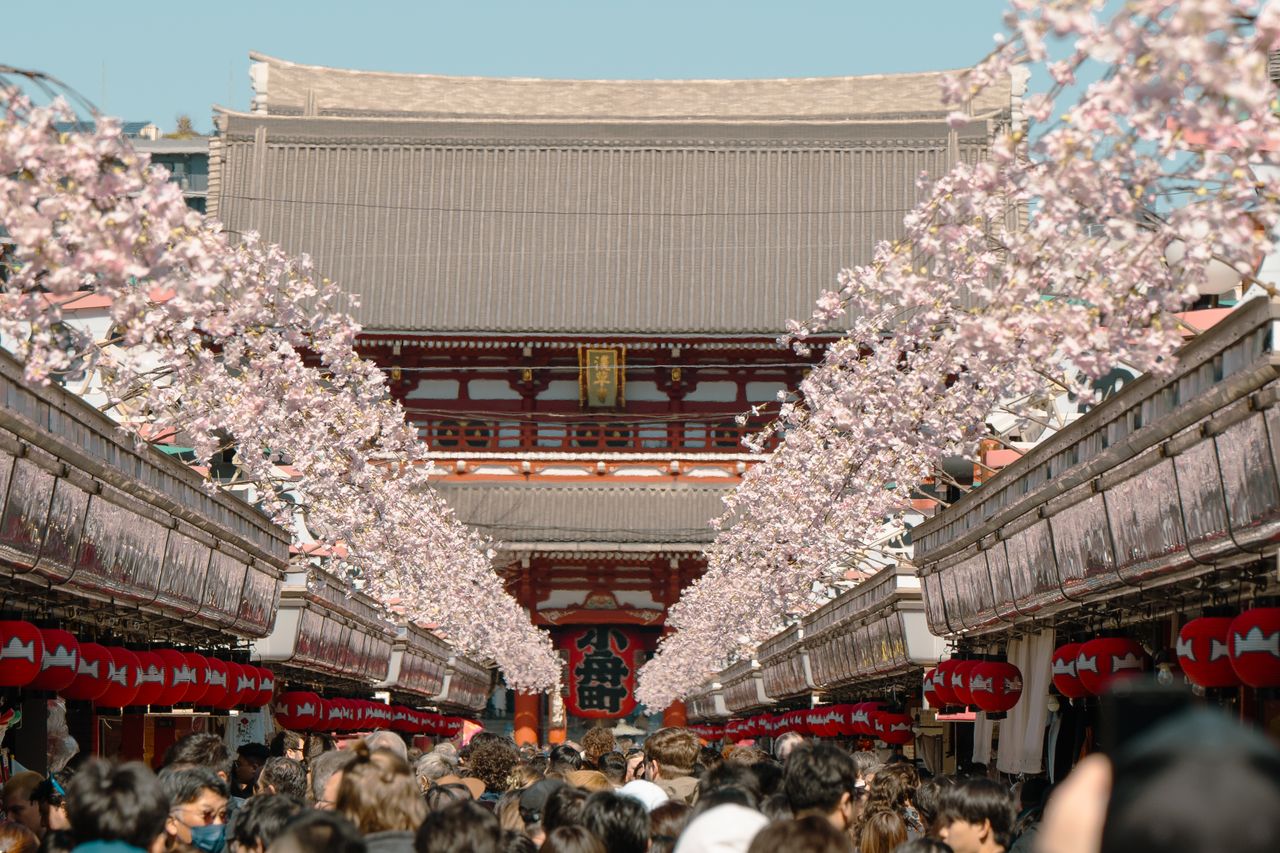
Japan has become one of the world’s most successful tourism destinations.
From Kyoto’s historic temples and Tokyo’s neon districts to Hokkaido’s ski resorts, Okinawa’s beaches and the mountain villages of the Japanese Alps, the country offers an extraordinary combination of culture, food, nature, transportation and hospitality.
International visitors have responded in record numbers.
Japan welcomed approximately 42.7 million international visitors in 2025, an all-time annual record, while inbound tourism spending reached roughly ¥9.5 trillion. The government continues to target 60 million international visitors and ¥15 trillion in visitor spending by 2030.
But there is a problem behind those impressive numbers.
Tourism is not automatically sustainable simply because the experience being sold is described as “eco-friendly.”
A forest-bathing excursion still requires visitors to travel there.
A sustainable hotel still requires electricity and water.
A local food experience still depends on transportation and supply chains.
And almost every overseas visitor arriving in Japan has traveled by airplane, one of the most difficult forms of transport to decarbonize.
Japan therefore faces a difficult question:
How can the country continue expanding tourism without allowing tourism itself to undermine the environment, local communities and destinations that attract visitors in the first place?
Tourism Has a Large Carbon Footprint
The environmental challenge begins before a visitor reaches Japan.
Because Japan is an island nation, most international tourists arrive by air.
According to analysis cited by The Japan Times, transportation accounts for more than half of tourism-related emissions in Japan, while long-haul flights can generate particularly large amounts of greenhouse-gas emissions per passenger.
This creates an uncomfortable paradox.
Japan can encourage tourists to use trains instead of rental cars once they arrive, stay in environmentally responsible hotels and avoid disposable plastics.
But none of those measures eliminates the emissions generated by the international flight that brought them there.
That does not mean sustainable tourism is impossible.
It means sustainability has to be considered across the entire tourism system, rather than only at the hotel or attraction level.
The Tourism Industry Is Bigger Than Hotels
When people hear “sustainable tourism,” they often think about environmentally friendly accommodation.
But tourism consists of a much larger network.
It includes:
- International aviation
- Domestic railways
- Buses
- Taxis
- Rental cars
- Hotels and ryokan
- Restaurants
- Convenience stores
- Tourist attractions
- Ski resorts
- Cruise ships
- Airports
- Waste management
- Water systems
- Energy infrastructure
- Food supply chains
- Local retailers
- Cultural institutions
- Tour operators
Every additional visitor interacts with many parts of this system.
That means improving tourism sustainability requires coordination among businesses, municipalities, residents and national government agencies.
Japan’s sustainable-tourism policy is increasingly moving in that direction.
Japan Wants More Tourists — But Not Everywhere
Japan’s tourism strategy contains an apparent contradiction.
The government wants to increase international visitor numbers to 60 million by 2030.
At the same time, officials increasingly acknowledge that certain destinations are already struggling with excessive concentrations of tourists.
The problem is therefore not simply the number of tourists entering Japan.
It is where they go.
Tokyo, Osaka and Kyoto absorb a particularly large share of international visitors. The OECD notes that these three major destinations account for approximately 60% of international tourist accommodation, excluding short-term rentals.
This concentration produces very different experiences across Japan.
A famous Kyoto street may be crowded beyond comfortable levels while a rural community elsewhere struggles to attract enough visitors to sustain hotels, restaurants and transportation.
That suggests one possible solution:
Japan does not necessarily need fewer tourists. It needs tourism to be distributed more intelligently.
The Problem With Simply Sending Tourists Elsewhere
Regional tourism is often presented as a straightforward answer to overtourism.
If Kyoto is crowded, encourage visitors to travel to smaller cities.
If Tokyo is overwhelmed, promote regional destinations.
If one mountain trail is congested, advertise another.
The logic is reasonable, but it has limitations.
Tourists usually choose famous destinations for a reason.
They are easy to find online, have established transportation networks and offer experiences travelers already recognize.
Social media reinforces this concentration.
A photograph becomes popular.
Visitors want the same photograph.
Businesses then advertise the same location.
More visitors arrive.
The location becomes even more famous.
Eventually, a place that was once a quiet local attraction becomes a global tourism hotspot.
Simply telling tourists to “go somewhere else” does not break that cycle.
Alternative destinations need transportation, accommodation, information, multilingual services and compelling experiences of their own.
Japan’s New Tourism Plan
Japan’s new Tourism Nation Promotion Basic Plan for fiscal 2026 through 2030 attempts to address this tension.
The government has retained its major growth targets while placing greater emphasis on balancing inbound tourism with residents’ quality of life.
It also aims to increase the number of regions implementing overtourism measures from 47 in 2025 to 100 by 2030.
That is an important policy shift.
It recognizes that tourism problems are often local.
A national visitor total cannot tell policymakers whether a particular road is congested, whether a local bus is overloaded or whether residents are being disturbed by short-term rentals.
Those problems must be measured and managed at the destination level.
The Japan Sustainable Tourism Standard
One of Japan’s most important tools is the Japan Sustainable Tourism Standard for Destinations, known as JSTS-D.
Developed with support from the Japan Tourism Agency, the framework provides destinations with a structured way to evaluate sustainability.
It goes beyond simply asking whether a destination has recycling bins or solar panels.
The framework considers areas including:
- Sustainable destination management
- Local economic benefits
- Cultural preservation
- Environmental protection
- Energy consumption
- Water use
- Wastewater
- Solid waste
- Greenhouse-gas emissions
- Low-impact transportation
- Noise
- Resident participation
- Visitor management
The Japan Tourism Agency says the framework is intended to help local governments and destination-management organizations conduct objective, data-based tourism management.
That emphasis on measurement is important.
A destination cannot meaningfully improve sustainability if it does not know where its biggest impacts are.
Sustainability Needs Numbers
A tourism destination may proudly advertise itself as sustainable.
But what does that actually mean?
Has energy consumption declined?
Has waste per visitor decreased?
Are local residents more satisfied?
Are tourism businesses reducing emissions?
Is groundwater being consumed faster than it can be replenished?
Are visitors staying longer rather than making short, high-impact trips?
Are local businesses receiving a greater share of tourism revenue?
These questions require data.
A recent academic study examining JSTS-D implementation across 47 destination units in 27 prefectures found an average sustainability implementation score of 51.7 out of 100, with substantial variation among destinations. Environmental sustainability was the lowest-scoring of the four major domains examined. The researchers cautioned that the results are a benchmark of participating destinations rather than a representative score for all of Japan.
The finding illustrates a larger challenge.
Having a sustainability framework is one thing.
Implementing it consistently is another.
Norikura Kogen: A Different Tourism Philosophy
One of the examples highlighted by The Japan Times is Norikura Kogen in Nagano Prefecture.
Located in Chubu Sangaku National Park, the area became Japan’s first designated “Zero Carbon Park” in 2021.
The initiative brings together local businesses, government and other stakeholders to pursue lower-carbon tourism.
The area’s challenges are unusually complex.
It is a mountain destination at around 1,500 meters elevation, meaning that hospitality businesses have substantial heating needs.
At the same time, the area faces environmental issues including invasive species and an expanding deer population.
Instead of treating tourism and environmental protection as completely separate activities, local stakeholders have attempted to integrate them.
Renewable Energy at the Destination
Norikura Kogen’s strategy includes renewable energy and locally available biomass.
Reducing plastic use is another part of the effort.
The objective is not to turn the destination into a completely artificial “green” tourism product.
It is to reduce the environmental costs associated with operating tourism businesses in a difficult mountain environment.
This is an important distinction.
Sustainability is often most effective when it is connected to the practical problems a community already faces.
If heating costs are high, improving building efficiency makes economic sense.
If waste disposal is expensive, reducing waste makes economic sense.
If transportation creates congestion and pollution, walking and cycling can improve both the visitor experience and local environment.
Slower Tourism Could Be Part of the Solution
Norikura also illustrates another concept: slow tourism.
Local businesses can encourage visitors to stay longer and explore destinations on foot or by bicycle instead of constantly moving between attractions by car.
The idea is relatively simple.
A traveler who stays several nights at one destination may generate economic value for local accommodation, restaurants and businesses while making fewer transportation journeys than someone rapidly moving through several destinations.
Longer stays can therefore potentially improve the economic efficiency of tourism.
This does not automatically make a trip carbon-neutral.
But it can change the relationship between visitor spending and environmental impact.
The Rise of the “Workation”
Some Japanese destinations are also experimenting with longer stays that combine work and travel.
The concept is often called a workation.
Instead of spending two days rushing through a destination, a visitor may stay for weeks while working remotely.
That can produce several potential advantages.
The visitor spends more money locally.
Accommodation is used for a longer period.
Travel emissions associated with repeated short trips are avoided.
And visitors have more time to engage with local communities rather than simply photographing major attractions.
For rural destinations, this model can be particularly attractive because it potentially creates demand outside traditional holiday periods.
Niseko Faces a Different Sustainability Problem
Hokkaido’s Niseko demonstrates how sustainability challenges can emerge even in destinations associated with nature.
Niseko has become an internationally famous ski destination, attracting luxury hotels, foreign investors and high-income visitors.
But rapid development brings environmental pressures of its own.
The Japan Times reports growing local concerns about energy consumption, waste generation and wastewater associated with tourism development.
The issue is particularly interesting because Niseko’s appeal depends heavily on its natural environment.
Snow is the tourism product.
Forests and mountain landscapes are part of the tourism product.
Clean water is part of the tourism product.
A healthy environment is therefore not simply an ethical objective.
It is also an economic asset.
Subsidies for Greener Tourism Businesses
Niseko has introduced a decarbonization subsidy program for local businesses and residents.
Support can cover measures including:
- Solar panels
- Energy-storage batteries
- More efficient air-conditioning systems
- Efficient water-heating systems
- New homes meeting higher sustainability standards
According to the local environmental planning department, 42 subsidies totaling approximately ¥24 million had been awarded since 2024.
This illustrates another important principle.
Governments cannot always expect small tourism businesses to finance expensive environmental upgrades themselves.
A family-run inn may want to install solar panels or replace an inefficient heating system but lack the capital to do so.
Targeted subsidies can reduce that barrier.
The Hidden Environmental Cost of “Authentic” Tourism
Japan’s tourism marketing increasingly emphasizes authenticity.
Travelers are encouraged to experience rural villages, traditional food, mountain forests, hot springs and local crafts.
These experiences can generate significant benefits for communities.
But authenticity can also become environmentally intensive.
Consider a remote mountain village suddenly receiving thousands of visitors.
More buses arrive.
More roads are used.
More wastewater is produced.
More food needs to be transported.
More electricity is consumed.
More rubbish has to be collected.
The very remoteness that makes the destination attractive can make tourism’s environmental footprint larger.
This is why “nature tourism” should not automatically be equated with “sustainable tourism.”
Eco-Tourism Is Not Automatically Low-Carbon Tourism
This distinction is particularly important.
A nature-based tourism experience may protect an ecosystem while still generating substantial carbon emissions.
For example, an overseas traveler could fly thousands of kilometers to Japan, take a domestic flight to another region, rent a vehicle and spend a day hiking in a protected area.
The hiking itself might have almost no environmental impact.
The journey to reach it may have a much larger footprint.
Sustainable tourism therefore requires looking at the entire journey rather than only the attraction.
Aviation Is Japan’s Difficult Problem
This may be the hardest issue for Japan to solve.
International aviation is deeply embedded in inbound tourism.
Japan cannot easily replace long-haul flights with trains.
And aviation remains difficult to decarbonize at the speed required to offset rapidly growing passenger numbers.
This creates a structural tension between Japan’s tourism growth targets and climate objectives.
If visitor numbers continue rising, improvements in hotels and local transportation must be substantial simply to prevent tourism emissions from rising alongside visitor numbers.
Even then, aviation remains a major source of emissions.
Could Japan Encourage Longer Trips?
One possible response is to encourage visitors to stay longer.
Consider two travelers.
Traveler A flies from Europe to Japan for five days.
Traveler B makes the same long-haul journey but stays for three weeks.
The flight emissions are broadly associated with the journey itself rather than each night spent in Japan.
A longer stay can therefore distribute the emissions of the international journey across more days and potentially more local economic activity.
This suggests that tourism policy should not focus exclusively on visitor numbers.
Other indicators could matter too:
- Average length of stay
- Regional distribution
- Spending per visitor
- Transport mode
- Seasonal distribution
- Environmental impact per visitor
- Local resident satisfaction
A destination with fewer but longer-staying visitors might have a different economic and environmental profile from one dominated by short visits.
Overtourism Is Also an Environmental Issue
Crowding is often discussed as a social problem.
But it is environmental too.
Large concentrations of people produce:
- More waste
- More traffic
- More water consumption
- More wastewater
- More noise
- More erosion
- Greater pressure on wildlife
- Greater energy demand
Japan has already seen examples of communities taking stronger measures.
In Fujiyoshida, Yamanashi Prefecture, a popular Mount Fuji cherry-blossom festival was canceled for 2026 after residents complained that tourism was threatening their quality of life. The city said congestion, littering, trespassing and other problems had become serious.
That example demonstrates why tourism sustainability cannot be reduced to carbon emissions.
A destination can have relatively efficient buildings and still be unsustainable if visitor pressure destroys local ecosystems or makes daily life intolerable.
Residents Are Part of the Sustainability Equation
A sustainable tourism destination must work for residents as well as visitors.
Japan’s JSTS-D framework explicitly includes resident participation and mechanisms for understanding residents’ expectations, concerns and satisfaction.
This is important because residents experience tourism differently from tourists.
A visitor may see a crowded street as exciting.
A resident may see the same street as the route to work.
A traveler may appreciate a late-night restaurant.
A neighbor may be dealing with noise.
A photographer may see a beautiful private property.
The owner may see hundreds of strangers entering the premises every week.
Sustainable tourism requires these perspectives to be considered together.
Tourism Revenue Needs to Stay Local
Another crucial issue is the distribution of tourism income.
A destination can receive millions of visitors while local residents receive relatively little economic benefit.
Large international hotel groups, online travel platforms and external investors can capture significant portions of tourist spending.
Meanwhile, municipalities may bear the costs of maintaining roads, cleaning streets and managing congestion.
This is why sustainable tourism increasingly includes an economic dimension.
Local farmers, restaurants, guides, craftspeople, transportation companies and accommodation providers need opportunities to benefit.
The goal is not simply to increase tourism spending.
It is to ensure that enough of that spending remains in the destination to support the people and infrastructure responsible for maintaining it.
Tourist Taxes Can Become Part of the Solution
Japan is also experimenting with tourism-related taxation and fees.
The international tourist tax, commonly known as the departure tax, is scheduled to rise from ¥1,000 to ¥3,000 per departing international traveler from July 2026. The government has indicated that increased revenue can support measures including overtourism management.
This creates an opportunity.
If tourism creates additional environmental and infrastructure costs, some of the revenue generated by tourism can be reinvested into addressing those costs.
But the effectiveness of such a system depends on how transparently and efficiently the money is used.
A tax alone does not make tourism sustainable.
The spending of the revenue matters.
Technology Can Help Manage Crowds
Japan is also increasingly looking at data and digital technology.
Real-time visitor information can show congestion.
Reservation systems can spread demand across different times.
Digital tickets can control access to popular attractions.
Transportation data can identify bottlenecks.
Sensors can measure environmental conditions.
Online platforms can encourage travelers to visit alternative locations.
Artificial intelligence could eventually help forecast visitor flows based on weather, holidays, transportation schedules and historical patterns.
The goal should not simply be to collect more data.
The objective is to use data to make better decisions.
The Danger of “Greenwashing”
As sustainability becomes a major selling point, another problem emerges.
Businesses have an incentive to describe themselves as sustainable.
But not every “green” tourism product has a meaningful environmental impact.
A hotel replacing plastic bottles may make a useful improvement.
But if the hotel simultaneously consumes enormous amounts of energy and water, that single change does not make the operation sustainable.
Similarly, planting trees to compensate for emissions does not necessarily eliminate the impact of long-distance aviation.
This is why measurable standards are important.
Claims should increasingly be supported by data.
Sustainable Tourism Requires Trade-Offs
There is no perfect tourism model.
Almost every tourism decision involves trade-offs.
Restricting cars may reduce emissions but make a destination harder to access.
Limiting visitors may protect nature but reduce local business revenue.
Building a new train line can reduce road traffic but has its own construction footprint.
Encouraging rural tourism can distribute economic benefits but risks creating new overcrowded destinations.
Higher tourism taxes can finance environmental programs but may affect lower-income travelers more heavily.
Sustainability is therefore not simply about choosing “green” options.
It is about deciding which impacts are acceptable, which should be reduced and who should bear the costs.
Japan’s Biggest Opportunity
Japan has an unusual advantage in addressing these challenges.
Its tourism appeal is extraordinarily diverse.
The country does not depend on a single attraction.
It has:
- Historic cities
- Rural landscapes
- Mountains
- Islands
- Beaches
- Ski resorts
- Hot springs
- Food culture
- Traditional crafts
- Modern architecture
- Festivals
- National parks
- Agricultural communities
That diversity provides an opportunity to distribute tourism more effectively.
But regional destinations need investment.
They need reliable transport.
They need accommodation.
They need digital marketing.
They need multilingual information.
They need local guides.
And, most importantly, they need the capacity to receive visitors without damaging the resources that make them attractive.
The Future May Be “Higher Quality,” Not Simply “More”
Japan’s tourism policy has traditionally emphasized increasing visitor numbers.
The next stage may require a broader definition of success.
Instead of asking only:
How many tourists came?
Japan may increasingly need to ask:
How much did they spend locally?
How long did they stay?
How much carbon did their trip generate?
Which regions benefited?
How satisfied were residents?
How much waste did they produce?
Did the natural environment improve or deteriorate?
Did tourism create better jobs?
These measurements tell a much more complete story.
A Sustainable Destination Must Be Good to Live In
The most important principle may be surprisingly simple.
A destination should be good to visit because it is good to live in, not because residents have been asked to tolerate tourism for the sake of economic growth.
Japan’s national tourism plan increasingly reflects this idea by emphasizing both visitor growth and residents’ quality of life.
That changes the meaning of sustainability.
It is not merely about reducing carbon emissions.
It is about creating destinations where tourism, residents, businesses and nature can coexist over the long term.
Japan’s Tourism Experiment Is Only Beginning
Japan has already demonstrated that it can attract enormous numbers of international visitors.
The next challenge is much harder.
It must demonstrate that those visitors can be accommodated without exhausting the country’s environment, infrastructure and local communities.
Some destinations are experimenting with renewable energy.
Others are developing low-impact transportation.
Some are measuring tourism more carefully.
Others are using taxes and fees to fund congestion management.
Still others are attempting to spread visitors into less crowded regions.
These initiatives will not eliminate tourism’s environmental footprint.
They can, however, make the industry more efficient, more resilient and potentially more compatible with local life.
The fundamental contradiction will remain.
A tourism industry cannot grow indefinitely without increasing its physical footprint.
Japan’s task is therefore not to make tourism impact-free.
It is to make the benefits of tourism large enough, fairly distributed enough and responsibly managed enough that communities continue to see tourism as an asset rather than a burden.
That means the future of Japanese tourism may depend less on attracting the next million visitors than on learning how to manage the millions already eager to come.
5 Frequently Asked Questions About Sustainable Tourism in Japan
1. Why is tourism becoming an environmental problem in Japan?
Tourism generates greenhouse-gas emissions through international aviation, domestic transportation, accommodation, food, energy use and other activities. The Japan Times reports that transportation accounts for more than half of Japan’s tourism-related emissions, while the rapid growth in visitor numbers is increasing pressure on destinations.
2. What is Japan doing to make tourism more sustainable?
Japan is using several approaches, including the Japan Sustainable Tourism Standard for Destinations (JSTS-D), overtourism subsidies, regional tourism promotion, congestion-management measures, sustainability programs and support for environmentally friendly businesses. The national tourism plan also aims to increase the number of regions implementing overtourism measures to 100 by 2030.
3. What is JSTS-D?
JSTS-D stands for the Japan Sustainable Tourism Standard for Destinations. It is a framework developed for Japanese local governments and destination-management organizations to evaluate and improve tourism sustainability. It covers environmental, cultural, socioeconomic and destination-management issues, including energy, water, waste, emissions, local participation and visitor management.
4. Can Japan achieve sustainable tourism while visitor numbers continue growing?
Growth and sustainability can potentially coexist, but increasing visitor numbers makes effective management more important. Japan is attempting to distribute visitors geographically, manage overtourism, improve transportation, encourage longer and higher-value stays, and reduce environmental impacts. However, international aviation remains a major challenge because long-distance flights generate substantial emissions.
5. What can tourists do to make their trip to Japan more sustainable?
Travelers can reduce their impact by using trains and public transportation where practical, staying longer rather than making very short trips, choosing locally owned businesses, avoiding overcrowded locations at peak times, following local rules, reducing waste, respecting wildlife and cultural sites, and considering less-visited regions. Most importantly, sustainable travel involves respecting residents and treating the destination as a living community rather than simply as a collection of attractions.
Sources the japan times