
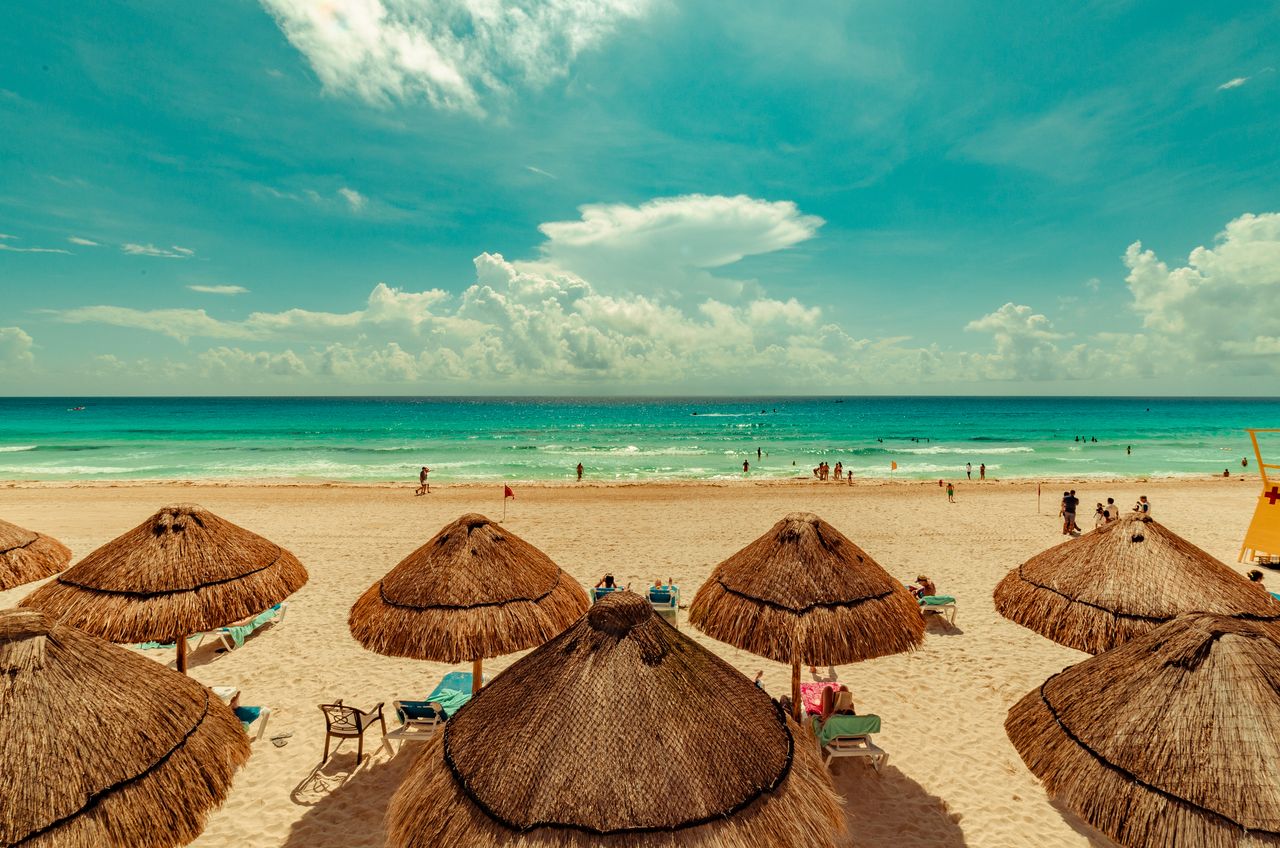
For decades, Mexico’s tourism formula seemed almost unbeatable: warm beaches, major resorts, short flights from the United States and a seemingly endless supply of foreign visitors.
Cancún, Los Cabos and Puerto Vallarta became global tourism brands by turning sun, sea and hospitality into one of Mexico’s most important economic engines.
Now that formula is facing a new test.
International air traffic to Mexico’s leading beach destinations has weakened, even as the country’s overall international visitor numbers remain strong. According to figures reported by Bloomberg, international passenger arrivals were down about 6% in Cancún, 8% in Los Cabos and 20% in Puerto Vallarta during 2026 to date at the time of the report. The declines follow another year of weakness at some major resort airports.
The challenge is more serious than a simple fall in visitor numbers because travelers arriving by air are among Mexico’s most valuable international tourists.
Mexico is therefore looking beyond its traditional North American markets. Tourism authorities are increasingly targeting China, arguing that Chinese long-haul visitors represent a largely untapped market with substantial potential spending.
The shift could reshape how Mexico promotes itself to the world.
A Tourism Industry Worth Around $150 Billion
Tourism is not a side business for Mexico.
Bloomberg’s reporting places the sector’s value at about $150 billion, equivalent to roughly 9% of economic activity. That makes tourism a crucial source of employment, foreign exchange and regional development.
Mexico’s official statistics nevertheless show why the situation can be confusing.
The country recorded 51.1 million international travelers during the first half of 2026, a 7.7% increase from the same period a year earlier. Within that total were 24.5 million international tourists, up 4.6%. International visitor spending reached about $18.8 billion.
In other words, the national tourism headline remains positive.
The weakness is concentrated in particular types of travelers and particular destinations.
That distinction matters enormously.
A country can receive more international visitors while simultaneously losing some of the tourists who generate the most revenue.
Not All Visitors Have the Same Economic Impact
One of the most important details in the current debate is the difference between a visitor and a tourist who stays overnight.
Mexico’s international-visitor statistics include cruise passengers, border crossers and other travelers who may spend relatively little during their trip.
Bloomberg reported that cruise passengers averaged about $84 per visit, while U.S. border visitors averaged about $59. By contrast, foreign tourists arriving by air generated around four-fifths of international visitor spending, and those travelers spent more than $1,200 per trip in 2025.
This helps explain why airport traffic is such an important indicator.
A reduction in a major beach airport’s international passengers does not necessarily mean the number of people entering Mexico has fallen by the same amount.
But it can mean that Mexico is losing some of the travelers most likely to stay in hotels, eat at restaurants, take tours, use transportation and spend money over several days.
That is a much more serious economic issue.
The Three Beach Destinations Under Pressure
The current slowdown is especially visible at three internationally famous destinations.
Cancún
Cancún remains Mexico’s largest international beach gateway, but international air arrivals have declined during 2026.
Official Quintana Roo data show average hotel occupancy in Cancún at 75.08% during January-June 2026, compared with 77.10% during the same period in 2025. The Riviera Maya fell from 76.63% to 72.77%, while Playa del Carmen declined from 77.05% to 72.58%.
The numbers do not indicate deserted resorts.
They indicate softer demand in markets that traditionally operated at very high occupancy.
Cancún is also exposed to a range of external factors, including airline capacity, U.S. consumer spending, competition from other Caribbean destinations and environmental conditions such as sargassum.
Los Cabos
Los Cabos serves a different market from Cancún, with a strong luxury and North American leisure component.
International air arrivals were down about 8% in the Bloomberg data and approximately 6.5% in another analysis of first-half airport figures.
That is significant because Los Cabos has spent years building a reputation around higher-end resorts, villas, golf, wellness and luxury experiences.
If high-spending visitors become more cautious, the destination can feel the impact even without a dramatic collapse in total tourism.
Puerto Vallarta
Puerto Vallarta has experienced the sharpest decline among the three.
International arrivals were down about 20% in the year-to-date Bloomberg figures. Separate airport data show an 18.2% decline during the first half of 2026.
Hotel occupancy has also weakened significantly. DataTur figures show Puerto Vallarta at 51.1% occupancy in June 2026, compared with 62.4% in June 2025.
That creates a more visible warning signal than airport traffic alone.
When fewer people arrive and hotel rooms also go unfilled, the effects spread through restaurants, transportation, excursions, retail and entertainment.
Why Are Travelers Pulling Back?
There is no single explanation.
Mexico’s tourism secretary, Josefina Rodríguez Zamora, identified several factors in comments reported by Bloomberg, including higher airfares, weaker U.S. demand, competition from other Caribbean and international destinations, and a stronger Mexican peso that has made travel in Mexico more expensive for some foreign visitors.
Airline economics are particularly important.
Fuel costs affect the economics of operating flights. If a route becomes less profitable, airlines can reduce frequencies, use smaller aircraft or discontinue service.
That creates a chain reaction.
Fewer flights mean fewer available seats.
Fewer seats can mean higher fares.
Higher fares can discourage discretionary travelers.
Lower demand then makes additional flights harder to justify.
Mexico therefore cannot control tourism demand entirely through marketing.
It also depends on the decisions of airlines and travelers.
The U.S. Matters More Than Any Other Foreign Market
Mexico’s geographic relationship with the United States is both a strength and a vulnerability.
U.S. travelers are by far the largest international air market for Mexico. DataTur recorded 6.9 million air arrivals from the United States during the first half of 2026, accounting for 63.7% of Mexico’s international air-tourist market.
That concentration has obvious advantages.
Mexico is close.
There are thousands of flight connections.
Travel between the two countries is deeply established.
American consumers are familiar with Mexican destinations.
But concentration creates risks as well.
If U.S. households reduce discretionary travel, airlines cut capacity or exchange-rate movements make Mexico more expensive, Mexican resorts can quickly feel the effect.
That is why diversification has become strategically important.
China Represents a Very Different Opportunity
Mexico’s tourism authorities are now looking at a market that could eventually reduce some of that dependence.
China sends roughly 150 million travelers abroad each year, according to figures cited by Mexico’s tourism secretary.
Yet only about 200,000 choose Mexico.
That gap is enormous.
The Mexican tourism ministry estimates that a Chinese visitor spends around $3,000 per trip—more than twice the average international tourist’s spending.
Even a relatively small increase in Chinese arrivals could therefore generate substantial additional tourism revenue.
But Mexico is not necessarily trying to persuade Chinese visitors to copy the traditional Cancún vacation.
The proposed strategy is more cultural.
Tourism officials are emphasizing Mexican food, historic sites, festivals, architecture, indigenous heritage and experiences such as Día de los Muertos.
That could benefit destinations well beyond the traditional beach resorts.
Mexico Has More to Sell Than Beaches
This may be the most important strategic opportunity.
For decades, international marketing often presented Mexico through an easily understood formula:
beach + resort + sunshine.
But Mexico’s tourism offer is far broader.
Mexico City provides major museums, architecture, food and urban culture.
Guanajuato offers colonial heritage and festivals.
Michoacán is known for traditions surrounding Día de los Muertos.
Baja California offers wine tourism, culinary experiences and border-region culture.
Quintana Roo provides access to Maya archaeological sites alongside the Caribbean coast.
By marketing these experiences, Mexico can potentially diversify both its geography and its tourist profile.
The government campaign is currently emphasizing Mexico City, Baja California, Michoacán, Guanajuato and Quintana Roo.
That is significant because it moves tourism promotion away from a purely beach-focused model.
Why Chinese Visitors Could Be Especially Valuable
Long-haul travelers are different from short-haul visitors.
Someone flying thousands of miles from China to Mexico may be more likely to build a multi-city itinerary.
Instead of spending five days in a single resort, they could combine Mexico City with Guanajuato, Oaxaca, cultural attractions and a Caribbean destination.
That creates more opportunities for regional economic distribution.
A longer itinerary can mean additional hotel nights, domestic flights, restaurants, guides, museums, shopping and transportation.
This is precisely the kind of visitor Mexico’s tourism officials appear to be targeting.
The goal is not necessarily to replace one beach crowd with another.
It is to attract travelers who contribute more spending across a wider portion of the economy.
But Attracting Chinese Travelers Will Require Investment
China is not an easy market to enter simply because the potential number of travelers is enormous.
Visitors need information in their own language.
Hotels need appropriate customer-service capabilities.
Payment systems and digital platforms need to accommodate Chinese consumers.
Tour guides need to communicate effectively.
Travel agencies and online promotion need to operate within the digital ecosystem used by Chinese travelers.
Mexico’s tourism authorities have said they want to train more Mandarin-speaking guides among the country’s approximately 13,000 licensed guides. They also plan greater use of Chinese-language signage and payment options.
Mexico also wants to strengthen its presence on platforms such as WeChat and Weibo and build networks involving Mexican creators in China and Chinese residents in Mexico.
These are not minor marketing adjustments.
They represent a long-term effort to redesign the visitor journey around a new source market.
Connectivity Is the Biggest Practical Challenge
Marketing can create interest, but airlines have to make the trip possible.
That is especially difficult for Chinese tourists because Mexico is geographically distant from China.
Mexico already has direct China connections from Tijuana, according to the tourism ministry, while Cancún can function as an entry point for visitors interested in the Yucatán Peninsula and Maya archaeological sites.
But sustainable tourism growth depends on sufficient seat capacity, competitive fares and convenient connections.
A destination cannot simply announce that it wants 500,000 additional visitors.
There have to be enough aircraft, hotel rooms, airport capacity, tour operators and trained workers to accommodate them.
Mexico Is Also Dealing With Security Concerns
Tourism decisions are influenced by perception as well as price.
Bloomberg cited recurring episodes of gang violence as another factor that can discourage visitors.
Mexico’s tourism map is highly uneven in this respect.
Many major resort areas continue to welcome millions of travelers, while security conditions vary considerably between states and cities.
For tourists, travel decisions are often based on headlines rather than detailed geographic distinctions.
A security incident in one state can therefore have reputational consequences for destinations that are hundreds of miles away.
This is one reason destination marketing increasingly involves not just beaches and hotels but confidence-building, visitor information and clear communication.
Sargassum Creates a Different Kind of Tourism Problem
Environmental conditions can also influence the beach business.
Sargassum, a type of floating seaweed, has become a recurring issue along parts of Mexico’s Caribbean coast.
Large accumulations can affect beaches, swimming conditions, hotel operations and the visual image sold to international travelers.
In July 2026, EFE reported that the Mexican Caribbean had collected more than 83,000 tons of sargassum during the year, while hotel occupancy at the start of the summer season was below 60% in some areas.
That illustrates an important reality.
Tourism competitiveness is not determined solely by advertising.
A destination has to maintain the physical environment that visitors are paying to experience.
The Strong Peso Has a Double Effect
Currency movements add another layer to the equation.
A stronger Mexican peso can make imported goods and international travel-related expenses relatively more expensive in Mexico when measured by foreign currencies.
For tourists paid in dollars, the practical effect can be a perception that Mexico is no longer the bargain it once was.
That does not automatically make Mexico unattractive.
But when travelers can choose among the Dominican Republic, Caribbean islands, Turkey and other international destinations, even modest changes in price can influence decisions.
Tourism is an unusually competitive market because consumers can change countries with a single flight booking.
The Caribbean Is Fighting for the Same Travelers
Mexico does not operate in isolation.
The Dominican Republic, Jamaica, the Bahamas and other Caribbean destinations are competing for many of the same North American travelers who might otherwise choose Cancún or Puerto Vallarta.
European and Middle Eastern destinations compete for long-haul travelers as well.
Turkey, for example, combines beaches with history, food and cultural tourism and has invested heavily in international promotion.
For Mexico, this means it cannot depend indefinitely on brand recognition.
It must continually offer competitive airfare, hotels, service, experiences and safety.
The World Cup Did Not Automatically Solve the Problem
Mexico entered 2026 with an enormous global marketing opportunity because it hosted matches during the FIFA World Cup alongside the United States and Canada.
Tourism officials had expected the tournament to generate substantial additional attention and visitor spending.
But strong national visitor statistics did not translate into uniformly strong beach-airport performance.
The weakness visible during the tournament period is therefore particularly notable. Bloomberg reported that international traffic through ASUR airports fell 12% in June, while August passenger numbers were down 15% in Cancún, 17% in Los Cabos and 26% in Puerto Vallarta.
This does not mean the World Cup failed to generate tourism.
It shows that major events cannot automatically overcome broader forces such as airline pricing, consumer confidence, competition and changing travel patterns.
The Government Has a Marketing Budget Problem Too
Mexico’s effort to diversify its tourism base faces another constraint: money.
Bloomberg reported that the federal government had budgeted about 43 million Mexican pesos—approximately $2.5 million at the time—for its principal tourism-promotion office in 2026. A further 100 million pesos was obtained for promotion during the second half of the year.
That is relatively modest for a country competing globally for high-value travelers.
Tourism boards in rival destinations may spend heavily on airline incentives, advertising, digital marketing, major travel exhibitions and partnerships.
Mexico has to decide how far its limited promotional resources should be spread.
The answer may increasingly be targeted marketing rather than mass advertising.
Domestic Tourism Remains an Important Safety Net
Mexico also has a huge domestic travel market.
International tourism receives most of the headlines because it brings foreign exchange, but Mexican travelers support hotels, restaurants and attractions throughout the country.
Official data show 42.8 million domestic tourists arriving at hotel rooms in the 70 selected destinations monitored by DataTur during the first half of 2026, up slightly from the previous year.
That market provides some protection when international demand weakens.
It is also another reason Mexico’s strategy should not become entirely dependent on any single foreign nationality.
The Opportunity May Be Bigger Than China Alone
The broader lesson is diversification.
China is important because of its size and spending potential.
But Mexico could simultaneously pursue travelers from Canada, Europe, South America and other Asian markets while strengthening domestic tourism.
This is especially important because tourism shocks are unpredictable.
An airline capacity cut can alter a destination’s performance quickly.
Currency changes can affect affordability.
Economic slowdowns can reduce discretionary spending.
Natural hazards can disrupt beach demand.
Security events can affect perceptions.
Relying too heavily on one market increases vulnerability to all of those shocks.
Mexico Also Needs to Diversify Where Tourists Go
The second type of diversification is geographic.
Cancún, Los Cabos and Puerto Vallarta are famous precisely because they succeeded so dramatically.
But that success can create concentration risk.
A broader tourism strategy could move more visitors toward Mexico City, Oaxaca, Guanajuato, Baja California, Michoacán and inland cultural destinations.
That would distribute spending across more communities.
It could also reduce pressure on some highly concentrated resort areas.
There is a sustainability argument here as well.
A country has more resilience when tourism revenue does not depend on a handful of airports and coastal hotels.
The “High-Value Tourist” Strategy Has Limits
There is a temptation in destinations worldwide to simply target wealthy travelers.
But higher spending per visitor is not a complete tourism strategy.
Luxury resorts still require workers.
Airports still need capacity.
Roads still get congested.
Water remains a scarce resource in many destinations.
Hotels and vacation rentals still require land.
And environmental pressures do not disappear when the price of a room increases.
Mexico therefore faces a more complicated goal:
Attract visitors who generate substantial economic value while ensuring that tourism growth remains geographically diversified, environmentally sustainable and beneficial to local economies.
China could help with the first objective.
It cannot solve all of the others.
What the Next Phase of Mexican Tourism Could Look Like
Mexico’s tourism industry is not facing a simple boom-or-bust moment.
The national numbers show continued international growth.
But the composition of that growth is changing.
Traditional high-spending beach markets are showing weakness.
Some resort airports are seeing fewer international passengers.
Hotel occupancy has declined in several major destinations.
Meanwhile, the government is searching for new markets that can generate more spending and diversify demand.
That makes China an obvious target—but also an ambitious one.
To succeed, Mexico would need more than advertising.
It would need direct and convenient air connections, Mandarin-speaking guides, Chinese-language services, compatible payment systems, digital marketing on Chinese platforms and itineraries that highlight the country’s cultural assets.
At the same time, Mexico would still need to maintain its enormous U.S. market and compete effectively for Canadian, European and Latin American travelers.
The future of Mexican tourism may therefore look less like one giant beach economy and more like a network of different tourism products.
Beach resorts will remain essential.
But culture, food, history, festivals, nature, wellness, wine and urban travel could become equally important pieces of the country’s international tourism strategy.
A New Tourism Race Is Taking Shape
Mexico has already demonstrated that it can attract enormous numbers of international travelers.
The challenge now is different.
It must determine which visitors it wants to attract, how much value they generate, where they spend their money and whether the tourism infrastructure can support them.
The current slowdown at Cancún, Los Cabos and Puerto Vallarta is a warning that a famous destination cannot rely forever on historical demand.
Travelers have more choices.
Airlines constantly adjust routes.
Exchange rates change.
Competition is intense.
Consumer preferences evolve.
And tourism spending can shift surprisingly quickly.
Mexico’s pursuit of Chinese travelers is therefore more than a campaign to fill hotel rooms.
It is part of a broader effort to make the country’s tourism economy more diversified and resilient.
The biggest question is whether Mexico can turn its extraordinary cultural and geographic diversity into a tourism model that generates higher-value, more widely distributed and more sustainable growth.
The beaches will remain a major attraction.
But the country’s next tourism story may be written far from the beach.
5 Frequently Asked Questions
1. Is tourism in Mexico actually declining in 2026?
Not across the entire country. Mexico recorded 51.1 million international travelers during the first half of 2026, up 7.7% year over year, while international tourist arrivals increased 4.6% to 24.5 million. The weakness is concentrated in certain beach destinations and particularly in international air traffic.
2. Why are Cancún, Los Cabos and Puerto Vallarta seeing fewer international visitors?
Several factors are contributing, according to Mexican tourism officials and industry data. They include higher airfares, softer U.S. demand, competition from other destinations, a stronger Mexican peso, security concerns and environmental problems such as sargassum.
3. Why does Mexico want more Chinese tourists?
Mexico sees China as a very large underdeveloped market. Tourism officials estimate that around 150 million Chinese travelers vacation abroad annually, while only about 200,000 visit Mexico. The tourism ministry estimates Chinese visitors spend approximately $3,000 per trip, more than twice the average international tourist.
4. Will Chinese tourists replace American tourists in Mexico?
That is unlikely to be the immediate objective. The United States remains overwhelmingly important, accounting for 6.9 million air arrivals during the first half of 2026 and 63.7% of Mexico’s international air-tourist market. The Chinese strategy is better understood as diversification rather than a simple replacement of the U.S. market.
5. What does Mexico need to do to attract more high-spending international travelers?
Marketing is only one part of the solution. Mexico also needs competitive air connectivity, reliable tourism infrastructure, strong safety and destination management, multilingual guides, convenient payment systems, appropriate digital marketing and more diversified cultural and regional experiences. The government is already planning Mandarin training for tourism guides, Chinese-language signage and stronger promotion on platforms such as WeChat and Weibo.
Sources Bloomberg