
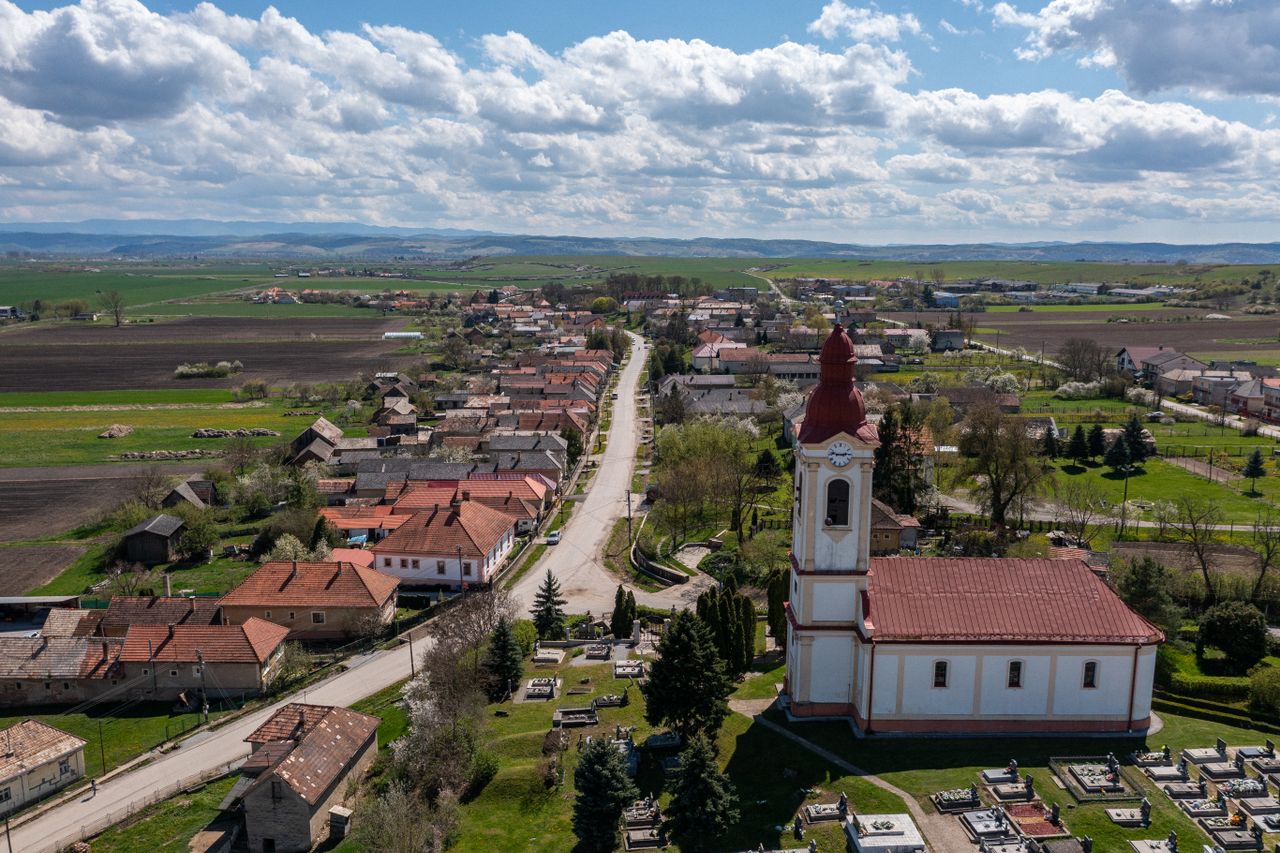
For centuries, Vlkolínec was simply a small mountain settlement in central Slovakia.
Its residents farmed, raised animals, worked with wood and lived in traditional log houses that blended naturally into the surrounding landscape.
Today, the village has a very different problem.
The settlement has become famous.
Around 100,000 visitors a year now come to see its traditional wooden houses, historic bell tower and preserved rural landscape, while only about 17 people live there year-round, according to recent reporting.
That extraordinary imbalance has produced an unusual form of tourism backlash.
Some residents have complained that visitors enter private gardens, photograph homes despite signs asking them not to, look through windows and treat the village as though it were an open-air museum.
One resident, Anton Sabucha, has said he would prefer the village to lose its UNESCO World Heritage designation.
But that is only one side of the story.
Local tourism officials say most residents support the UNESCO status and argue that the designation has brought money for conservation, restoration and visitor infrastructure. Ružomberok, the municipality responsible for Vlkolínec, already has a 2022-2031 management plan designed to protect the village while keeping it a functioning community.
The result is a fascinating question for the future of tourism:
How can a place remain authentic when the very authenticity that attracts visitors makes everyday life increasingly difficult for the people who live there?
Vlkolínec Was Never Intended to Be a Museum
The most important fact about Vlkolínec is also the easiest for tourists to forget.
It is a real village.
The settlement is a municipal district of Ružomberok, rather than a museum complex constructed solely for tourists. UNESCO describes it as a remarkably intact rural settlement in the mountains of northern central Slovakia, with traditional log houses, agricultural buildings, fields and pastures forming one connected cultural landscape.
Local tourism authorities make the same point.
The village’s own tourism information says that some of its traditional buildings are still inhabited and that visitors should not enter private houses or yards because those properties are people’s homes.
That distinction is fundamental.
A visitor walking through a reconstructed historical village expects to see actors, demonstrations and staged activities.
A person walking through Vlkolínec is walking past someone’s home.
The house that looks like an architectural exhibit may contain a kitchen.
The garden that looks picturesque may be where someone grows food.
The wooden fence that makes a beautiful photograph may be there to provide privacy.
For tourists, these details can appear decorative.
For residents, they are everyday life.
The Village Has Been Preserved for More Than a Century
Vlkolínec’s history reaches much further back than its UNESCO designation.
Slovakia’s tourism authority says the settlement was first mentioned in written records in 1376. Its traditional residents included woodcutters, shepherds and farmers.
UNESCO’s historical assessment places the roots of the settlement as far back as the 10th century, although its first documentary records date to the late 14th century. The current settlement pattern developed over centuries, with five streets documented by 1469. Most surviving structures, however, date from the 19th century.
That history helps explain why the architecture is so important.
Vlkolínec is not merely a cluster of old houses.
The value lies in the relationship between the houses and the landscape.
Long narrow plots.
Wooden homes.
Barns and haylofts.
Small agricultural areas.
Pastures.
A stream through the settlement.
Mountain terrain.
The entire arrangement provides evidence of how people historically adapted to life in the Carpathian foothills.
What Makes Vlkolínec So Special?
UNESCO identifies Vlkolínec as one of the best-preserved traditional Central European rural settlements of its type.
The World Heritage property covers about 4.9 hectares, while its surrounding buffer zone extends to roughly 320.7 hectares. UNESCO says the site contains the elements needed to express its outstanding universal value, including traditional houses, agricultural structures and the surrounding landscape.
Among the features visitors encounter are:
The traditional log homes.
The 1770 wooden bell tower.
The church of the Visitation of the Virgin Mary, completed in 1875.
The village well.
The former school.
The Farmer’s House exhibition.
Haylofts and agricultural buildings.
The surrounding meadows and fields.
The visual appeal is obvious.
Wooden façades are painted in shades of white, yellow, blue and other soft colors, while steep roofs and small windows create the appearance of a settlement almost untouched by modern development.
That appearance is precisely why the village became internationally famous.
UNESCO Recognition Came in 1993
Vlkolínec was added to the UNESCO World Heritage List in 1993 under criteria (iv) and (v).
Criterion (iv) relates to examples of architectural or technological ensembles illustrating significant stages in human history.
Criterion (v) relates to traditional human settlements, land use or sea use that are representative of a culture or human interaction with the environment, especially when those traditions have become vulnerable.
Those criteria are particularly relevant to Vlkolínec.
The village’s importance is not simply that its houses are old.
It is that the settlement preserves a relationship between architecture, farming, landscape and traditional ways of life.
That relationship is now precisely what tourism can threaten.
The Irony of Authenticity
This creates one of the most complicated problems in cultural tourism.
People visit Vlkolínec because it feels authentic.
But preserving the feeling of authenticity can require limiting the changes residents are allowed to make to their own properties.
UNESCO says the site has the highest level of national monument protection available under Slovak legislation.
Vlkolínec was already designated a Reservation of Folk Architecture in 1977, before UNESCO recognition.
Most buildings inside the World Heritage property are protected as national cultural monuments, while any proposed changes must be reviewed by the regional monuments authority. Changes of use also require approval when they could affect protected characteristics.
For conservationists, these rules help prevent inappropriate modern construction.
For residents, however, they can make ordinary life more complicated.
A homeowner may want to add insulation.
Replace a window.
Modify a room.
Build a modern extension.
Change a roof.
Install equipment.
Each decision potentially has heritage implications.
The more historically significant the building, the greater the restrictions can become.
Residents Say Tourism Has Changed Daily Life
Recent reporting gives a particularly personal picture of the problem.
Anton Sabucha, one of only about 17 year-round residents, says that tourists sometimes enter private spaces, photograph homes despite warnings and behave as if residents themselves are part of the attraction.
He has reportedly installed barriers and signs reading “No Trespassing” and “No Photos” at his property.
His complaint is not simply about crowds on a street.
It is about privacy.
A person living in an internationally photographed building cannot easily disappear from view when thousands of strangers arrive throughout the year.
A tourist may regard a traditional window as an interesting photographic detail.
The resident may regard that same window as a bedroom window.
That difference in perspective is at the heart of the conflict.
The Population Has Shrunk Dramatically
Tourism is not the only force changing Vlkolínec.
The resident population has fallen dramatically.
Sabucha told DW that around 200 people once lived in the village, compared with only about 17 today.
The decline reflects broader rural demographic trends as younger generations move toward towns and cities, agricultural practices change and traditional rural economies become less viable.
This produces a difficult feedback loop.
Fewer permanent residents mean fewer people maintaining traditional agricultural activities.
Less agricultural activity changes the surrounding landscape.
A changing landscape can weaken the authenticity that makes the village valuable.
Tourism then becomes increasingly important as an economic activity.
But tourism can also turn a residential community into a visitor destination.
The village can become economically valuable precisely as it becomes less viable as an ordinary village.
The Landscape Is Part of the Heritage
It is easy to focus on the houses because they are the most photogenic feature.
But UNESCO’s description makes clear that the surrounding landscape is part of the property’s heritage value. Traditional fields, meadows, pastures and haylofts contribute to the character of the settlement.
Sabucha has argued that some traditional farming practices are disappearing.
DW reported that surrounding meadows are no longer regularly cut and old agricultural terraces have become overgrown.
This creates an important conservation question.
Should a heritage site preserve buildings only?
Or should it also preserve the agricultural practices that created the landscape surrounding those buildings?
UNESCO’s designation of Vlkolínec suggests that the answer is broader than architecture alone.
A Village Can Look Authentic While Losing Its Original Way of Life
This is one of the paradoxes of heritage tourism.
A tourist might arrive today and think:
“Nothing has changed.”
The buildings look old.
The road is quiet.
The mountains surround the houses.
Wooden fences remain.
The bell tower still stands.
But beneath that visual continuity, the social and economic system can be very different.
The people who once farmed the land are fewer.
Some properties have become second homes or recreation houses.
Traditional skills can disappear.
Agricultural land can become overgrown.
Modern tourism businesses can replace older livelihoods.
UNESCO itself acknowledges that the site has been affected by increasing numbers of temporary residents purchasing properties for recreational purposes and by the decline in traditional uses for some outbuildings.
That may be just as significant a threat to authenticity as physical development.
UNESCO Recognized the Tourism Problem Long Ago
The current debate did not suddenly appear in 2026.
UNESCO’s own earlier cultural-landscape research has documented tourism pressure in Vlkolínec for decades.
A UNESCO case study noted that the village already received approximately 80,000 visitors in 1995, only two years after its World Heritage designation. Researchers identified insufficient infrastructure and a lack of public facilities as problems, while residents objected to being treated as part of a “permanent exhibition.”
This historical context is crucial.
Tourism pressure is not a brand-new problem caused solely by social media.
The village was already experiencing visitor pressure in the 1990s.
The difference today is the scale and speed of global tourism.
Smartphones, social media and image-driven travel can turn a remote place into an internationally recognized destination much faster than traditional tourism channels could.
Social Media Adds a New Layer
A visitor in the 1990s might arrive because a guidebook recommended Vlkolínec.
A visitor today may discover it through Instagram, TikTok, YouTube, Pinterest or an online travel list.
That changes the way attractions are consumed.
A beautiful wooden house is not just something to see.
It is something to photograph.
The photograph becomes part of the trip.
The image is then shared.
Other travelers see the image.
They visit.
More images appear.
The destination becomes even more recognizable.
That feedback loop can produce large visitor numbers without an equivalent expansion in infrastructure.
In Vlkolínec, where only a few dozen people live permanently, the consequences can be particularly intense.
UNESCO Status Is Not the Sole Cause of the Problem
The current debate sometimes frames UNESCO as the source of Vlkolínec’s difficulties.
But the evidence is more nuanced.
The village already had heritage protection before 1993.
UNESCO itself says that the recent increase in visitor numbers reflects broader global tourism trends and should not be attributed solely to the World Heritage inscription, which occurred more than three decades ago.
At the same time, resident Sabucha believes UNESCO recognition accelerated the village’s transformation by giving it much greater visibility.
Both observations can coexist.
The designation may have increased awareness.
But broader travel growth, social media, rising interest in cultural tourism and easier access to Central European destinations may also have contributed substantially.
What UNESCO Recognition Has Given the Village
There is another side of the equation.
Visit Liptov tourism official Katarína Šarafínová told Euronews that the majority of local residents support continued UNESCO status and emphasized the preservation benefits associated with recognition.
She said UNESCO recognition contributed to restoration of heritage monuments owned by the city, private owners and the church.
It also helped support new exhibitions, a UNESCO House and a tourist information center.
That is an important counterweight to the criticism.
Without recognition and associated funding, some historic structures might be more vulnerable to deterioration or inappropriate modernization.
The problem is therefore not simply:
UNESCO versus residents.
It is:
How can the conservation benefits of UNESCO be maintained without allowing tourism to overwhelm the community?
Ružomberok Already Has a Management Plan
The local government is not starting from scratch.
Ružomberok’s 2022-2031 management plan identifies the preservation of Vlkolínec’s outstanding universal value, authenticity and integrity as a central goal.
But the plan also explicitly aims to keep the settlement a living residential community with good quality of life for local residents.
Its priorities include:
Preserving historic buildings.
Supporting permanent residence.
Improving tourism infrastructure.
Improving parking.
Restoring traditional landscape features.
Supporting traditional crafts.
Creating local employment.
Improving safety and fire protection.
Involving residents in decision-making.
Managing the site together with the surrounding landscape.
That is significant because the management plan recognizes the precise conflict now attracting international attention.
The official goal is not to preserve Vlkolínec by turning it into a museum.
It is to preserve it as a living settlement.
A Dedicated Site Manager Has Been Considered
The management plan also calls for professional management and a site manager responsible for coordinating preservation, visitor services, infrastructure and funding.
Euronews reported that there were plans to reinstate a site manager for Vlkolínec and that a local working group already provides a mechanism for discussing problems.
This matters because overtourism is rarely solved through one rule.
Somebody has to monitor visitor numbers.
Somebody has to coordinate parking.
Somebody has to communicate with residents.
Somebody has to maintain signage.
Somebody has to work with tourism businesses.
Somebody has to assess where visitors go and when they arrive.
Without that coordination, individual solutions tend to emerge.
That can mean fences, gates and “No Photography” signs—the very symptoms now visible in Vlkolínec.
One Proposed Solution Is to Move Cars Away From the Village
The management proposals include a park-and-ride system below the hillside settlement, according to DW’s reporting on Ružomberok’s plans.
This would address more than parking.
Reducing vehicle traffic inside or close to the historic core could improve the environment for residents and pedestrians while protecting the appearance of the settlement.
It could also change visitor behavior.
When people arrive by shuttle rather than driving directly to the village, there is an opportunity to provide information before they enter.
A short orientation could explain:
This is a living community.
Private homes are not attractions.
Photography is restricted in certain areas.
Visitors should remain on designated paths.
The landscape is protected.
Traditional buildings are fragile.
Those messages are easier to deliver when arrival is organized.
Visitor Management Is a Conservation Tool
UNESCO’s broader Sustainable Tourism Toolkit emphasizes that visitor movement and behavior can be actively managed.
Its guidance recommends studying visitor peaks by season, day and time, directing visitors toward less sensitive areas and providing information that allows people to make better choices.
That approach could be particularly relevant to Vlkolínec.
The objective does not have to be reducing visitors to zero.
It may instead involve reducing concentration.
For example, authorities could encourage:
Off-peak visits.
Timed entries for particularly busy periods.
Small guided groups.
Designated photography areas.
Clear private-property boundaries.
Parking outside the settlement.
Alternative attractions nearby.
Longer stays spread across the wider region rather than mass day trips.
The idea is to manage where, when and how visitors arrive—not simply count them.
Seasonality Is an Important Opportunity
Vlkolínec’s current visitor website is itself experimenting with seasonal messaging.
From September 16, 2026, exhibitions are open daily from 10 a.m. to 4 p.m., with Mondays closed, and the site explicitly promotes autumn as a quieter time to visit.
That is a small but potentially important shift.
Instead of treating peak summer as the ideal experience, destination managers can encourage visitors to travel during periods when pressure is lower.
Autumn could offer colorful forests and cooler temperatures.
Spring can bring different landscape experiences.
Winter can create a completely different visual atmosphere, subject to weather and access.
Seasonal diversification can reduce pressure without necessarily reducing annual tourism income.
The Village Is Also More Than Its Main Street
Another way of managing visitor pressure is to encourage tourists to explore the wider region.
Slovakia has more than 14,000 kilometers of marked hiking trails and around 10,000 kilometers of marked cycling trails, according to the national tourism organization.
The surrounding Liptov region contains mountains, caves, thermal areas, cycling routes and other cultural attractions.
That creates an opportunity.
A visitor who travels to Slovakia specifically to see Vlkolínec does not need to spend the entire day inside the village.
Travel packages could combine a short visit with hiking, cycling, museums, food experiences or other villages.
That distributes spending across the regional economy.
It also reduces the pressure placed on a settlement that is simply too small to absorb very large visitor numbers.
The “Tiny Village” Problem Is Common Across Europe
Vlkolínec is not alone.
Europe has seen similar tensions in villages and historic communities that suddenly become famous through social media or heritage designation.
The fundamental problem is mathematical.
A town with 100,000 residents can absorb 100,000 annual tourists differently from a community with 17 permanent residents.
There is a huge difference between:
100,000 visitors across a city,
100,000 visitors across a county,
and 100,000 visitors arriving at a tiny village.
The number itself does not define overtourism.
Visitor concentration relative to local capacity does.
That is why a destination can have relatively modest national tourism numbers while one small community experiences severe pressure.
Japan’s Shirakawa-go Offers a Useful Comparison
Japan’s Shirakawa-go provides another example of a World Heritage mountain settlement dealing with heavy visitation.
The official village website explicitly warns visitors not to enter private property for social-media photographs and provides guidance on parking, pedestrian areas, fire prevention and appropriate visitor behavior.
The comparison is useful because both destinations depend on traditional architecture and living communities.
The solution is not necessarily to keep tourists away.
It is to establish a system in which tourists understand the boundaries between public heritage and private life.
Shirakawa-go’s experience also shows why visitor education has to be treated as part of destination management rather than as an optional courtesy.
UNESCO’s Own Tourism Guidance Supports Community Participation
UNESCO’s sustainable-tourism framework explicitly says host communities should have a voice in shaping tourism processes that affect them.
Its guidance recommends identifying community concerns, aspirations and potential negative impacts before policies are implemented.
Another UNESCO guide emphasizes that good destination governance requires cooperation between tourism operators, conservation experts, transport agencies and community representatives.
Vlkolínec’s current working group and management plan are consistent with that approach.
But the effectiveness of such systems depends on whether residents believe their input actually changes decisions.
A consultation that merely asks residents for opinions after a policy has already been designed is unlikely to build much trust.
What About the Money?
One of the most difficult questions is who benefits financially.
A tourist may pay an entrance fee.
A local shop may sell food.
A nearby hotel may gain a booking.
A tour operator may sell a package.
But only a small fraction of the visitor’s total expenditure necessarily remains inside the village.
Sabucha told DW that residents receive around €400 per year from ticket revenues, describing that amount as inadequate relative to the burdens associated with tourism.
That is one resident’s account rather than a comprehensive accounting of all tourism-related benefits.
Nevertheless, it raises a central policy question.
If visitors come because a community has maintained its heritage, how much tourism revenue should flow directly back to the people maintaining that heritage?
Local Spending Could Be More Important Than Admission Fees
A sustainable model does not necessarily require paying every resident a large share of entrance fees.
Instead, authorities could expand opportunities for residents to earn from tourism.
Local guiding.
Craft workshops.
Traditional food.
Homestays where appropriate.
Small shops.
Agricultural products.
Heritage interpretation.
Cultural demonstrations based on genuine local traditions.
Maintenance and conservation jobs.
The objective would be to connect tourism income to the people who live in the place.
UNESCO’s sustainable-tourism guidance specifically recognizes the importance of designing products and services that allow local communities to capture more economic value.
But Commercializing Traditions Can Create Another Problem
There is a limit.
Turning every local activity into a tourist performance can undermine the very authenticity being marketed.
Recent reporting noted that Vlkolínec stages craft demonstrations, harvest celebrations and traditional wedding reenactments.
Sabucha has questioned whether some of these customs were genuinely traditional to Vlkolínec or had already disappeared from everyday life.
That raises a difficult distinction between:
living heritage
and
heritage performed for tourists.
A cultural demonstration can educate visitors.
But when a staged performance replaces the actual practice it claims to represent, the experience can become artificial.
Authenticity therefore involves not only protecting buildings but also being honest about what is historical reconstruction, what is contemporary tourism programming and what remains part of residents’ lives.
Why Delisting Would Be So Unusual
Some residents have suggested losing UNESCO status as a way to reduce pressure.
But UNESCO has only removed three sites from the World Heritage List since the program began: Oman’s Arabian Oryx Sanctuary, Germany’s Dresden Elbe Valley and Liverpool Maritime Mercantile City in the United Kingdom.
In each case, delisting was associated with changes that caused the properties to lose or seriously compromise the qualities for which they had been inscribed.
There is no established precedent for a community voluntarily seeking removal because tourism has become burdensome.
UNESCO has said that it stands ready to help member states and local authorities manage tourism pressures and that dialogue with local communities is important.
So delisting would not be a straightforward administrative escape valve.
Losing UNESCO Status Would Not Necessarily Eliminate Tourism
This is another important point.
Even if UNESCO status disappeared, Vlkolínec would not suddenly become unknown.
The village is already promoted through travel websites, guidebooks, social media and regional tourism organizations.
Its architecture would remain unusual.
Its location would remain attractive.
Its proximity to hiking areas would remain.
Its designation as a Slovak folk-architecture reserve would also remain relevant to its legal protection.
In other words, delisting might remove one source of international visibility, but it would not necessarily solve the underlying tourism problem.
Visitor demand can exist independently of UNESCO.
The Real Problem May Be Too Many Visitors in One Small Area
That suggests a different solution.
Instead of asking:
“How do we stop people coming?”
authorities can ask:
“How do we manage where visitors go, how long they stay and what they do?”
UNESCO recommends exactly this kind of visitor-flow management.
A small settlement may be able to handle a certain annual number of visitors if arrivals are dispersed.
The same number can become overwhelming if thousands arrive simultaneously on summer weekends.
This is why visitor management needs granular data.
Monthly numbers.
Daily numbers.
Peak-hour numbers.
Group sizes.
Vehicle counts.
Parking demand.
Average length of stay.
Resident complaints.
Waste volumes.
Noise levels.
Footpath wear.
Economic spending.
Those indicators provide a much clearer picture than annual visitor totals alone.
Tourism Can Help Keep a Village Alive
There is an important reason not to treat tourism solely as the enemy.
Without economic opportunities, rural villages can decline.
Young people leave.
Buildings deteriorate.
Traditional skills disappear.
Fields become overgrown.
Schools close.
Shops disappear.
A carefully managed tourism economy can provide another reason for residents to remain.
The 2022-2031 management plan explicitly links sustainable tourism with new employment opportunities, traditional crafts and improved services for residents and visitors.
That is the positive side of the equation.
Tourism can create money that helps maintain the physical structures.
It can create jobs.
It can support local businesses.
It can make traditional crafts economically viable.
It can give younger residents opportunities connected to their community.
But only when the economic benefits are sufficiently local and the social costs remain manageable.
Heritage Restoration Is Expensive
Traditional wooden buildings require specialized maintenance.
Roofs deteriorate.
Wood can rot.
Fire is a serious threat.
Drainage matters.
Road improvements can be difficult in historic settlements.
Modern heating and utilities must be installed carefully.
Conservation can therefore be more expensive than ordinary property maintenance.
UNESCO’s earlier case study notes that government funding supported reconstruction of roads and water infrastructure, while cultural grants helped fund roof restoration using traditional wooden shingles.
This is one reason heritage status can be financially valuable.
A small rural community may not otherwise be able to finance this level of specialist conservation.
Fire Safety Is Especially Important in a Wooden Village
The concentration of wooden buildings creates a particular emergency-management challenge.
A fire in a modern concrete building is already dangerous.
A dense historic settlement made largely from timber can face rapid fire spread.
The protection of Vlkolínec therefore involves more than aesthetics.
The management plan explicitly includes fire protection and the safety of residents and visitors among its strategic goals.
Tourism management must also consider emergency access.
Large crowds and parked vehicles can make it more difficult for emergency vehicles to reach a site.
That is another reason parking and visitor circulation are not merely convenience issues.
They are safety issues.
Residents Need Modern Services Too
A heritage settlement cannot survive simply by preserving old walls.
People living there need modern necessities.
Healthcare access.
Transportation.
Internet connectivity.
Waste collection.
Heating.
Water.
Education.
Shopping.
Deliveries.
Emergency services.
Ružomberok officials have reportedly provided twice-weekly transport to nearby Ružomberok for older residents, according to DW.
This may seem like a small detail.
It actually illustrates a core principle of living heritage.
If preserving historical appearance makes ordinary life impossible, residents eventually leave.
When residents leave, the village becomes less authentic.
The best preservation strategy may therefore be the one that makes modern life compatible with historic buildings.
A Living Village Needs New Generations
Perhaps the biggest long-term challenge is demographic.
If Vlkolínec continues losing permanent residents, the question becomes whether it can remain a genuine community at all.
Tourists may still arrive.
Hotels may still operate nearby.
Guided tours may continue.
The houses may remain beautifully preserved.
But without residents, the settlement could gradually become a heritage display rather than a living village.
That would change the meaning of the place.
Its greatest attraction today is partly the fact that people still live there.
The paradox is that tourism could eventually help finance preservation while simultaneously contributing to the disappearance of the human community that gives the preservation meaning.
The September 2026 Calendar Shows the Balance Authorities Are Trying to Strike
The current Visit Vlkolinec website promotes autumn as a calmer period and has adjusted exhibition opening hours from mid-September. It is also advertising a September 27, 2026 harvest-thanksgiving event marking the end of the summer season.
That scheduling hints at a more sustainable tourism model.
Instead of relying on constant summer crowds, the destination can encourage seasonal experiences.
The harvest event also connects tourism with the agricultural and cultural themes that are central to Vlkolínec’s heritage.
The important question is whether those experiences reflect genuinely local traditions and provide benefits to residents.
What Responsible Visitors Can Do
Travelers also have a role.
The simplest rule is to remember that Vlkolínec is not an open-air museum.
Visitors should stay on public paths.
Do not enter private yards or buildings.
Do not photograph people through windows.
Respect “No Photography” and “Private Property” signs.
Avoid blocking access roads.
Use designated parking.
Buy from local businesses where possible.
Consider visiting outside the busiest summer periods.
Do not treat residents as tourist attractions.
Ask before photographing people or private activities.
These behaviors cost visitors almost nothing.
But collectively they can change the atmosphere of a destination.
Visiting During Quieter Periods Can Help
The village’s current tourism messaging explicitly promotes autumn as a quieter time to visit.
That is useful for travelers who want a less crowded experience.
It can also reduce pressure during peak periods.
But travelers should still check opening times and local conditions.
As of September 16, 2026, the visitor exhibitions are listed as open from 10 a.m. to 4 p.m. Tuesday through Sunday, with Mondays closed.
Outdoor access is different from exhibition opening hours, and weather in the surrounding mountains can change quickly.
Slovakia Has Plenty of Alternatives for Rural Tourism
One way to make tourism more sustainable is to avoid concentrating every visitor around one famous village.
Slovakia’s tourism network promotes many rural and mountain destinations beyond Vlkolínec.
Visitors can explore the Štiavnica Mountains, Horehronie, Slovak Paradise, Slovak Karst, Poloniny, the Little Carpathians and numerous foothill villages.
The national tourism authority says the country offers more than 14,000 kilometers of marked hiking trails and around 10,000 kilometers of marked cycling routes.
That gives Slovakia an opportunity to move toward a distributed tourism model.
Instead of marketing one “perfect” village as the must-see destination, tourism organizations can promote a collection of communities and landscapes.
The result could be less pressure on Vlkolínec and more income for smaller destinations that currently receive fewer visitors.
“Slow Travel” May Be a Better Fit
Slovakia’s national tourism organization increasingly promotes experiences built around nature, locality and authenticity, describing the country as a compact destination suited to slower, more immersive travel.
That fits Vlkolínec particularly well.
The village is not a place that needs to be “conquered” in 30 minutes.
Its value lies in its details.
The architecture.
The landscape.
The history.
The relationship between houses and fields.
The surrounding hiking routes.
The quiet.
A visitor who spends a few hours understanding the place may create more meaningful value than a large bus group arriving briefly, taking photographs and leaving.
More Tourists Do Not Always Mean More Tourism Value
This is a broader lesson for destinations around the world.
Tourism success is often measured using visitor numbers.
But visitor numbers are only one metric.
A destination may be better off with fewer visitors who:
Stay longer.
Spend more locally.
Travel outside peak periods.
Use local accommodation.
Hire local guides.
Respect residents.
Follow environmental rules.
Visit a wider range of attractions.
A million visitors who create severe infrastructure costs may not generate the same community benefit as a smaller number of visitors who distribute their spending more effectively.
UNESCO’s tourism guidance explicitly discusses changing the visitor profile and directing tourism toward visitors and experiences that are more sustainable when simply increasing visitor numbers is not appropriate.
Could Vlkolínec Become a Model for Other Heritage Villages?
Potentially.
The village already has several components of a modern heritage-management system:
A UNESCO designation.
National monument protection.
A municipal management plan.
A local tourism organization.
A visitor center.
A working group.
Conservation grants.
Plans for improved infrastructure.
A focus on community involvement.
The challenge is implementation.
The management plan contains ambitious objectives, including improving parking, restoring traditional landscapes, supporting residents and creating professional site management.
The effectiveness of the approach will depend on whether those measures become visible improvements in everyday life.
The Most Important Indicator May Be the Number of Residents
Tourist numbers are easy to count.
Resident wellbeing is harder to measure.
But for Vlkolínec, it may be the more important indicator.
If the village can retain or rebuild a permanent population while maintaining its architecture, that would suggest tourism and heritage protection are working together.
If the number of residents continues to decline while visitor numbers increase, the village risks becoming increasingly disconnected from its original social purpose.
UNESCO’s own tourism guidance says the impact on host communities should be monitored and that communities should have a meaningful role in shaping tourism strategies.
That suggests indicators could include:
Permanent population.
Age distribution.
Number of occupied homes.
Local employment.
Local tourism income.
Resident satisfaction.
Visitor satisfaction.
Heritage condition.
Landscape maintenance.
Infrastructure capacity.
Such measurements would provide a much fuller picture than annual arrivals.
The Future May Require a Different Definition of Success
Vlkolínec’s situation challenges a common assumption in tourism:
That every increase in visitors is automatically positive.
For a major city, an additional 10,000 tourists may have relatively modest consequences.
For a settlement with 17 permanent residents and a fragile historic landscape, the same number can be significant.
The appropriate tourism target therefore has to be based on capacity.
How many visitors can the community accommodate?
At what times?
Through which access points?
For how long?
With what facilities?
And with what economic return?
Those are planning questions rather than marketing questions.
UNESCO Can Protect a Place, But It Cannot Solve Every Local Problem
World Heritage status can provide visibility, funding and international recognition.
It can support conservation.
It can encourage governments to pay attention.
But UNESCO designation does not automatically provide enough housing, parking, public transport, waste facilities, jobs or privacy.
Those issues require local and national policy.
UNESCO itself describes sustainable tourism as a process requiring cooperation among heritage managers, communities, businesses and other stakeholders.
Vlkolínec is therefore testing the limits of what heritage designation can achieve.
The label can protect buildings.
The community has to protect the community.
The Village Does Not Need to Choose Between Tourists and Residents
The apparent choice may actually be false.
Vlkolínec can remain internationally recognized.
Tourists can continue visiting.
Residents can continue living there.
Heritage buildings can be restored.
Local businesses can earn money.
Traditional crafts can be supported.
But achieving all five at the same time requires limits.
It requires visitor rules.
It requires infrastructure.
It requires enforcement.
It requires resident participation.
It requires financial mechanisms that return value to the community.
And it requires tourists to accept that a living village cannot operate exactly like a museum.
The Biggest Change May Need to Be in Visitor Expectations
Perhaps the most useful message for travelers is also the simplest:
Do not visit Vlkolínec expecting a theme park.
Its imperfections are part of the reality.
A modern vehicle parked near an old house does not necessarily ruin the experience.
A resident walking into their garden is not a performance.
A closed gate is not an invitation to look over it.
A “No Photography” sign is not a challenge.
Someone living inside a centuries-old building is still entitled to privacy.
That understanding is what allows a heritage site to remain alive.
What Happens Next?
As of September 2026, there is no indication that Vlkolínec is about to disappear from the UNESCO World Heritage List.
The more immediate issue is management.
Ružomberok is continuing to pursue restoration, infrastructure improvements and sustainable-tourism measures. In June 2026, the city announced plans to seek Norwegian-funded support for a larger restoration and revitalization project; the program has more than €41 million available overall, with at least half earmarked for Slovak UNESCO sites. Ružomberok could potentially prepare a Vlkolínec project worth up to €5 million, with projects under the program expected to be completed by April 2031 if funding is secured.
The proposed work includes more than repairing buildings.
The stated objective is to keep Vlkolínec a living, accessible and sustainable place for residents, communities and visitors.
That is exactly the balance the current tourism debate demands.
The Story of Vlkolínec Is Really About What “Authentic” Means
At first, the controversy sounds like a simple conflict.
Residents want fewer tourists.
Tourists want to see the village.
UNESCO wants the heritage preserved.
Local officials want tourism revenue.
But the reality is more interconnected.
The village’s authenticity attracts tourists.
Tourism generates money for conservation.
Conservation rules help preserve the architecture.
Those same rules can constrain residents.
The declining population makes tourism more economically important.
Growing tourism makes the remaining residents more vulnerable to intrusion.
Increased tourism can fund restoration.
But restoration without a living community can turn heritage into a display.
The cycle has no easy answer.
Vlkolínec’s Future Depends on Remaining a Place, Not Just a Picture
The most valuable thing about Vlkolínec is not its Instagram appeal.
It is the fact that its buildings, landscape and human history still form a connected place.
A photograph can show a wooden house.
It cannot show who lives there.
A drone image can show a mountain landscape.
It cannot show whether the surrounding fields are still maintained.
A tourism brochure can promise authenticity.
It cannot create authentic community life.
That is why the village’s future cannot be measured only by visitor numbers.
The ultimate question is whether people can continue to call Vlkolínec home.
If they can, tourism and heritage protection may reinforce one another.
If they cannot, the village risks becoming an extraordinarily well-preserved record of a way of life that no longer exists.
That would be the greatest irony of all.
Vlkolínec became famous because it remained a living village.
Its challenge now is ensuring that fame does not make living there impossible.
5 Frequently Asked Questions About Vlkolínec and Slovakia’s Village Tourism
1. Why is Vlkolínec famous?
Vlkolínec is famous for its exceptionally well-preserved traditional Central European mountain architecture and landscape. UNESCO inscribed it on the World Heritage List in 1993 under criteria (iv) and (v). The site contains a group of traditional wooden houses, agricultural buildings, a 1770 bell tower, a 19th-century church and surrounding fields and pastures.
2. How many people live in Vlkolínec?
Recent reporting puts the permanent year-round population at approximately 17 people. That compares with around 100,000 annual visitors, creating an unusually large visitor-to-resident imbalance for such a small community.
3. Do residents want Vlkolínec removed from UNESCO?
Some residents have called for the UNESCO designation to be removed because of tourism pressure and concerns about privacy. However, local tourism officials say the majority of residents support continued UNESCO status because it has helped preserve buildings and bring funding for restoration and visitor infrastructure. There is currently no indication that the village is about to be delisted.
4. Can tourists enter the traditional houses in Vlkolínec?
Generally, no. Vlkolínec is a living community, and many of its traditional homes remain private residences. Visitors can enter designated museum and exhibition buildings, but private homes and yards should be treated as private property. Local tourism information specifically emphasizes that the settlement is not an open-air museum and that visitors should not enter private houses or courtyards.
5. When is the best time to visit Vlkolínec?
The village’s current visitor information promotes autumn as a quieter period, after the busiest summer season. From September 16, 2026, the exhibitions are listed as open from 10 a.m. to 4 p.m. Tuesday through Sunday, with Mondays closed. Visitors should still check current information before traveling because opening hours and access can change.
Vlkolínec offers one of the clearest lessons in modern cultural tourism: a heritage destination cannot be separated from the people who give it life. The challenge is not necessarily to eliminate tourism, but to make tourism compatible with privacy, conservation, local income, infrastructure and permanent residence. UNESCO’s own sustainable-tourism framework emphasizes exactly that combination of visitor management, infrastructure, community participation and protection of heritage value.
For travelers, the responsibility is equally straightforward. Visit with curiosity, but remember that the picturesque houses are homes; admire the architecture without entering private spaces; consider visiting in quieter periods; spend money locally; and explore the broader Liptov and Slovak mountain region rather than concentrating every part of a trip around one tiny village.
The goal should not be to stop people from discovering Vlkolínec.
It should be to make sure there is still a real Vlkolínec for people to discover in the future.
Sources The New York Times