
Archaeologists have announced the discovery of a massive prehistoric structure near Stonehenge — a find so significant that it reshapes our understanding of one of the world’s most studied ancient landscapes. The newly identified site, composed of huge pits arranged in a vast circular pattern, suggests an elaborate level of planning and engineering by Neolithic communities thousands of years before modern tools or measurement systems existed.
While initial reporting highlights the magnitude of the discovery and its potential connection to Stonehenge, the deeper story is far more complex — involving questions about ritual landscapes, social organization, engineering sophistication, and the interconnected cultures that once thrived across ancient Britain.
This expanded article breaks down what we know, what archaeologists suspect, and what the discovery means for our understanding of prehistoric Europe.
1. What Exactly Was Found? A Megastructure Hidden in Plain Sight
Researchers uncovered a huge circular structure composed of deep shafts, each several meters wide and up to 5 meters deep. Ground-penetrating radar and remote sensing revealed dozens of these massive pits forming an enormous ring around an existing Neolithic site known as Durrington Walls, a large settlement thought to be linked to Stonehenge’s builders.
Key features include:
- an immense circular layout, several kilometers in diameter
- pits likely dug by hand with antler picks and bone tools
- alignment that suggests intentional design, not natural landforms
- proximity to Stonehenge’s ritual landscape
- complex engineering for the era
Archaeologists believe the structure may date back 4,500–5,000 years, roughly contemporary with major phases of Stonehenge’s construction.
2. Why This Discovery Matters
Stonehenge has long been viewed as the centerpiece of a ritual and ceremonial landscape. This new structure suggests the area was even more monumental — and more organized — than previously imagined.
It demonstrates:
- advanced surveying skills long before written language
- large-scale, coordinated labor among Neolithic communities
- a landscape built not just for ceremonial sites, but for boundaries, processions, or astronomical purposes
- social organization capable of constructing megastructures
The scale rivals some of Europe’s other great prehistoric complexes, challenging the belief that Neolithic Britain lacked hierarchical leadership or large coordinated groups.
3. What the Original Reporting Didn’t Fully Cover
To form a more complete picture, here are deeper elements researchers are considering.
A. The Structure May Not Be a “Monument” in the Traditional Sense
Most reports emphasize ritual significance. But the pits may also have served as:
- territorial markers
- movement boundaries
- water traps or seasonal reservoirs
- astronomical reference points
- ceremonial “thresholds” marking sacred zones
Stonehenge may have been one element within a sprawling ritual ecosystem.
B. Evidence of Multiple Construction Phases
Preliminary analysis suggests the pits were dug at different times across generations. This means:
- long-term cultural continuity
- shared mythologies lasting centuries
- generational maintenance and repair
The landscape was not built overnight — it evolved.
C. The Link to Durrington Walls Could Be Crucial
Durrington Walls, located near the newly discovered circle, was a bustling village that housed Stonehenge’s builders during winter solstice periods.
The pits may have:
- guided ceremonial processions
- defined the boundaries of a ritual “no-go” zone
- symbolized spiritual protection
- demarcated sacred paths between settlements and Stonehenge
If true, this suggests an entire ritual landscape, not isolated monuments.
D. New Technology Made the Discovery Possible
The site was hidden for millennia because:
- the pits were too large to recognize from ground level
- erosion softened their edges
- farming filled in shallow portions
- no visible markers remained
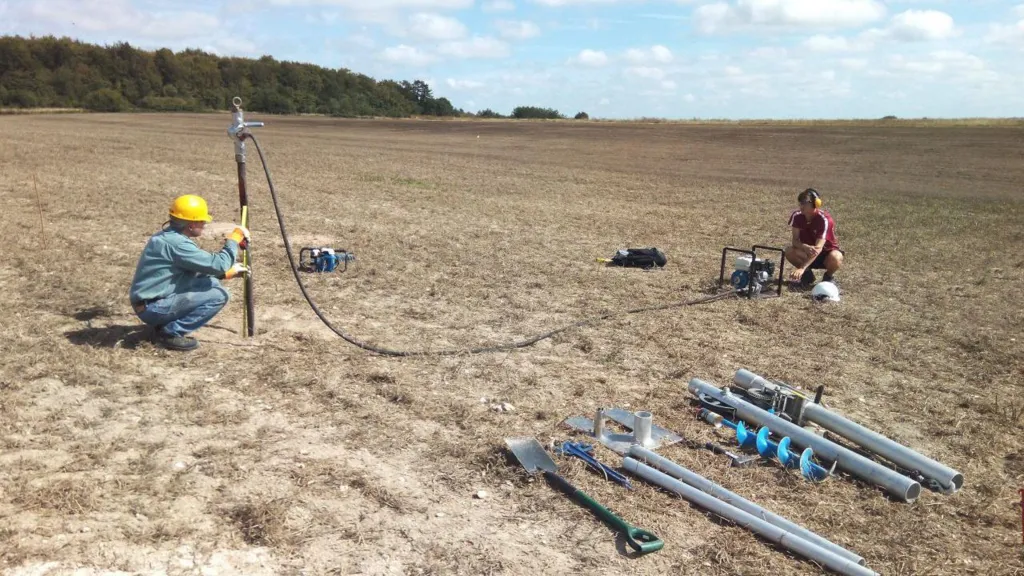
Only advances in:
- airborne laser scanning
- ground-penetrating radar
- magnetometry
- high-resolution digital modeling
made it possible to detect the formation.
E. This May Indicate a Larger Prehistoric Network Across Britain
Similar pits, circles, and engineered landscapes have been found in:
- Orkney
- the Thames Valley
- Cornwall
- Wales
Together, these may form a cultural and ritual network, showing that prehistoric Britain was far from isolated or primitive.
4. What the Discovery Tells Us About the People Who Built It
1. Highly Organized Societies
Mass labor coordination suggests cooperation across clans or villages.
2. Spiritual and Astronomical Knowledge
The circular layout may reflect celestial alignments like solstice or lunar cycles.
3. Ritual Specialists or Early Engineering Leaders
Construction would require leaders skilled in surveying and ritual interpretation.
4. Strong Communal Traditions
Generational construction points to enduring belief systems.
5. What Comes Next?
Archaeologists plan:
- deeper excavations of selected pits
- soil analysis to identify organic materials
- radiocarbon dating
- environmental reconstruction
- potential linking of the site to other nearby monuments
Much remains buried — both physically and historically.
Frequently Asked Questions
Q1: What exactly was discovered?
A massive circular arrangement of deep prehistoric pits, forming one of the largest Neolithic structures ever found in Britain.
Q2: How old is it?
Roughly 4,500–5,000 years old, contemporary with the major construction phases of Stonehenge.
Q3: Who built this structure?
Neolithic communities living near Durrington Walls — likely the same groups responsible for building Stonehenge.
Q4: What was the purpose of the pits?
Possibly ritual boundaries, astronomical markers, territorial divisions, or ceremonial pathways. The exact purpose remains under study.
Q5: How were the pits found?
Using advanced remote sensing technology, including ground-penetrating radar and aerial laser scanning.
Q6: Does this change what we know about Stonehenge?
Yes. It suggests Stonehenge was part of a larger, highly structured ceremonial landscape.
Q7: Is the site open to visitors?
Not yet. Much of it lies on farmland or protected land, but future visitor access may be considered.
Q8: Are there similar discoveries elsewhere?
Yes — other large ritual landscapes have been discovered across the UK, indicating widespread prehistoric engineering expertise.
Q9: Could there be more structures still undiscovered?
Almost certainly. Modern scanning often reveals new features hidden beneath fields and forests.
Final Thoughts
The newly discovered structure near Stonehenge is far more than another ancient curiosity — it is a window into the minds, beliefs, and engineering abilities of prehistoric Britons. It challenges old assumptions, enriches our understanding of Neolithic life, and underscores the vastness of the ritual landscapes that once shaped the ancient world.
As archaeologists continue to peel back layers of earth and time, the story of Stonehenge and its surrounding ceremonial complex grows more intricate — and more astonishing — with every discovery.

Sources BBC

