
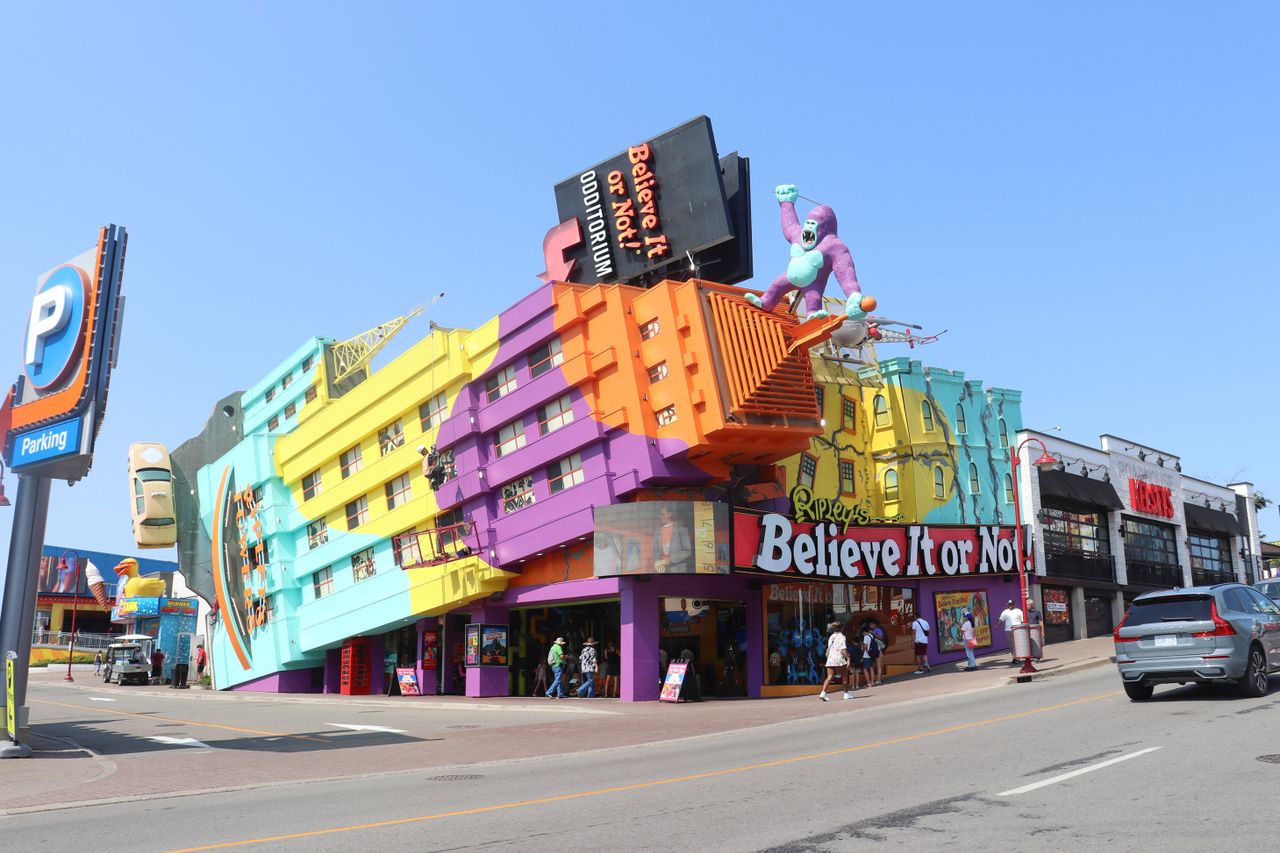
One of San Francisco’s most recognizable tourist attractions is preparing to disappear from Fisherman’s Wharf.
Ripley’s Believe It or Not!, the oddities museum at 175 Jefferson Street, will close before the end of 2026, ending a run that began in 1967. The company has not yet announced the exact final operating date, and the attraction remains open while preparations for the closure continue.
The announcement comes at an interesting moment for San Francisco tourism.
The city is experiencing a broader recovery in visitor numbers and spending, while Fisherman’s Wharf itself is undergoing a substantial redevelopment and resilience program designed to reshape one of the city’s most visited neighborhoods.
That means Ripley’s departure should not automatically be interpreted as evidence that tourists have stopped coming to San Francisco.
Instead, the closure illustrates how a long-established attraction can reach the end of its current business chapter even while the surrounding destination is undergoing its own transformation.
Ripley’s San Francisco Attraction Opened in 1967
The San Francisco Odditorium officially opened on February 2, 1967.
According to Ripley’s president Jim Pattison Jr., the attraction originally promoted itself as San Francisco’s “newest and most unusual attraction.” Nearly six decades later, the company says millions of people have passed through its doors.
For generations of visitors, the museum became part of the standard Fisherman’s Wharf sightseeing itinerary.
Its appeal was deliberately different from conventional museums.
Instead of concentrating on fine art or conventional historical artifacts, Ripley’s built its brand around unusual objects, extraordinary human achievements, optical illusions, cultural curiosities and stories presented in a highly theatrical environment.
That formula has remained central to the company for more than a century.
The Ripley’s Brand Began With a Newspaper Cartoon
The San Francisco attraction was not the beginning of the Ripley’s story.
Founder Robert Ripley built his reputation through a newspaper cartoon that eventually became known as Believe It or Not!
Ripley’s own history says the first Believe It or Not! cartoon appeared on December 19, 1918. He later traveled around the world collecting material and transformed the idea into books, radio programs, exhibitions and eventually physical attractions.
The first Ripley’s Odditorium opened at the 1933 World’s Fair in Chicago.
According to the company, the attraction drew approximately two million visitors and featured cartoons, performers and unusual artifacts from Ripley’s travels.
The concept was therefore already several decades old when the San Francisco location opened.
San Francisco Has a Special Connection to Robert Ripley
The company’s relationship with San Francisco runs even deeper.
Ripley was born in Santa Rosa, California, and developed an early fascination with the cultures and communities around him. Ripley’s official history says he was particularly interested in California’s Chinese communities before moving into his career in sports illustration and newspaper publishing.
His connection to San Francisco continued throughout his career.
The company’s president has highlighted Ripley’s work with the San Francisco Bulletin in 1909, as well as his participation in the Golden Gate International Exposition in 1939 and 1940 on Treasure Island.
That makes the closure more significant than the departure of an ordinary tourist business.
The Ripley’s brand has historical ties to the Bay Area that predate the Fisherman’s Wharf Odditorium by decades.
Why Is Ripley’s Closing?
The company has been careful not to identify a single reason.
In a statement announcing the closure, President Jim Pattison Jr. said Ripley’s had made the “difficult decision” after nearly 60 years at the location. A company spokesperson separately said the decision was not the result of “one single challenge or event.” Instead, the company reviewed the attraction, the changing landscape of Fisherman’s Wharf and what made sense for Ripley’s going forward.
That distinction is important.
It means reports about tourism, business conditions or neighborhood changes should be understood as context, rather than as officially stated causes for the closure.
Ripley’s has not publicly attributed the decision to a specific decline in attendance, a specific lease dispute, security issue or another single factor.
The official explanation is broader.
The Closure Comes as Fisherman’s Wharf Is Changing
Although Ripley’s has not named Fisherman’s Wharf redevelopment as the direct cause, the timing is notable.
The Port of San Francisco is carrying out a major initiative called Fisherman’s Wharf Forward, designed to reinvigorate the district and prepare it for long-term economic and environmental changes. The project includes public-space improvements, new retail opportunities, upgrades to the Inner Lagoon and major seismic and sea-level-rise resilience work.
The Port says the long-term project will include work around Taylor Street and the Inner Lagoon, including strengthening or replacing portions of the seawall and wharves and improving facilities for the fishing industry. The current project timeline extends well beyond 2026, with long-term resilience improvements continuing into the 2030 period.
For a neighborhood that has evolved repeatedly over decades, this represents a substantial transition.
Ripley’s is leaving at the same time that the surrounding waterfront is being redesigned for another generation.
Fisherman’s Wharf Remains One of San Francisco’s Biggest Visitor Hubs
The closure should not be mistaken for the disappearance of Fisherman’s Wharf as a tourist destination.
The Port of San Francisco says Fisherman’s Wharf attracted more than 10 million people in 2024, making it the city’s most visited neighborhood according to Placer.ai data cited by the Port. Other Port material has reported more than 12.5 million visitors in 2024 using another Placer.ai measure.
The differing estimates reflect differences in how visitor counts are measured, but both point to the same broad reality:
Millions of people continue to visit the Wharf every year.
The neighborhood includes restaurants, shops, historic fishing operations, waterfront excursions, PIER 39 and other entertainment attractions.
It also remains an important gateway to San Francisco’s waterfront.
San Francisco’s Overall Tourism Economy Is Improving
The broader city tourism picture provides additional context.
San Francisco Travel reported that the city welcomed 23.7 million visitors in 2025, who generated approximately $9.4 billion in visitor spending. Tourism-supported employment reached 63,900 jobs, while 60% of visitor spending occurred outside hotels, benefiting restaurants, retail businesses, cultural institutions and neighborhood companies.
For 2026, San Francisco Travel’s August forecast projected:
24.4 million visitors
$9.94 billion in visitor spending
70.7% hotel occupancy
and approximately $266.16 average daily hotel rates.
The organization attributed part of the momentum to conventions, major events and continuing gains in domestic and leisure travel.
The numbers show why it would be misleading to interpret a single attraction’s closure as a direct measure of the entire tourism sector.
San Francisco is simultaneously seeing tourism growth and changes in individual businesses.
Why Tourism Growth Does Not Guarantee Every Attraction Will Survive
Tourism is an ecosystem, not a guarantee that every individual business remains viable.
Visitor numbers can rise while tourists change how they spend their money.
They may spend more on restaurants and less on admission-based attractions.
They may favor outdoor activities over museums.
They may prioritize major landmarks or interactive experiences.
They may stay in neighborhoods away from traditional tourist corridors.
Entertainment preferences also change.
An attraction established in 1967 competes today in a completely different environment from the one that existed decades ago.
Visitors now have smartphones, social-media experiences, immersive entertainment, interactive museums, online videos, themed attractions and a vast range of free digital content available before they even arrive.
The definition of a compelling tourist attraction has changed.
Ripley’s Was Designed for a Different Kind of Tourist Experience
Ripley’s traditional attraction model depends on a combination of curiosity and physical presence.
Visitors have to enter a building.
They walk through galleries.
They encounter strange objects.
They take photographs.
They react to displays.
They eventually exit through a gift-shop environment.
That physical model still works in many destinations.
But modern visitors increasingly compare admission-based experiences with an enormous amount of free online entertainment.
For Ripley’s, maintaining a location therefore requires continual investment in new exhibits and visitor experiences.
The company currently operates a global network of attractions, with locations including Hollywood, Niagara Falls, Branson, Mexico City and Copenhagen, among others.
The closure in San Francisco does not represent the end of the Ripley’s brand.
It represents the end of one particular location.
Some San Francisco-Related Exhibits May Leave Too
The closure could also change where some unusual pieces associated with the San Francisco attraction are seen.
Pattison said Ripley’s intends to offer a selection of exhibits with special ties to the city for sale.
Items under consideration include a Golden Gate Bridge miniature created on the head of a pin, toothpick versions of the bridge, Joe DiMaggio’s crutches, a chicken-wire portrait of Janis Joplin, and other San Francisco-related curiosities.
The potential sale adds a second layer to the closure.
The building will disappear from the tourist map as a Ripley’s attraction, but individual objects connected to the museum may continue to exist in private collections, other attractions or museums.
It remains unclear which objects will actually be sold and where they will ultimately go.
The Museum Has Helped Define the Character of Fisherman’s Wharf
Fisherman’s Wharf has never been a conventional cultural district.
Its identity comes from a mix of working waterfront activity and highly commercialized tourism.
Visitors come to see fishing boats and seafood markets, but they also expect souvenirs, street entertainment, restaurants, attractions and unusual experiences.
Ripley’s fits naturally into that environment.
Its oddities-based identity is almost a caricature of the tourist attraction itself: colorful, strange, theatrical and designed for visitors looking for something they cannot find in a conventional museum.
Losing it therefore changes the visual and experiential character of the street, even if the Wharf remains extremely busy.
Ripley’s Is Not the First Longtime Business to Leave the Wharf
The departure comes after other major changes at Fisherman’s Wharf.
Alioto’s, a restaurant that operated on Taylor Street for nearly a century, closed during the pandemic and its former site has since been incorporated into the Port’s new public-space plans.
The Port formally unveiled Alioto’s Plaza in September 2026 as part of Fisherman’s Wharf Forward. The new public space expands access and views toward the Inner Harbor and incorporates elements intended to highlight the fishing industry’s history.
The Port has also been working to attract new restaurant and retail tenants.
Port documents show new concepts and leases involving restaurants and other businesses in the district, illustrating that commercial change is occurring in both directions: some longstanding businesses are leaving while new operators are entering.
A Public Plaza Has Replaced One Historic Landmark
The transformation of the former Alioto’s site provides a useful example of the direction Fisherman’s Wharf is taking.
Instead of replacing an old restaurant with another attraction exactly like it, the Port has created public space intended to accommodate residents, workers and visitors.
The new space expands access, provides views toward the Inner Lagoon and creates opportunities for events and activities.
That suggests the future Wharf may rely less on a collection of individual legacy attractions and more on a combination of public spaces, food, maritime heritage, events and flexible experiences.
Ripley’s departure takes place within that larger evolution.
Sea-Level Rise Is Reshaping the Wharf’s Long-Term Future
There is another issue that extends beyond tourism trends: physical resilience.
The Port’s Fisherman’s Wharf Forward plan includes long-term improvements related to earthquake risk and sea-level rise.
The Port says the project is designed to adapt Taylor Street and the Inner Lagoon through 2100, including potential seawall and wharf replacement, flood-proofing, improvements to the fishing fleet’s facilities and changes to the public realm.
This is important because Fisherman’s Wharf occupies valuable but physically vulnerable waterfront land.
A tourist attraction operating there must exist within an environment that requires significant long-term investment.
That makes redevelopment decisions about more than retail or tourism trends.
They are also about what kind of waterfront infrastructure San Francisco wants to maintain for the future.
The Pandemic Changed the Tourist Landscape
The Port’s Fisherman’s Wharf strategy was launched in response to longer-term challenges that accelerated during and after the pandemic.
The Port says that since the beginning of COVID-19 it has prioritized investments in the Wharf’s recovery, including new waterfront improvements, public-realm investments and efforts to fill vacant commercial spaces. It also acknowledges that more work is necessary to improve the neighborhood’s economic vitality.
San Francisco’s broader tourism statistics show that recovery is underway.
But the structure of tourism continues to evolve.
Business travel, international travel, conventions, domestic leisure trips and neighborhood-level tourism do not necessarily recover at the same speed.
Individual attractions therefore operate within a changing market even when overall visitor numbers are rising.
Fisherman’s Wharf Is Trying to Become More Than a Tourist Strip
The Port’s long-term vision is notable because it emphasizes both visitors and residents.
Fisherman’s Wharf Forward includes public access improvements, fishing-industry infrastructure, events, public plazas, retail opportunities and resilience measures.
The objective appears to be making the neighborhood more functional year-round.
That could matter because tourist districts can become vulnerable when they depend heavily on seasonal or destination-specific traffic.
A waterfront that attracts residents as well as visitors can potentially maintain more consistent activity.
The Port’s 2026-2030 strategic plan explicitly identifies waterfront activation, arts, culture, events and neighborhood businesses as part of its broader economic-revitalization strategy.
Could Ripley’s Return to San Francisco?
The company has not ruled out a future San Francisco presence.
Pattison said the closure should not necessarily be understood as saying goodbye to San Francisco permanently.
That leaves open several possibilities.
Ripley’s could eventually appear in another San Francisco location.
The company could introduce a smaller attraction.
It could establish a temporary exhibition.
Or the brand could remain absent from the city indefinitely.
There is no announced replacement location at present, so any future return remains uncertain.
Visitors Still Have Time to See the Attraction
For tourists who want to experience the San Francisco Odditorium, the important practical point is that it remains open for now.
The company says it expects the final operating day to occur before the end of 2026 and will announce the exact date once it has been finalized.
Travelers should therefore check the attraction’s current operating information before planning a visit, particularly as the final date approaches.
Anyone hoping to see a particular exhibit should also understand that displays can change and that the planned sale of San Francisco-related pieces does not necessarily mean every item will remain on view through the final day.
The Closure Is Part of a Much Larger Tourism Story
Ripley’s departure is easy to view through the lens of nostalgia.
For nearly six decades, the Odditorium was part of the visual landscape of Fisherman’s Wharf.
Generations of visitors encountered its unusual exhibits.
Families posed for photographs.
Tourists wandered inside while exploring Jefferson Street.
The attraction became part of the neighborhood’s identity.
But nostalgia is only one part of the story.
San Francisco’s visitor economy is growing again.
Fisherman’s Wharf remains one of the city’s busiest visitor destinations.
New public spaces and businesses are being introduced.
The Port is preparing the waterfront for sea-level rise and seismic risks.
The tourism industry is evolving toward new forms of entertainment and visitor experiences.
Ripley’s is closing at precisely the moment when the Wharf itself is being redesigned.
What the Next Generation of Fisherman’s Wharf Could Look Like
The future Wharf is unlikely to abandon tourism.
Instead, the district appears to be moving toward a blend of maritime heritage, restaurants, events, public spaces, entertainment and modern infrastructure.
The Port’s plans include a new Inner Lagoon overlook, lighting that highlights the fishing fleet, event opportunities, new retail and restaurant uses, and long-term resilience work.
That is a different tourism model from the one that existed when Ripley’s opened in 1967.
Back then, the iconic attraction was a physical oddities museum.
Today’s visitor economy is more diverse.
Visitors can ride the SkyStar Observation Wheel, explore PIER 39, take waterfront excursions, eat at restaurants, visit maritime attractions, attend events or simply use the waterfront as public space.
The challenge is making those experiences work together.
A 59-Year Tourist Attraction Is Leaving, But the Wharf Is Not Disappearing
The closing of Ripley’s Believe It or Not! marks the end of an unusually long chapter in San Francisco tourism.
The attraction opened in 1967.
Its roots reach back to Robert Ripley’s work more than a century ago.
Its San Francisco connection predates the current museum by decades.
And its location became closely associated with Fisherman’s Wharf.
Yet the closure is taking place within a citywide tourism economy that is recovering and a waterfront district undergoing a substantial transformation.
For now, the museum remains open.
Its final day has not been announced.
Some of its most distinctive San Francisco exhibits may soon enter the market.
And the building that housed generations of Ripley’s visitors will eventually become something else.
The larger story is therefore not simply about a strange museum closing.
It is about how a famous tourist district changes when one generation of attractions gives way to another.
Fisherman’s Wharf is entering a new phase—one shaped not only by tourism demand, but also by public-space design, new businesses, maritime heritage and the need to make one of San Francisco’s most iconic waterfront areas resilient for decades to come.
5 Frequently Asked Questions About Ripley’s Believe It or Not! San Francisco Closing
1. When will Ripley’s Believe It or Not! San Francisco close?
The attraction will close before the end of 2026, but Ripley’s has not announced the exact final operating date. Until the company announces that date, the museum remains open to visitors.
2. Why is Ripley’s closing in San Francisco?
Ripley’s has not identified one specific cause. Company representatives say the decision followed a broader review of the attraction, the changing landscape of Fisherman’s Wharf and what makes sense for the company going forward.
3. How long has Ripley’s Believe It or Not! been in San Francisco?
The San Francisco Odditorium opened on February 2, 1967, meaning the location will have operated for nearly 60 years when it closes. The Ripley’s brand itself dates back to Robert Ripley’s newspaper cartoon, which first appeared in 1918.
4. What will happen to Ripley’s San Francisco exhibits?
Ripley’s plans to sell a selection of exhibits with special connections to San Francisco. Potential items mentioned by the company include miniature Golden Gate Bridges, Joe DiMaggio’s crutches and a chicken-wire portrait of Janis Joplin. The company has not announced the complete list of items that will be sold or where each object will ultimately go.
5. Is Fisherman’s Wharf declining as a tourist destination?
The closure of Ripley’s does not by itself demonstrate a decline in Fisherman’s Wharf’s overall visitor demand. The Port of San Francisco continues to describe the Wharf as the city’s most visited neighborhood, reporting millions of visitors annually, while the citywide tourism economy has continued to recover. At the same time, the Wharf is undergoing major redevelopment intended to improve public spaces, economic activity and long-term waterfront resilience.
Ripley’s Believe It or Not! may be leaving Fisherman’s Wharf, but the neighborhood’s tourism story is continuing. San Francisco’s wider visitor economy is expanding, while the Wharf is being reshaped through new public spaces, businesses and long-term infrastructure projects. The museum’s closing therefore represents both an ending and a reminder that even the most familiar tourist attractions eventually become part of a destination’s history.
Sources KTLA 5