
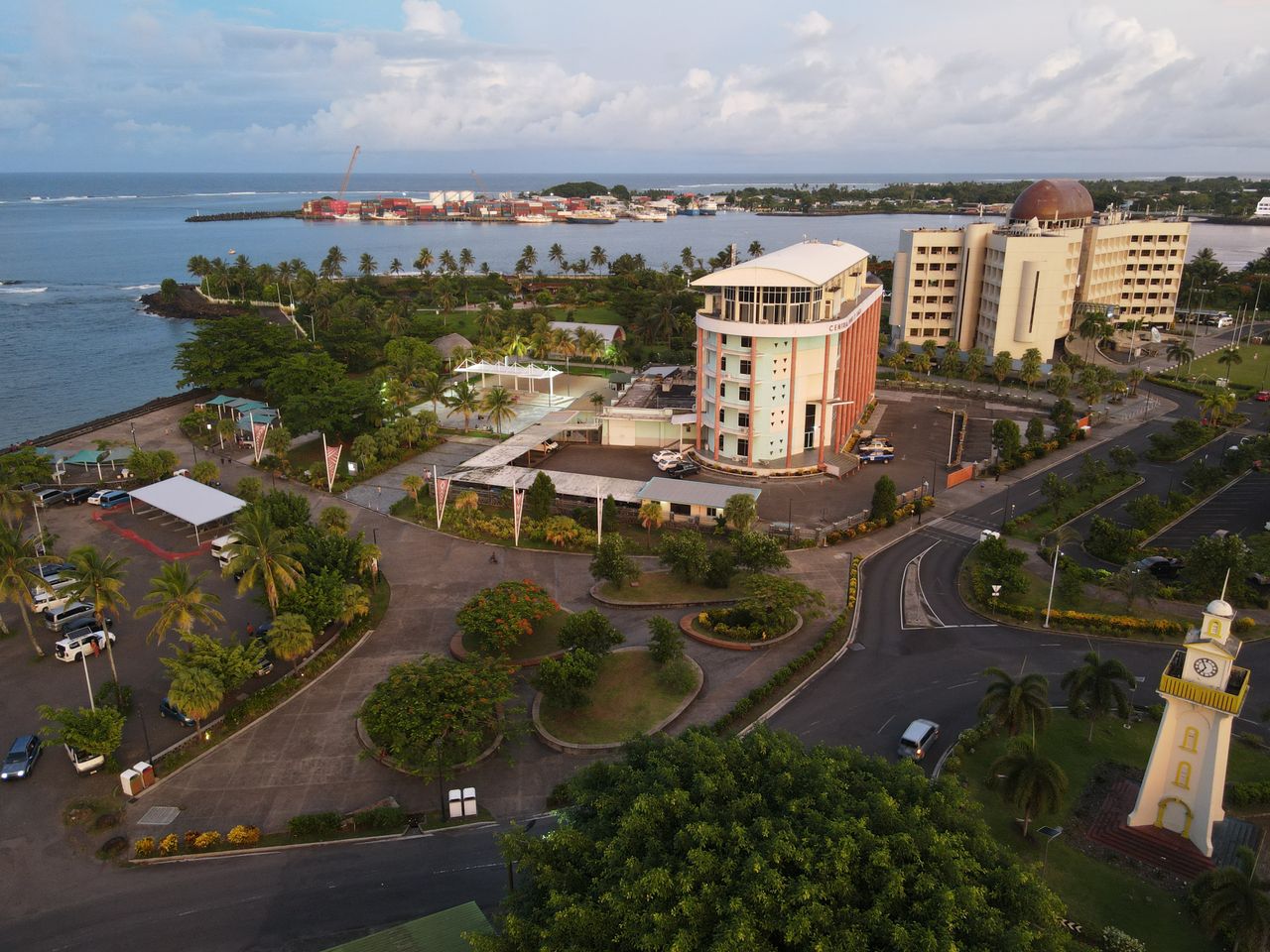
On the surface, Saipan looks like an unlikely center of America’s immigration debate.
The small Pacific island is known for beaches, coral reefs and its role in the Second World War. It has a population of roughly 50,000 and sits thousands of miles from the continental United States.
Yet Saipan occupies a remarkable position in American immigration law.
It is the capital of the Commonwealth of the Northern Mariana Islands (CNMI), a U.S. territory. A child born there is generally a U.S. citizen or national under the applicable territorial and federal rules. The U.S. State Department specifically lists the Northern Mariana Islands among U.S. territories where people born there acquire U.S. nationality.
That fact helped transform Saipan into an unusual destination for Chinese women seeking to give birth to children with access to U.S. citizenship.
For years, the practice developed into a small but highly organized commercial industry.
Now it is facing a very different political and legal environment.
The Trump administration has made birth tourism a national policy issue, the U.S. State Department has announced new visa restrictions targeting people involved in commercial birth-tourism networks, and lawmakers have proposed legislation aimed at restricting the practice further.
The result is a fascinating story about immigration, geography, citizenship, economic decline and the unintended consequences of special visa arrangements.
Why Saipan Became a Birth-Tourism Destination
The story begins with Saipan’s unusual immigration status.
The Northern Mariana Islands became a U.S. commonwealth in 1976 and came under federal immigration control in 2009.
At the same time, special arrangements allowed certain Chinese and Russian tourists to enter the Northern Mariana Islands without obtaining a U.S. tourist visa in advance.
That created an extraordinary loophole from the perspective of birth tourism.
A pregnant woman who could not easily obtain a conventional U.S. visa could potentially travel to Saipan, give birth there and have a child who acquired U.S. citizenship.
Saipan was also much closer to China than the U.S. mainland.
The island is several hours by air from major Chinese cities, rather than requiring a long journey across the Pacific to California or another mainland destination.
For birth-tourism operators, that combination was attractive.
The island offered:
- U.S. territorial status;
- access to American citizenship for children born there;
- relatively convenient travel from East Asia;
- hotels and rental accommodation;
- medical facilities;
- translators;
- and a tourism economy already accustomed to serving Chinese visitors.
What began as a specialized travel arrangement eventually became a recognizable industry.
The Numbers Once Reached Extraordinary Levels
Birth tourism in Saipan was never simply a matter of a handful of individual travelers.
The number of births associated with foreign tourists rose dramatically.
According to FactCheck.org’s review of government and media data, births to foreign tourists in the Northern Mariana Islands reached a peak of 581 in 2018.
That was significant for a territory with a relatively small population.
At the height of the boom, pregnant Chinese visitors became visible enough to be a familiar part of everyday life on the island.
Local businesses supplied groceries and other services.
Translators helped expectant mothers communicate with medical staff.
Accommodation providers served women who might stay for extended periods around the time of childbirth.
Specialized birth-tourism businesses emerged to arrange travel, housing, transportation and medical services.
In other words, the phenomenon was not merely about citizenship.
It became an economic ecosystem.
The Business Behind Birth Tourism
Birth tourism is often discussed as though a pregnant traveler simply arrives at an airport and gives birth.
The reality can be much more complicated.
Commercial operators can arrange packages involving:
- airfare;
- accommodation;
- transportation;
- translation;
- prenatal appointments;
- hospital arrangements;
- food and grocery delivery;
- postpartum care;
- documentation;
- and assistance with obtaining a birth certificate and passport.
Some operators have charged customers tens of thousands of dollars.
Federal investigators have previously uncovered mainland U.S. birth-tourism operations charging between $40,000 and $80,000 per customer.
The business model works because American citizenship is perceived by some foreign families as enormously valuable.
A U.S. passport can provide access to international travel, education and the possibility of living in the United States later in life.
For families with sufficient resources, the cost of a birth-tourism package can therefore be viewed as an investment in a child’s future.
Why Chinese Travelers Were Particularly Important
Chinese citizens became central to Saipan’s birth-tourism story partly because of the island’s unusual visa arrangements.
The Northern Mariana Islands was historically much easier for certain Chinese tourists to reach than the continental United States.
That did not mean Chinese visitors had unlimited access to America.
The special rules applied to the Northern Mariana Islands and existed within a distinct immigration framework.
But from the perspective of birth-tourism operators, the difference was enormously important.
The island was U.S. territory while being geographically close to China.
That made it a rare combination:
American jurisdiction without American mainland geography.
The arrangement helped Saipan’s broader tourism industry, but it also created opportunities for people whose primary interest was childbirth rather than vacation.
Saipan’s Economic Decline Made the Industry More Significant
Birth tourism did not develop in an economic vacuum.
Saipan had previously been a major center of garment manufacturing.
Factories employed large numbers of workers and produced clothing for international brands.
But the garment industry eventually collapsed amid changing trade rules, labor controversies and the loss of preferential access to the U.S. market.
The decline had devastating consequences for the island’s economy.
Tourism became increasingly important.
Chinese visitors were therefore not simply tourists to be welcomed or discouraged. They were also an important source of income for hotels, restaurants, retailers, transportation companies and other local businesses.
That created a difficult policy dilemma.
The same travel system that helped generate tourism revenue could also facilitate a form of immigration-related activity that federal officials increasingly wanted to restrict.
The Island’s Geography Makes the Story Unusual
Saipan’s geography adds another dimension.
The island lies in the western Pacific, relatively close to China, Japan, Taiwan and Guam.
It is also strategically important to the United States.
The Northern Mariana Islands were heavily involved in the Pacific theater of the Second World War. Nearby Tinian was the base from which the U.S. aircraft Enola Gay flew the mission that dropped an atomic bomb on Hiroshima in 1945.
Today, the Mariana Islands remain important to American military planning because of their location in the western Pacific.
That strategic importance has contributed to the increasingly national-security-focused discussion surrounding Saipan.
From Tourism Issue to National-Security Debate
The most controversial claims surrounding Saipan go beyond birth tourism itself.
Some U.S. commentators and officials have raised concerns that Chinese access to the Northern Mariana Islands could create vulnerabilities for American national security.
The argument is that people who acquire U.S. citizenship through birth could theoretically possess an American passport while maintaining close connections with China.
Some commentary has gone further, raising allegations that birth tourism could be exploited for espionage or other strategic purposes.
Those claims require careful treatment.
There is a documented history of birth tourism on Saipan.
There is also documented concern among U.S. officials about China’s strategic activities in the Pacific.
But the existence of birth tourism does not by itself establish that the Chinese government is systematically using the practice to create spies.
That is an important distinction.
The available evidence supports discussion of immigration vulnerabilities and potential security risks, but claims of an organized Chinese government program to produce “passport-equipped spies” should be treated as allegations unless supported by specific evidence.
The Industry Has Already Shrunk Dramatically
The Saipan birth-tourism industry of the late 2010s is not the same industry that exists today.
After years of increased scrutiny, authorities tightened the rules.
The length of permitted stays was reduced, and enforcement became more aggressive.
The COVID-19 pandemic also disrupted international travel.
The result was a sharp decline in visible birth tourism.
According to figures cited by FactCheck.org, births to foreign tourists fell to 47 in 2025, down dramatically from the 581 recorded in 2018.
That decline is important because it complicates the picture.
Saipan still has birth tourism.
But it is no longer operating at the scale seen during the peak years.
Why the Practice Has Gone Underground
One consequence of tighter immigration controls is that the practice can become less visible rather than disappearing entirely.
When the legal environment becomes more restrictive, travelers and businesses may become more cautious about openly advertising what they are doing.
That can create a different problem for authorities.
An activity that once occurred openly can move into informal networks.
Pregnant travelers may stay out of public view.
Businesses may avoid advertising services.
Travel arrangements may be made through personal contacts rather than public websites.
And authorities may find it harder to measure the scale of the activity.
This does not prove that every hidden pregnancy involves immigration violations.
It does, however, illustrate a broader problem in immigration enforcement:
restricting an activity does not necessarily eliminate demand for it.
The U.S. Government’s New Approach
The Saipan story has become especially significant because of major changes in U.S. policy in 2026.
On August 6, President Donald Trump signed an executive order titled “Ending Birth Tourism.”
The order defines birth tourism as entering the United States on a nonimmigrant visa for the purpose of giving birth on American soil, or facilitating such entry. It directs federal agencies to develop policies to implement the administration’s approach.
The administration argues that commercial birth-tourism networks exploit the immigration system by encouraging foreign nationals to misrepresent their intentions and by selling access to U.S. citizenship.
That policy is broader than the Saipan issue.
It applies to the United States’ overall approach to commercial birth tourism.
A New Visa Restriction Policy
The State Department then announced another significant measure on September 23.
Secretary of State Marco Rubio said the department would use Section 212(a)(3)(C) of the Immigration and Nationality Act to restrict visas for people who knowingly engage in, facilitate or profit from commercial birth tourism.
The department specifically identified:
- owners and operators of birth-tourism networks;
- managers of such networks;
- visa “fixers” who coach applicants to commit fraud;
- foreign medical providers who knowingly facilitate the practice;
- and other people who knowingly support commercial birth tourism.
The State Department also said some family members could fall within the restrictions.
This represents a significant shift in emphasis.
Rather than focusing only on individual pregnant travelers, the government is also targeting the commercial infrastructure surrounding birth tourism.
What About Pregnant Travelers?
This is where the issue becomes particularly important for ordinary travelers.
The existence of a crackdown on birth tourism does not mean that every pregnant foreign visitor is automatically prohibited from entering the United States.
The key issue is purpose and compliance with immigration rules.
The U.S. government’s current policy specifically targets birth tourism and those who knowingly facilitate or profit from it.
A traveler who legitimately qualifies for a particular visa and complies with its conditions is not necessarily in the same legal category as someone who deliberately misrepresents the purpose of travel to obtain entry for childbirth.
The distinction between pregnancy and fraudulent birth tourism is therefore essential.
Birth Tourism Was Already a Legal Problem Before 2026
The current crackdown did not emerge from nowhere.
The Trump administration’s first term introduced a 2020 regulation addressing birth tourism under the B-visa framework.
That rule made clear that a person seeking a visitor visa primarily to give birth in the United States in order to obtain U.S. citizenship for the child was not eligible for that visa purpose.
The issue has therefore existed in American immigration policy for years.
What has changed in 2026 is the scale and intensity of enforcement.
Birthright Citizenship Is a Separate Question
One of the biggest sources of confusion is the difference between birth tourism and birthright citizenship.
They are not identical.
Birth tourism describes a person’s reason for traveling.
Birthright citizenship describes the legal status of a child born within U.S. jurisdiction under the applicable constitutional and statutory framework.
A person can oppose commercial birth tourism without necessarily reaching the same conclusion about the legal principle governing citizenship at birth.
This distinction has become especially important because the Trump administration has attempted to change the interpretation of birthright citizenship through executive action.
The legal status of that broader effort has been contested in federal court.
The September 2026 Saipan story should therefore be understood as part of a much larger debate over American citizenship and immigration law.
Why the Northern Mariana Islands Are Different
The CNMI’s legal history is unusually complicated.
Unlike a foreign country, it is part of the U.S. territorial system.
Unlike a state, however, it has a different constitutional and political relationship with the federal government.
That distinction explains why immigration policy on the islands has sometimes differed from policy on the mainland.
It also explains why Saipan could become a special destination for Chinese tourists.
The island’s position was created through a combination of geography, territorial law and economic policy.
Once the unintended consequences became visible, changing the rules became politically difficult because tourism was such an important part of the local economy.
The Human Side of the Story
Behind the statistics are individual families making difficult decisions.
Some women travel because they genuinely believe an American passport will provide their children with opportunities that are unavailable at home.
Some may see U.S. citizenship as insurance against political or economic uncertainty.
Others may be responding to commercial operators promising benefits that are exaggerated or misleading.
And some may simply be trying to secure what they believe is a better future for their children.
That does not determine whether their conduct complies with U.S. immigration law.
But understanding the motivations matters.
Immigration policy is ultimately not just about numbers and borders.
It is also about people’s expectations for their children.
The Risks for the Women Involved
Birth tourism can also create serious risks for pregnant travelers.
A woman traveling alone to a remote island shortly before childbirth may face medical complications without her normal family support network.
She may encounter unexpected hospital expenses.
She may have difficulty communicating with medical staff.
She may depend heavily on translators or intermediaries.
And if her immigration status becomes uncertain, she may become reluctant to seek assistance.
Commercial operators can therefore occupy an unusually powerful position.
The traveler may have paid a large amount of money and become dependent on the operator for accommodation, transportation and medical arrangements.
That creates potential opportunities for exploitation.
The U.S. government’s 2026 policy specifically points to concerns about commercial networks and fraud, while the broader history of Saipan includes documented cases involving illegal employment and unregistered birth-tourism businesses.
What Happens to Saipan’s Economy?
The decline of birth tourism creates a difficult economic question for the island.
If authorities successfully eliminate the practice, that may remove income from businesses that once served pregnant visitors.
But birth tourism was only one part of Saipan’s tourism economy.
The island still has beaches, diving, fishing, historical sites and a strategic location within the western Pacific.
The long-term challenge is whether Saipan can rebuild a tourism model based on conventional visitors rather than specialized immigration-related travel.
That transition could be economically painful, particularly because the island has already experienced the collapse of its manufacturing sector.
Could Guam Face Similar Problems?
Guam is another U.S. territory in the western Pacific.
It is geographically close to the Northern Mariana Islands and has a much larger tourism and military infrastructure.
There have been concerns about birth tourism there as well.
However, the immigration arrangements are different.
Guam does not have exactly the same visa-free framework that historically made Saipan unusually attractive to Chinese birth tourists.
That difference demonstrates how small changes in immigration policy can produce major differences in migration patterns.
The Broader Lesson for U.S. Territories
Saipan’s experience highlights an unusual problem faced by U.S. territories.
Territories can have different economic needs from the mainland.
They may depend heavily on tourism.
They may seek special immigration arrangements to attract visitors.
But the consequences of those arrangements can eventually become national issues.
What begins as a local economic policy can affect:
- immigration;
- citizenship;
- healthcare;
- law enforcement;
- national security;
- and federal spending.
Saipan is therefore an example of how territorial policy and national policy can collide.
What Comes Next?
The future of birth tourism in Saipan will probably depend on several factors.
First, immigration enforcement will determine how difficult it becomes for foreign pregnant travelers to enter and remain in the territory.
Second, the availability of commercial birth-tourism services will influence whether women can continue to arrange births there.
Third, the legal battles surrounding the Trump administration’s broader immigration policies could affect how citizenship and birth tourism are treated.
Fourth, the CNMI government must balance federal enforcement with the territory’s economic interests.
Finally, the island’s relationship with China will remain important because of its geography and the strategic importance of the western Pacific.
The most significant change may already have occurred.
Birth tourism has moved from a relatively obscure island phenomenon to a subject of national American immigration policy.
Conclusion
Saipan’s birth-tourism story is ultimately about much more than pregnant women traveling across the Pacific.
It is about what happens when geography, immigration law and economic incentives create an unexpected pathway to citizenship.
The island’s special status once made it possible for Chinese tourists to reach U.S. territory far more easily than they could reach the American mainland. Birth-tourism businesses recognized the opportunity and built an industry around it.
At its peak, hundreds of foreign-tourist births were recorded annually.
Today, the numbers are dramatically lower.
But the controversy has not disappeared.
The Trump administration has made commercial birth tourism a national enforcement priority, introduced new visa restrictions and attempted to reshape the broader debate over birthright citizenship.
At the same time, claims that Saipan is being deliberately used by Beijing to create American spies remain allegations that require evidence rather than assumptions.
The most defensible conclusion is simpler.
Saipan demonstrates how a relatively small change in immigration policy can create a major unintended market — and how difficult it can be to dismantle that market once businesses and families begin depending on it.
For an island thousands of miles from Washington, Saipan has become an unexpected front line in America’s argument over immigration, citizenship and the meaning of being born on U.S. soil.
Frequently Asked Questions
1. Why do Chinese women travel to Saipan to give birth?
Saipan is part of the U.S. Commonwealth of the Northern Mariana Islands, and people born there generally acquire U.S. nationality under applicable law. Its historical visa arrangements also made the territory significantly easier for certain Chinese travelers to reach than the U.S. mainland. These factors helped create a market for birth tourism.
2. Is Saipan part of the United States?
Yes. The Northern Mariana Islands is a U.S. commonwealth and U.S. territory. It is not a U.S. state, but people born in the CNMI after the applicable date generally acquire U.S. nationality. U.S. government guidance specifically recognizes the CNMI as a U.S. territory.
3. How big is birth tourism in Saipan today?
It is substantially smaller than it was at its peak. Foreign-tourist births in the Northern Mariana Islands reached 581 in 2018, according to figures cited by FactCheck.org, while the figure cited for 2025 was 47. The decline followed tighter immigration controls, changes in permitted stays, the pandemic and increased enforcement.
4. Is birth tourism illegal in the United States?
The legal situation is more complicated than simply saying that giving birth in the United States is illegal. U.S. policy has long prohibited using certain temporary visitor visas primarily for the purpose of giving birth to obtain citizenship, and misrepresentation or fraud can create serious immigration consequences. In September 2026, the State Department also announced visa restrictions targeting people who knowingly participate in, facilitate or profit from commercial birth-tourism schemes.
5. Does the Saipan controversy prove that China is using birth tourism for espionage?
No such conclusion is established simply by the existence of birth tourism. Saipan has documented birth-tourism activity and has strategic importance because of its location in the western Pacific. Some commentators have raised national-security concerns, including allegations about potential Chinese exploitation of the territory, but those claims should be distinguished from documented evidence of individual birth-tourism activity. The two issues should not automatically be treated as the same thing.
Sources The Telegraph