
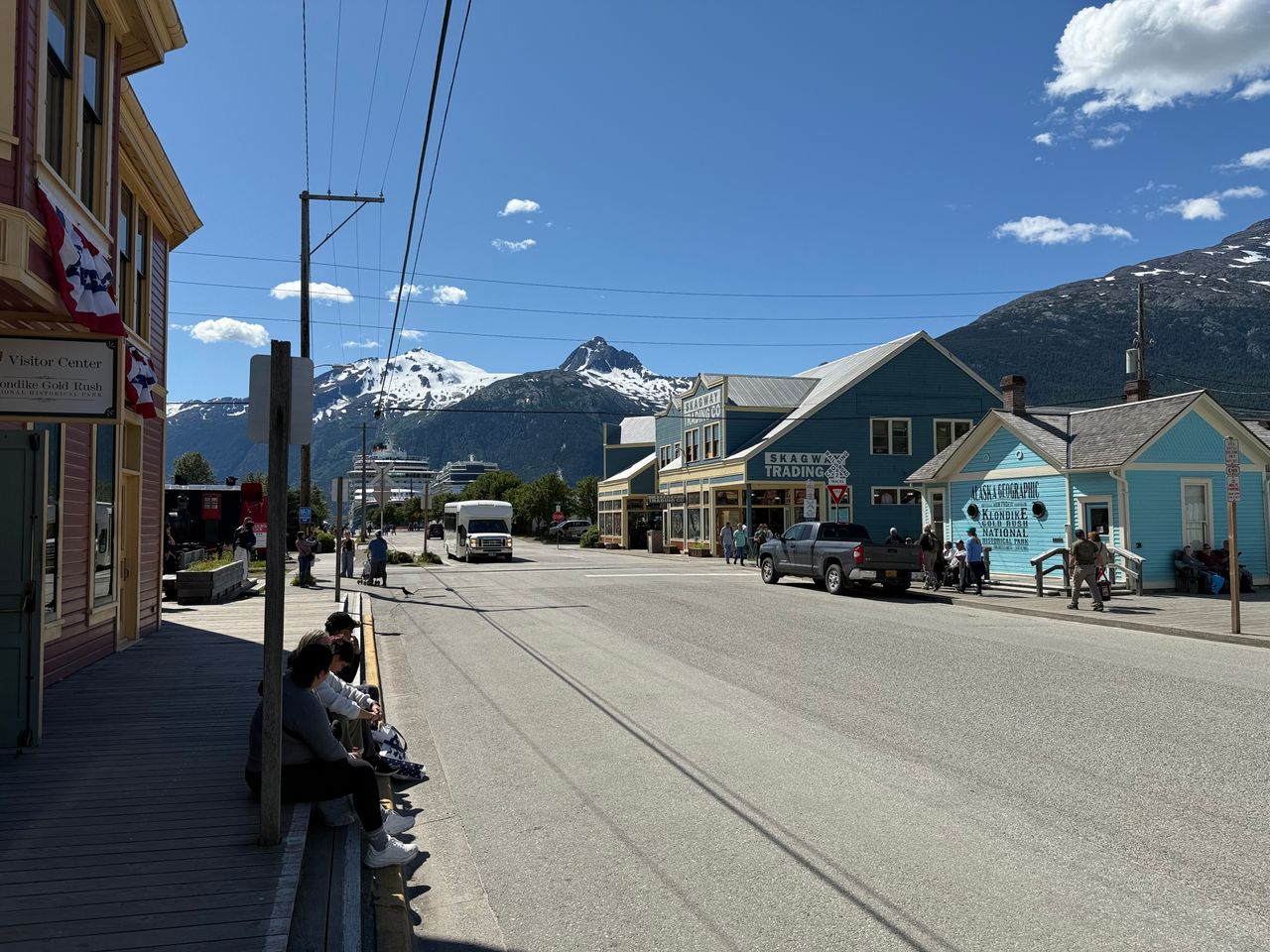
Imagine living in a town of roughly 1,100 people that welcomes more than a million cruise passengers every year.
During summer, the streets are packed. Restaurants serve visitors from around the world, tour guides lead excursions through spectacular mountain scenery, and local shops enjoy some of their busiest days of the year.
Then the cruise season ends.
The ships disappear over the horizon, seasonal workers head home, businesses close their doors and the town returns to a much quieter existence.
Welcome to Skagway, Alaska, one of the most fascinating and increasingly complicated cruise destinations in North America.
In 2025, approximately 1.36 million cruise passengers visited Skagway across 512 ship calls. More than half a million crew members also passed through the port. For a community with a permanent population of around 1,100, those numbers are extraordinary.
But behind the tourism success story is a growing problem. Housing is becoming harder to find, hotels are being converted into employee accommodation, local businesses struggle to remain open through winter, and residents are questioning whether the town’s dependence on cruise tourism is becoming too great.
Skagway’s story raises a question that many popular tourist destinations are beginning to confront:
What happens when a place becomes so successful at attracting visitors that it becomes increasingly difficult for local people to live there?
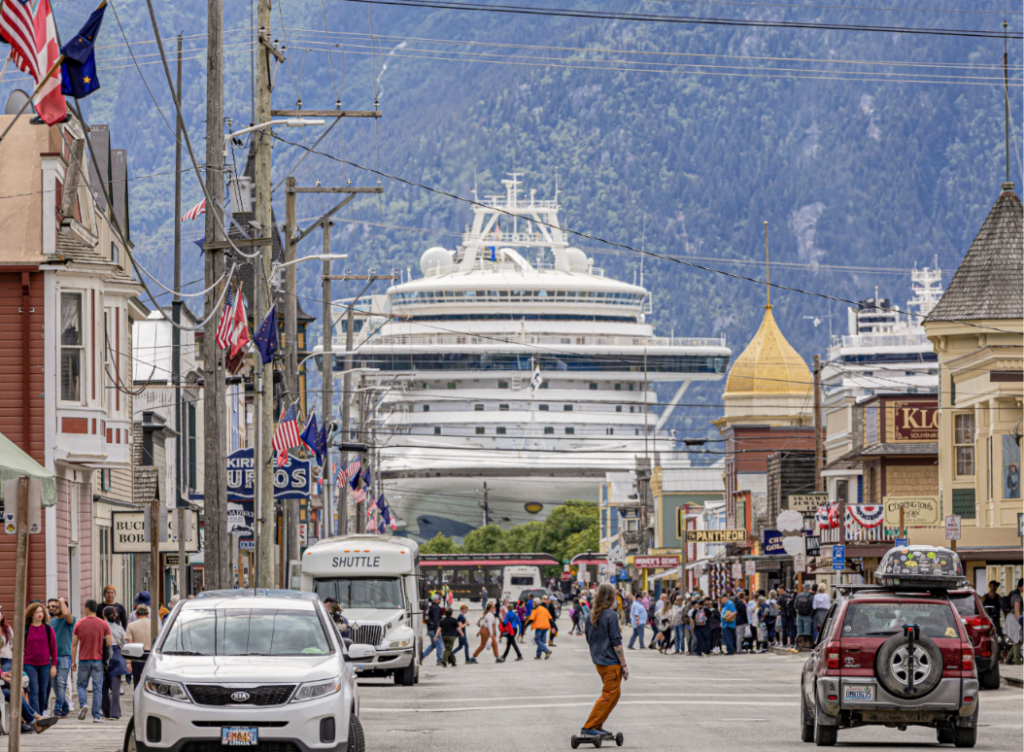
1. From Gold Rush Boomtown to Alaska’s Cruise Tourism Hotspot
Skagway’s history has always been shaped by people arriving in search of opportunity.
Located in southeastern Alaska, at the northern end of the Inside Passage, the town is surrounded by dramatic mountains and spectacular coastal scenery.
Its most famous historical chapter began during the Klondike Gold Rush of the late 1890s.
When news spread that gold had been discovered in Canada’s Yukon territory, thousands of prospectors travelled to Skagway hoping to reach the goldfields.
The town quickly became a major gateway for people seeking their fortunes.
At its peak, Skagway had approximately 10,000 residents. It was a rough, rapidly expanding settlement filled with businesses, saloons, hotels and people hoping to become wealthy.
Skagway became Alaska’s first incorporated city in 1900.
But the Gold Rush did not last forever.
As the rush faded, prospectors moved elsewhere and the population collapsed. By 1910, only around 600 people remained.
For decades, Skagway was a relatively quiet community with a remarkable historical legacy.
Then cruise tourism transformed its fortunes once again.
The numbers behind Skagway’s tourism explosion
Cruise ships brought a new kind of economic opportunity.
Instead of attracting people hoping to discover gold, Skagway began attracting holidaymakers interested in mountain scenery, historic streets, railway journeys and Alaskan adventures.
The growth has been dramatic.
| Year | Cruise ship calls | Cruise passengers |
|---|---|---|
| 2016 | 362 | 817,308 |
| 2019 | 441 | 1,036,452 |
| 2022 | 411 | 704,298 |
| 2023 | 493 | 1,195,100 |
| 2024 | 489 | 1,257,000 |
| 2025 | 512 | 1,358,500 |
Source: Alaska Department of Commerce commercial passenger vessel statistics.
Passenger numbers increased by roughly 66% between 2016 and 2025.
The pandemic briefly interrupted the boom. No cruise ships visited Skagway in 2020, but passenger numbers recovered over the following years.
By 2025, the town had reached another record.
The economic opportunity is enormous, but so is the pressure placed on a small community.
2. A Town of 1,100 People Must Prepare for Millions of Visitors
The difference between Skagway’s permanent population and its annual visitor numbers is difficult to ignore.
Imagine a small town designed to serve approximately 1,100 residents. Now imagine that during the summer it must accommodate thousands of additional people every day.
That means more demand for almost everything:
- Accommodation and rental housing.
- Restaurants, shops and public facilities.
- Roads, pedestrian areas and transport.
- Water, electricity and sewage systems.
- Waste collection and public toilets.
- Medical services and emergency response.
- Workers to operate tours, hotels and businesses.
The challenge is that most of this additional demand is temporary.
Skagway needs far more workers and services during the cruise season, but it cannot simply maintain the same level of activity throughout the year.
This creates a difficult economic balancing act.
Businesses need enough employees to handle summer demand, while workers need somewhere to live. The town needs infrastructure capable of handling large crowds, but it must also maintain those facilities during the quieter months.
The result is a community whose economy expands dramatically during summer and contracts when the ships leave.
3. The Housing Crisis: Where Do All the Seasonal Workers Sleep?
One of the biggest problems facing Skagway is housing.
Tourism creates employment, but every new seasonal job requires another person to find somewhere to live.
That sounds simple enough until you consider the town’s geography.
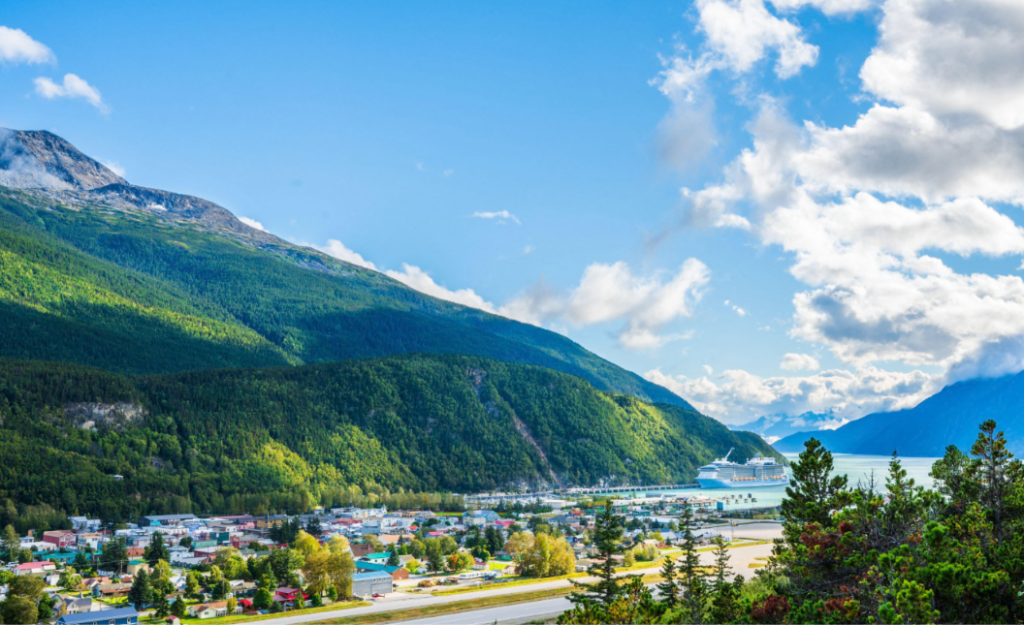
Skagway sits in a narrow valley surrounded by mountains. There is limited land available for new construction, and its remote location makes development more expensive and complicated.
A 2023 housing report commissioned by the Skagway Development Corporation identified 644 housing units in the community. Even with subsequent additions, housing supply has struggled to keep up with the demands of permanent residents, seasonal workers and businesses.
The situation has forced some workers into uncomfortable living arrangements.
Seasonal employees have reportedly relied on:
- Crowded shared accommodation.
- Warehouses converted into sleeping areas.
- Recreational vehicles and motorhomes.
- Tents and temporary structures.
- Informal arrangements with friends or other workers.
The Guardian also reported that some people have resorted to sleeping in hammocks in wooded areas rather than sharing overcrowded accommodation.
It is a remarkable situation for a town whose tourism industry depends on attracting workers from outside Alaska.
When camping restrictions make things harder
Some seasonal employees previously relied on campsites for accommodation.
However, local rule changes prohibited season-long camping.
According to residents interviewed by the Guardian, this pushed some workers towards conventional housing that had previously been available to permanent residents.
This illustrates the difficulty of managing a seasonal workforce.
Authorities need to ensure that accommodation is safe and appropriate. But if temporary options disappear before alternative housing is available, the pressure simply moves somewhere else.
The real solution requires a proper workforce housing strategy rather than forcing workers to compete for an already limited supply of homes.
4. Hotels Are Becoming Homes for Employees
Perhaps the clearest sign of Skagway’s housing problem is what has happened to some of its hotels.
Hotels are normally built to accommodate visitors.
In Skagway, however, some properties have increasingly been used to house seasonal employees.
One example is Sergeant Preston’s hotel.
Longtime resident Mike Healy bought the property after struggling to find suitable land to build enough accommodation for workers employed by his businesses.
He eventually converted the hotel into seasonal housing.
From a business perspective, the decision makes sense.
Workers need somewhere to stay, and an existing hotel already has rooms and basic facilities.
But there is a catch.
Every hotel converted into employee accommodation reduces the number of rooms available to independent travellers.
That creates a strange situation: Skagway welcomes enormous numbers of cruise passengers but has fewer accommodation options for visitors who want to stay overnight.
Local business owner and town assembly member Jonathan Hillis has warned that the town has fewer places available for independent tourists.
This matters because independent travellers can contribute to the local economy in a different way from cruise passengers.
They may stay several nights, eat at local restaurants, visit attractions and book multiple excursions.
Cruise passengers often spend only a few hours in town before returning to their ships.
Both groups are valuable, but a destination that depends almost entirely on day visitors may miss opportunities to develop a more diverse tourism economy.
5. October Arrives, the Crowds Disappear—and the Town Changes Completely
The end of the cruise season brings a dramatic transformation.
During summer, Skagway is filled with visitors, seasonal workers and businesses operating at full capacity.
When autumn arrives, much of that activity disappears.
Tour companies suspend operations. Shops reduce their opening hours. Seasonal employees leave for other destinations. Restaurants close or operate with limited schedules.
The Guardian reported that the Sweet Tooth cafe, once a longstanding year-round diner, had disappeared as a local gathering place and become a seasonal jewellery storefront.
Only two local restaurants were reported to remain open outside the main tourist season, both operating with limited hours.
For visitors, this might sound like an ordinary seasonal business cycle.
For permanent residents, however, the consequences are more personal.
A town needs more than houses and roads to remain a community.
People need places to meet, eat, buy groceries, access everyday services and spend time with friends.
A year-round cafe may not appear particularly important in a tourism report, but it can be one of the few places where residents regularly see one another.
When these businesses disappear during winter, the town loses part of its social life.
Why winter businesses matter
Small year-round businesses provide more than commercial services.
They create jobs, maintain community connections and give residents a reason to spend time in the town centre.
A grocery store, cafe or restaurant can become a social meeting point.
When these businesses struggle to survive, residents may have fewer options and become more dependent on services that operate only during the tourist season.
Skagway’s challenge is therefore not just about keeping shops open.
It is about maintaining the everyday infrastructure of a functioning community.
Mayor Orion Hanson has expressed concern about the town’s ability to sustain its year-round population and economy.
That concern reflects a bigger question: how can Skagway remain a real place to live rather than becoming a destination that exists primarily for visitors?
6. Cruise Tourism Brings Millions of Dollars Into Skagway
Despite the problems, cruise tourism remains extremely important to Skagway.
It would be unrealistic to suggest that the town could simply turn away cruise ships without serious economic consequences.
The industry supports local tour operators, restaurants, shops, transport companies and other businesses.
It also provides substantial income to the municipality through passenger taxes, vessel impact fees and port charges.
A 2025 report prepared by McKinley Research Group for the Municipality of Skagway examined the costs and revenues associated with cruise passengers in 2024.
The findings show how financially important the industry has become.
Where does Skagway’s cruise-related municipal revenue come from?
| Revenue source | Amount in 2024 |
|---|---|
| Vessel Impact Fees | $13.77 million |
| Commercial Passenger Vessel Tax | $5.96 million |
| Port fees, dockage, security and utilities | $1.62 million |
| Rental tax | $663,000 |
| Sales tax from onboard purchases | $598,000 |
| Tender unloading fees | $403,000 |
| Permits, licences and other fees | $243,000 |
| Total direct revenue | $23.26 million |
These figures demonstrate why local authorities cannot ignore the financial contribution of cruise tourism.
The money helps support port operations, public facilities, infrastructure and municipal services.
But revenue is only one part of the story.
How much does it cost to welcome all those visitors?
The same study estimated that cruise passengers cost the municipality approximately $12.8 million in 2024, equivalent to about $10.20 per passenger.
The costs included:
- Port maintenance and operations.
- Road cleaning and public works.
- Parks and trail maintenance.
- Public toilets and waste collection.
- Medical services and emergency response.
- Fire and ambulance services.
- Police and dispatch.
- Infrastructure improvements and rockslide mitigation.
The report estimated operating costs at approximately $9.9 million and capital costs at around $2.9 million.
This is an important point.
Tourism does not simply generate income. It also requires public investment.
The town needs roads, sanitation, emergency services and infrastructure capable of handling the additional demand.
Is cruise tourism financially worthwhile?
The figures indicate that direct cruise-related municipal revenue exceeds the estimated cruise-related municipal costs.
However, the difference should not automatically be treated as the total economic benefit to Skagway.
The calculations do not capture every effect on local residents.
For example, the municipality also estimated approximately $10.2 million in tourism-related sales tax revenue in 2024, with at least $10 million attributed to cruise passengers. This is a separate indirect revenue estimate, not another direct fee.
Meanwhile, private businesses receive income from excursions, shopping, meals and other visitor spending.
At the same time, housing shortages, pressure on public services and the reduced availability of independent accommodation create wider economic and social costs.
The real financial picture is therefore more complicated than simply comparing revenue and expenses.
7. COVID-19 Exposed the Danger of Depending on One Industry
Skagway’s reliance on cruise tourism creates another problem: what happens when the ships stop coming?
The COVID-19 pandemic provided a painful answer.
In 2020, cruise ships did not visit Skagway.
Businesses lost an important source of customers, tourism-related employment disappeared and municipal revenue was affected.
The wider Alaskan tourism economy also suffered.
For a small community, the disruption was especially serious because cruise tourism supports so many parts of the local economy.
This is why Mayor Hanson has warned about the danger of putting all the town’s economic eggs in one basket.
The lesson is straightforward.
An economy that depends heavily on one industry is vulnerable when that industry experiences a crisis.
Cruise tourism can be affected by pandemics, economic downturns, fuel prices, geopolitical events, changing consumer preferences and environmental regulations.
Skagway needs the income generated by cruise ships, but it also needs alternative sources of economic activity.
8. Skagway’s Geography Makes Expansion Difficult
Some tourist destinations can solve overcrowding by expanding into nearby suburbs or building new transport links.
Skagway does not have that luxury.
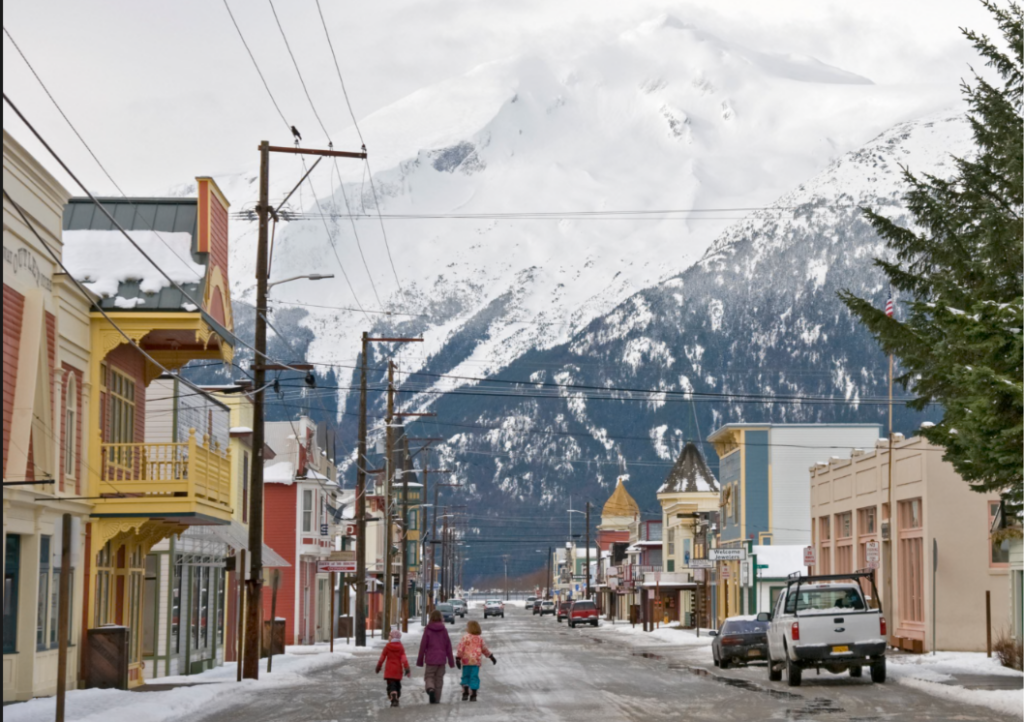
The town is squeezed into a narrow valley, with steep mountains limiting the amount of developable land.
Its remote location also makes it more expensive to transport construction materials and other supplies.
This creates several challenges.
Building new housing is expensive
New accommodation requires land, planning approvals, construction materials, utility connections and financing.
Even when developers are willing to build, the municipality must consider whether roads, water supplies and sewage infrastructure can support additional residents.
Public services face seasonal pressure
The municipality must prepare for a sharp increase in visitors during the summer.
The cruise passenger cost report identified significant expenses across the port, public works, clinic, fire and emergency medical services.
For example, the Fire and Emergency Medical Services Department recorded approximately $1.12 million in cruise-related operating costs in 2024, representing 55% of the department’s total expenses.
This demonstrates how much visitor activity can affect the workload of essential public services.
Natural hazards complicate port development
Skagway has also faced serious rockslide safety concerns.
In 2022, rockslides above the privately owned Railroad Dock reduced its capacity and led to restrictions on passenger access.
Safety measures and mitigation work have continued.
The town must therefore balance tourism development with the need to protect passengers, workers and residents from environmental hazards.
9. The Environmental Cost of Cruise Tourism
The discussion about Skagway is also part of a much larger debate about the environmental impact of cruise tourism.
Large cruise ships bring thousands of people into destinations that may have limited infrastructure.
Their operations require fuel, electricity, waste management and extensive port facilities.
At the destination level, large visitor numbers can increase pressure on:
- Roads and pedestrian areas.
- Freshwater and wastewater systems.
- Waste collection and disposal.
- Local transport and excursion routes.
- Natural attractions and outdoor recreation areas.
- Medical and emergency services.
Cruise ships also produce greenhouse gas emissions.
Their environmental performance depends on factors such as fuel type, engine technology, vessel operations and access to shore power.
For destinations surrounded by sensitive coastal and marine ecosystems, these issues deserve serious attention.
However, it is important to distinguish between the general environmental footprint of cruise tourism and the specific impacts measured in Skagway.
The municipality’s financial report identifies spending on waste services, public works and port infrastructure. It is not, by itself, a complete environmental impact assessment.
That means claims about local pollution levels or ecological damage should be supported by separate environmental monitoring.
When tourism becomes overtourism
Overtourism does not necessarily mean that every visitor is unwelcome.
It describes a situation in which the volume, timing or concentration of tourism places excessive pressure on a destination and its residents.
Skagway faces a particularly concentrated form of this problem.
The town must share its public spaces and infrastructure with enormous numbers of temporary visitors during a relatively short season.
The question is how to maintain the economic benefits of tourism without damaging the qualities that make Skagway attractive.
10. Skagway Is Not the Only Alaska Town Struggling With Cruise Crowds
Other communities along Alaska’s Inside Passage are facing similar questions.
The issue is no longer simply how to attract more cruise ships. It is how to manage their impact.
Juneau: Putting a limit on daily cruise passengers
Alaska’s capital, Juneau, has become one of the most prominent examples of a destination trying to control cruise tourism growth.
The city and major cruise lines agreed to a five-ship-per-day threshold beginning in 2024.
A further agreement introduced daily passenger-capacity limits for 2026: 16,000 lower berths from Sunday to Friday and 12,000 on Saturdays.
The aim is to prevent extreme visitor concentrations while maintaining the economic contribution of cruise tourism.
However, passenger limits in one destination can affect the wider cruise itinerary network.
When ships cannot dock in one port, operators may adjust schedules or redirect vessels elsewhere.
Ketchikan: Could restrictions simply move the crowds?
Ketchikan is another major cruise destination in southeastern Alaska.
If cruise traffic is restricted in one port, other communities may receive additional ship calls.
This raises an important question: are visitor limits solving overcrowding or simply transferring the pressure to another town?
A regional approach is essential.
Sitka: Planning for future visitor growth
Sitka has also been reviewing its arrangements with the cruise industry as it considers the impact of future passenger numbers.
The wider challenge is whether Alaska’s cruise communities should continue competing for more traffic or work together to manage the total number of visitors moving through the region.
Cooperation could help reduce the risk of overcrowding simply shifting from one destination to another.
11. Do Skagway Residents Want More Cruise Ships?
It is tempting to imagine that the community is divided into two groups: people who want more cruise ships and people who want fewer.
The reality is more complicated.
A survey conducted by Oregon State University and reported by the Guardian found that:
- Just over 40% of respondents believed tourism’s benefits outweighed its costs.
- Around 25% believed the costs outweighed the benefits.
- Approximately 33% considered the relationship roughly balanced.
These findings suggest that residents recognise both the economic opportunities and the social pressures.
Cruise tourism creates employment and income. It supports businesses that might otherwise struggle in a remote community.
But it also contributes to housing competition, seasonal crowding and pressure on public services.
Some business owners benefit directly from tourism while worrying about the difficulty of finding accommodation for workers.
This is why the debate cannot be reduced to a simple question of whether cruise ships are good or bad.
The real issue is how the town can retain the benefits without making itself increasingly difficult to live in.
12. Can Skagway Build an Economy That Works All Year?
Reducing dependence on cruise tourism does not mean abandoning the industry.
Cruise ships will probably remain central to Skagway’s economy for the foreseeable future.
However, the town could become more resilient by supporting additional activities that provide jobs and income throughout the year.
Here are several possibilities.
Encourage independent travellers
Independent tourists often stay longer than cruise passengers.
They may arrive by road, ferry or air, book accommodation, eat at local restaurants and explore the surrounding region over several days.
Encouraging this type of tourism could create a more balanced visitor economy.
But the town needs enough accommodation to make that possible.
If hotels continue being converted into employee housing, independent travellers will have fewer places to stay.
A sensible strategy must consider both workforce accommodation and visitor accommodation.
Support year-round businesses
Skagway needs businesses that serve permanent residents as well as tourists.
These could include:
- Grocery stores and essential retail services.
- Restaurants and cafes with year-round opening hours.
- Construction and maintenance companies.
- Local food production and supply businesses.
- Professional and remote-work services.
- Community and cultural activities.
Not every business needs to operate throughout the winter.
The goal is to maintain enough essential services and social spaces for the permanent community.
Invest in better workforce housing
Safe and affordable accommodation is essential for attracting seasonal workers.
Potential solutions include:
- Designating suitable land for employee housing.
- Partnerships between employers and local government.
- Renovating underused buildings.
- Developing purpose-built seasonal accommodation.
- Establishing clear standards for shared housing.
- Planning for the transition between summer and winter use.
A successful housing strategy should improve conditions for workers without making permanent residents compete for even fewer homes.
Work with neighbouring communities
Skagway could also cooperate with other Inside Passage destinations on tourism scheduling, infrastructure planning and workforce accommodation.
Regional coordination could help prevent restrictions in one port from simply transferring overcrowding to another.
It could also support longer, multi-destination trips that benefit more communities.
13. What Would Sustainable Cruise Tourism Look Like?
The future of cruise tourism does not have to be a choice between unlimited growth and shutting down the industry.
A better approach would focus on managing visitor numbers, improving infrastructure and ensuring that local communities receive a fair share of the benefits.
Several measures could help.
Smarter visitor scheduling: Cruise arrivals could be distributed more evenly to avoid extreme daily peaks.
Better local infrastructure: Passenger-related fees should help fund port operations, public services, waste management and safety improvements.
Affordable workforce accommodation: Seasonal employees need safe places to live that do not displace permanent residents.
Protection of independent tourism: Destinations should maintain sufficient accommodation for travellers who want to stay beyond a short cruise stop.
Environmental monitoring: Authorities should measure the effects of tourism on waste, water, transport, air quality and nearby ecosystems.
Meaningful community participation: Residents should have a genuine role in decisions about port expansion, visitor limits and development.
The most important point is that sustainable tourism should be measured by more than passenger numbers.
A destination cannot claim complete success if it welcomes millions of visitors but struggles to provide stable housing and basic services for its own residents.
14. What Can Travellers Do to Support Skagway?
For people planning an Alaska cruise, Skagway remains an extraordinary destination.
Visitors can explore its historic downtown, discover the Klondike Gold Rush story and take scenic excursions through the surrounding mountains.
The White Pass & Yukon Route railway is one of its best-known attractions, offering spectacular views along a historic mountain route.
But travellers can also make choices that benefit the local community.
Here are some practical ideas:
- Consider staying longer. If accommodation is available, an independent visit can provide a different experience from a short cruise stop.
- Support locally owned businesses. Choose locally operated restaurants, shops and tour companies where possible.
- Respect residential areas. Remember that Skagway is a home for thousands of people across the year, not simply a tourist attraction.
- Follow environmental guidance. Stay on marked trails and respect wildlife and natural areas.
- Be flexible during busy periods. Popular excursions and public spaces may become crowded when several ships arrive.
- Learn about local history. Understanding Skagway’s Gold Rush heritage makes a visit more meaningful than simply shopping and sightseeing.
Travellers should also check cruise schedules and seasonal opening hours before arranging independent activities.
15. The Real Question: Can Skagway Survive Its Own Success?
Skagway’s story is a reminder that tourism success can come with unexpected consequences.
The town once grew rapidly because of the Gold Rush. When the gold disappeared, its population collapsed.
Now cruise tourism has brought a new economic boom.
But this time, the challenge is not simply how to attract visitors. It is how to manage their impact while preserving a functioning community.
Housing is scarce. Some hotels have become employee accommodation. Independent travellers have fewer places to stay. Local businesses struggle through winter, and the town must maintain expensive infrastructure for a seasonal visitor economy.
Its geography makes expansion difficult, while dependence on cruise tourism leaves the local economy vulnerable to sudden disruption.
There is no easy answer.
Restricting cruise ships could reduce some pressures but also affect jobs, businesses and municipal revenue. Allowing unlimited growth could make housing, services and infrastructure problems worse.
A more realistic path involves carefully managed tourism, stronger workforce housing policies, better infrastructure planning and investment in a broader year-round economy.
Skagway does not need to choose between welcoming visitors and protecting its residents.
It needs a tourism model that allows both to coexist.
After all, the real measure of a successful destination should not be how many cruise passengers it can welcome in July.
It should be whether the people who live there can still afford to call it home in January.
Frequently Asked Questions (FAQs)
1. How many cruise ship passengers visit Skagway, Alaska, each year?
Skagway received approximately 1,358,500 cruise passengers in 2025 across 512 ship calls, according to Alaska state figures. More than half a million cruise crew members also visited. These numbers are remarkable for a town with roughly 1,100 year-round residents.
2. Why does Skagway have a housing shortage?
Skagway is located in a narrow valley surrounded by mountains, leaving limited land for new construction. Cruise tourism also creates substantial demand for seasonal workers who need accommodation. Some hotels and other buildings have been converted into staff housing, reducing the number of rooms available to permanent residents and independent travellers.
3. What happens to Skagway when cruise ships leave for winter?
When the cruise season ends, most visitors and many seasonal workers leave. Shops reduce their opening hours, tour companies suspend operations and restaurants close or operate on limited schedules. The town returns to a much smaller year-round population, but residents must continue maintaining essential services and infrastructure throughout winter.
4. Does Skagway benefit financially from cruise ship tourism?
Yes. In 2024, the municipality received approximately $23.26 million in direct cruise-related revenue, including vessel impact fees, passenger taxes and port charges. A municipal study estimated cruise-related costs at approximately $12.8 million. Cruise passengers also support local businesses, although the wider economic and social impact is more complicated than these municipal figures alone.
5. Is Skagway trying to limit cruise ship tourism?
Skagway’s challenge is to balance tourism revenue with housing, infrastructure and community needs. Cruise tourism remains central to its economy, but residents and officials are debating how much growth the town can accommodate. Other Alaska destinations, including Juneau, have introduced agreements with cruise lines to manage ship numbers and passenger capacity.
Sources The Guardian