

As international travel rebounds and technology becomes more deeply embedded in everyday life, language barriers remain one of the biggest anxieties for travelers. Apple’s AirPods live translation feature, powered by iOS and Apple’s translation ecosystem, promises something close to science fiction: real-time conversations across languages, delivered discreetly through wireless earbuds.
But how well does this technology actually work in a complex, fast-paced city like Tokyo—where politeness, nuance, and context matter as much as vocabulary? Beyond basic testing, the real question is whether tools like AirPod translation meaningfully change how people travel, communicate, and experience foreign cultures.
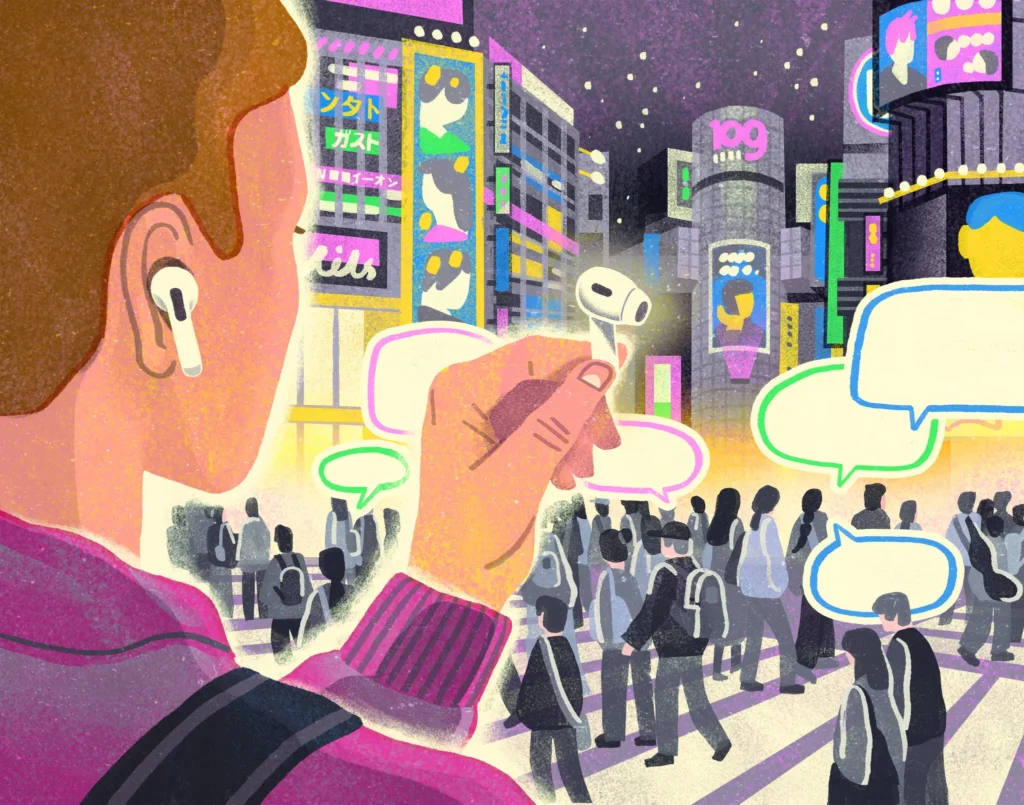
How AirPod Live Translation Works
Apple’s live translation functionality is not built directly into the AirPods themselves, but rather operates through a connected iPhone, using:
- The Apple Translate app
- Speech recognition
- On-device and cloud-based machine learning
When enabled, one person speaks, their words are translated on the iPhone, and the translated audio is played through the AirPods. The conversation can be set up in conversation mode, allowing back-and-forth dialogue between two speakers using different languages.
This setup aims to be more seamless and discreet than holding up a phone and reading text translations, especially in social or professional settings.
Why Tokyo Is the Ultimate Test Case
Tokyo is a challenging environment for live translation tools for several reasons:
- Language Complexity
Japanese relies heavily on context, formality levels, and implied meaning. Direct word-for-word translation often misses nuance. - Politeness and Social Norms
Honorifics, indirect phrasing, and cultural expectations are deeply embedded in speech. Misinterpretation can change the tone of an interaction. - Urban Noise
Busy train stations, restaurants, and streets test the accuracy of speech recognition. - Speed of Conversation
Native speakers often talk quickly, with idiomatic expressions that AI may struggle to parse.
If live translation works here, it can work almost anywhere.
Where AirPod Translation Performs Well
1. Basic Travel Interactions
AirPod translation excels at transactional conversations, such as:
- Ordering food
- Asking for directions
- Checking into hotels
- Shopping and payments
In these contexts, accuracy is generally high enough to communicate intent clearly, even if phrasing is imperfect.
2. Hands-Free Convenience
Wearing AirPods allows travelers to keep their hands free, maintain eye contact, and appear less distracted compared to constantly looking at a phone screen. This subtle shift improves social comfort and reduces the feeling of being “technologically isolated” while traveling.
3. Reduced Anxiety
For travelers who feel intimidated by unfamiliar scripts or pronunciation, live translation provides confidence. Knowing you can at least make yourself understood lowers the barrier to exploration and interaction.

Where the Technology Falls Short
1. Nuance and Cultural Meaning
While translation may be technically correct, it often lacks:
- Politeness markers
- Emotional tone
- Cultural context
This can result in speech that sounds blunt or awkward to native speakers, even if the meaning is clear.
2. Lag and Conversation Flow
Live translation introduces small but noticeable delays, which can disrupt natural conversation rhythm. This is especially noticeable in social situations rather than simple exchanges.
3. Idioms and Slang
Colloquial Japanese, regional accents, and slang can confuse speech recognition and translation models, leading to partial or incorrect output.
4. One-on-One Limitations
The setup works best in controlled, one-on-one situations. Group conversations or fast back-and-forth exchanges are still difficult to manage smoothly.
How AirPod Translation Compares to Other Tools
Compared to:
- Text-based translation apps: Faster and more natural, but less precise
- Dedicated translation devices: More specialized, but less integrated
- Human interpreters: Still far superior for complex or sensitive conversations
AirPod translation sits in the middle — a powerful convenience tool, not a replacement for language learning or professional interpretation.
What This Means for the Future of Travel
Lowering Language Barriers
Live translation tools may encourage more people to travel to destinations where English is less widely spoken, expanding tourism beyond traditional comfort zones.
Changing Traveler Behavior
Instead of sticking to tourist-friendly areas, travelers may feel empowered to:
- Visit local neighborhoods
- Eat at smaller, family-run restaurants
- Engage more directly with residents
Not a Substitute for Cultural Awareness
Technology can assist communication, but it cannot replace:
- Cultural sensitivity
- Basic language effort
- Respect for local norms
Travel remains a human experience first, technological one second.
Best Practices for Using Live Translation in Japan
- Speak slowly and clearly
- Use simple sentence structures
- Avoid idioms and slang
- Combine translation with gestures and visual cues
- Learn basic Japanese phrases as a courtesy
These steps dramatically improve results and social reception.
Frequently Asked Questions (FAQs)
1. Do AirPods translate languages on their own?
No. AirPods rely on a connected iPhone and Apple’s Translate app to process speech and deliver translated audio.
2. Does AirPod live translation work offline?
Some translation functions work offline if language packs are downloaded, but live conversation features generally perform best with an internet connection.
3. Is AirPod translation accurate enough for travel in Japan?
It is accurate for basic interactions like dining, shopping, and transportation, but not ideal for complex conversations or sensitive topics.
4. Can locals understand translated speech naturally?
They usually understand the meaning, but the phrasing may sound unnatural or overly direct due to missing cultural nuance.
5. Will live translation replace learning foreign languages?
Unlikely. While it reduces barriers, language learning still offers deeper cultural connection, understanding, and respect that technology cannot fully replicate.
Conclusion
Apple’s AirPod live translation is an impressive step toward frictionless global communication. In a city as linguistically and culturally complex as Tokyo, it proves capable of handling everyday travel needs — but it also reveals the limits of AI-driven language tools.
Rather than a magic solution, live translation works best as a travel companion: a safety net that empowers exploration, not a substitute for curiosity, cultural awareness, or human connection. As translation technology continues to improve, the future of travel may be less about speaking the same language — and more about understanding each other better, with a little help from AI.
Sources The New York Times

