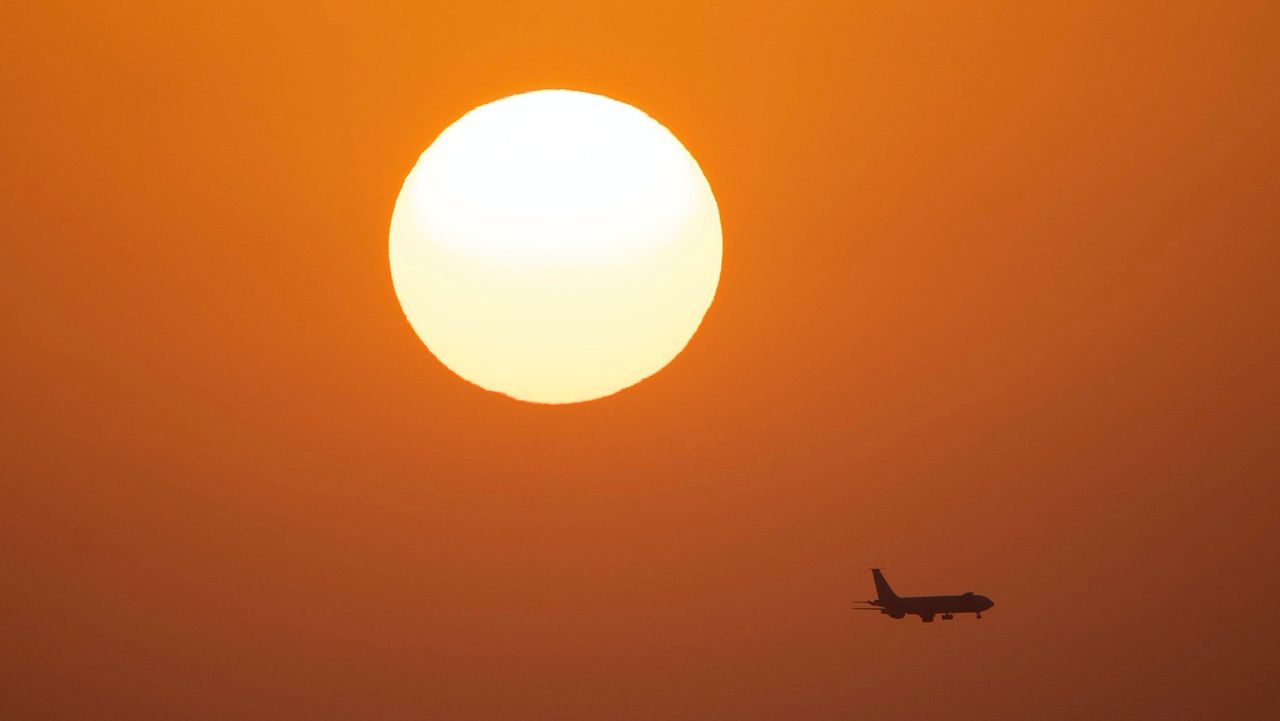
Europe’s heatwave problem is no longer just a weather story. It is becoming an economic story—and the bill is getting harder to ignore.
The summer of 2026 has exposed a vulnerability that stretches far beyond overheated streets and cancelled outdoor activities. Extreme heat, drought and wildfires are now disrupting tourism, agriculture, electricity generation, river transport, industrial production and the ability of workers to remain productive.
An estimate from Dutch sustainable lender Triodos puts the potential economic damage from this summer’s extreme heat and drought at around €180 billion, equivalent to roughly 1% of EU economic output. That is striking because it is close to the amount of economic growth the bloc had expected for 2026.
In other words, Europe may spend much of this year running just to stand still.
And this isn’t simply about one unusually hot summer.
It is a warning that European economies designed around relatively moderate temperatures are entering an era in which heat itself becomes an economic variable.

From Weather Forecast to Economic Forecast
For decades, European economic forecasts focused on familiar variables:
- inflation;
- interest rates;
- energy prices;
- consumer spending;
- unemployment;
- trade;
- government debt.
Weather appeared mostly as a footnote.
That is becoming harder to justify.
Extreme heat can reduce the number of hours people can safely work. Drought can restrict industrial water supplies. Low rivers can prevent cargo ships from operating normally. Hot water can force power plants to reduce output. Wildfires can destroy infrastructure and discourage tourists.
The consequences then ripple through the economy.
A farmer loses crops.
A food company pays more for ingredients.
A restaurant raises prices.
A household cuts spending.
A central bank watches inflation.
One climate event can therefore move through multiple economic sectors.
The €180 Billion Warning
The Triodos estimate is particularly significant because it attempts to capture the wide economic effects of heat and drought rather than simply counting direct physical damage.
The potential €180 billion reduction in EU output is roughly equivalent to 1% of GDP.
That does not mean Europe will literally receive a €180 billion invoice.
Economic damage is more complicated.
Some losses represent production that never happens.
Some represent delayed activity.
Some are costs businesses absorb.
Some are paid by governments.
Some appear as higher prices.
And some never show up neatly in GDP statistics at all.
That last category matters.
A worker suffering from heat stress may still be employed, for example, but produce less.
A family avoiding a restaurant because it is too hot still represents lost economic activity.
A tourist cancelling a walking tour may still spend money elsewhere.
The economic impact is therefore diffuse.
France: When Heat Hits the Nuclear Power System
France provides perhaps the clearest example of how climate and energy infrastructure are becoming intertwined.
France relies heavily on nuclear power, which normally gives it an important advantage in European electricity markets.
But many nuclear plants depend on rivers or other water sources for cooling.
When rivers become exceptionally warm or water levels fall, operators can face environmental constraints or physical limitations on how much heat they can discharge.
During the current heatwave, French nuclear production has been constrained, contributing to higher European electricity prices. Reuters reported that French nuclear availability could be reduced by as much as 7.3 GW, around 12% of the country’s nuclear fleet, during the latest episode.
This creates an uncomfortable climate paradox.
Europe needs more electricity for cooling buildings.
At precisely the same time, extreme heat can make some power-generation systems less efficient or force them to reduce output.
The Air-Conditioning Trap
Heatwaves create a vicious circle for electricity systems.
When temperatures rise:
More people use air conditioning.
That increases electricity demand.
Higher demand pushes power prices upward.
But heat can simultaneously reduce electricity supply.
The result is a tighter grid and potentially much higher prices.
Reuters reported that European spot electricity prices jumped more than 20% during the latest heatwave, with France and Germany particularly affected.
This is one of the central economic challenges of climate adaptation.
The continent needs more cooling.
But cooling requires energy.
And energy infrastructure itself must become more resilient to heat.
Germany Has a Different Problem: The Rhine
Germany illustrates another pathway through which climate disruption reaches the economy.
The Rhine is one of Europe’s most important commercial waterways.
Low water levels can reduce the amount of cargo ships can carry.
That means more journeys are needed to move the same amount of goods.
Transportation costs rise.
Industrial supply chains become less efficient.
Germany’s chemical and manufacturing sectors are particularly exposed because major industrial facilities are connected to the river system.
The economic problem is therefore not simply:
“The river is low.”
It becomes:
“Factories cannot receive or ship materials as efficiently.”
That is a much bigger problem.
Why Low Rivers Matter So Much
Modern European industry was built around infrastructure that assumed relatively predictable water conditions.
The Rhine connects industrial regions with:
- ports;
- refineries;
- chemical plants;
- manufacturing centers;
- warehouses;
- international markets.
When water levels fall, the entire logistics network can become more expensive.
Recent analysis has suggested that the wider economic cost of Europe’s drought could be enormous once agriculture, energy, shipping and industrial disruption are included.
The lesson is blunt:
Europe’s rivers are economic infrastructure.
They should be treated with the same strategic importance as roads, railways and power grids.
Italy: Tourism, Agriculture and Public Finances Under Pressure
Italy faces a particularly complicated situation because several climate-sensitive industries are economically important.
Agriculture is another.
Both are highly exposed to heat.
The Guardian reports that Italy could lose around 1.1 percentage points of GDP growth as a result of the current heat and drought conditions. The country’s agricultural sector has already suffered climate-related damage estimated at roughly €20 billion over four years.
That matters because agriculture isn’t an isolated industry.
Lower agricultural output can mean:
- higher food prices;
- lower farm incomes;
- greater import dependence;
- increased government support;
- pressure on consumers.
And when a country already carries significant public debt, repeated climate shocks can make fiscal management even harder.
Tourism Is Both Victim and Survivor
Tourism may seem like an industry that should benefit from summer heat.
After all, people go to Europe for sunshine.
But there is a huge difference between pleasant warmth and dangerous heat.
When temperatures become extreme, tourists may:
- cancel outdoor activities;
- avoid city sightseeing;
- shorten excursions;
- remain inside hotels;
- shift travel times;
- choose cooler destinations.
That changes how tourism revenue is distributed.
A hotel may remain full while a walking-tour operator loses business.
A resort may do well while a museum or outdoor attraction struggles.
A restaurant may lose its lunchtime customers but gain evening business.
So tourism does not simply disappear.
It changes shape.
Spain Shows Why Tourism Can Be Surprisingly Resilient
Spain has endured severe heat and devastating wildfires during 2026.
The Guardian reports that around 275,000 hectares have been affected by wildfires, yet tourism spending has remained relatively resilient.
That resilience is important.
Spain has an enormous and highly diversified tourism economy.
It benefits from:
- coastal resorts;
- major cities;
- cultural tourism;
- islands;
- food tourism;
- international air connections;
- domestic travel.
That diversity can cushion individual climate shocks.
But resilience should not be confused with immunity.
The same analysis suggests Spain’s GDP growth could still be reduced by nearly 1 percentage point if the extreme conditions persist.
The New Tourism Question: Where Is It Cool?
A fascinating new travel trend is emerging across Europe.
Instead of asking:
“Where will it be sunny?”
travelers are increasingly asking:
“Where will it be bearable?”
That is helping northern European destinations attract visitors during periods when southern Europe becomes dangerously hot.
Countries such as Germany, Scandinavia, the Netherlands and parts of the UK can increasingly market themselves as cooler summer destinations.
The climate map of European tourism may therefore be changing.
The Rise of “Coolcation” Tourism
The term coolcation has entered the tourism vocabulary to describe holidays designed around cooler temperatures.
It sounds like marketing fluff.
It isn’t entirely.
If heatwaves become more frequent and intense, temperature becomes a genuine destination-selection factor.
That could benefit:
- northern Germany;
- Scotland;
- Scandinavia;
- Ireland;
- the Baltic states;
- mountainous regions;
- coastal areas with milder climates.
Tourism geography could gradually shift northward.
But Northern Europe Isn’t Immune
There is an important caveat.
Climate change doesn’t simply turn southern Europe into a desert and northern Europe into a comfortable paradise.
Extreme heat is expanding across the continent.
Northern countries can also experience:
- drought;
- wildfires;
- flooding;
- infrastructure failures;
- agricultural losses.
The European climate problem is therefore not simply about moving tourism north.
It is about making the entire tourism system more climate-resilient.
Productivity: The Invisible Economic Damage
Perhaps the most important impact of extreme heat is also the least visible.
Worker productivity.
A worker doesn’t have to stop working completely for heat to cause economic damage.
They may:
- work more slowly;
- take more breaks;
- make more mistakes;
- become fatigued;
- struggle to concentrate;
- leave work early.
Outdoor workers are particularly vulnerable.
That includes:
- construction workers;
- agricultural workers;
- delivery drivers;
- road crews;
- tourism employees;
- emergency responders.
But indoor workers can also suffer when buildings lack adequate cooling.
Heat Changes the Working Day
Businesses may have to redesign schedules.
Construction could move toward early mornings.
Restaurants may shift operating hours.
Tour guides may avoid midday.
Farm workers may start before sunrise.
Delivery companies may reduce daytime activity.
This can preserve productivity—but it also increases complexity.
A working day designed around extreme heat is fundamentally different from one designed around mild summer temperatures.
Heat Also Raises Health Costs
Economic productivity isn’t the only concern.
Extreme heat increases health risks, particularly for:
- older adults;
- people with cardiovascular conditions;
- outdoor workers;
- children;
- people without access to cooling.
Heat-related illness creates costs for:
- hospitals;
- emergency services;
- employers;
- families;
- governments.
And mortality represents an economic and human loss that GDP cannot adequately capture.
The UK, for example, has already recorded thousands of excess heat-related deaths during the 2026 summer, prompting calls for stronger national heat preparedness.
Agriculture Is on the Front Line
Farmers experience climate change in the most direct possible way.
Plants need the right combination of:
- temperature;
- water;
- sunlight;
- soil conditions.
Too much heat combined with too little water can sharply reduce yields.
That threatens everything downstream.
Lower harvests can mean:
less supply → higher prices → lower household purchasing power.
For countries with large agricultural sectors, the macroeconomic effects can be significant.
Food Inflation Could Become a Bigger Climate Story
Europe has already spent years dealing with inflation.
Climate shocks introduce another source of price pressure.
If drought reduces:
- wheat;
- fruit;
- vegetables;
- olives;
- grapes;
- rice;
food prices can rise.
This creates a particularly difficult policy problem.
Central banks can raise interest rates to control demand.
But they cannot manufacture rainfall.
Climate-driven inflation is therefore harder for conventional monetary policy to solve.
Wine Is Another Industry Facing a New Climate Reality
Europe’s wine regions are especially exposed.
Heat can accelerate grape ripening.
Drought can reduce yields.
Extreme temperatures can affect grape quality.
Some vineyards are already experimenting with:
- new grape varieties;
- different planting elevations;
- altered harvest schedules;
- irrigation;
- canopy management.
The wine industry is effectively conducting a giant climate-adaptation experiment.
Wildfires Add Another Layer of Economic Damage
Wildfires don’t merely destroy forests.
They can damage:
- homes;
- roads;
- power lines;
- tourism infrastructure;
- farms;
- telecommunications networks.
They also create smoke that can affect cities far from the fire itself.
And the costs continue after the flames disappear.
Governments must pay for:
- firefighting;
- reconstruction;
- compensation;
- ecological restoration.
Insurance companies face additional claims.
Local economies may lose visitors.
Europe’s Insurance Problem Is Getting Worse
Climate-related economic losses are increasingly exposing a gap between what businesses lose and what traditional insurance covers.
Reuters reported that more than €43 billion in losses from last summer’s heat events produced only about €500 million in insurance payouts, highlighting how much economic damage remains uninsured.
That is a major warning sign.
If insurers cannot profitably cover climate risks, businesses and governments ultimately carry more of the burden.
Parametric Insurance Could Become More Important
One possible response is parametric insurance.
Instead of paying after assessing physical damage, parametric policies pay when a predefined trigger occurs.
For example:
If temperatures exceed a certain threshold for a specified number of days, the policy pays.
This can be much faster than traditional claims assessment.
It may become increasingly useful for businesses exposed to heatwaves.
But insurance cannot replace adaptation.
A company cannot insure its way out of a fundamentally unsafe workplace.
Europe’s Infrastructure Was Built for Yesterday’s Climate
This may be the deepest structural problem.
Roads.
Railways.
Power stations.
Buildings.
Water networks.
Ports.
Bridges.
Many were designed using historical climate assumptions.
But the climate those assumptions were based on is changing.
Infrastructure designed for yesterday’s extremes may not be adequate for tomorrow’s.
The Cost of Adaptation Is Huge—but So Is the Cost of Doing Nothing
Europe faces an uncomfortable investment decision.
It can spend more today on:
- cooling;
- water storage;
- resilient electricity grids;
- flood protection;
- drought-resistant agriculture;
- wildfire prevention;
- heat-resistant roads;
- building insulation.
Or it can spend later on:
- emergency repairs;
- lost productivity;
- disaster recovery;
- health costs;
- business failures.
Adaptation isn’t cheap.
But repeated emergency response isn’t cheap either.
Europe Needs a Different Energy Strategy
Extreme heat is exposing the weaknesses of electricity systems.
The continent needs more:
- grid capacity;
- renewable generation;
- energy storage;
- interconnectors;
- demand management;
- cooling efficiency.
Solar power has an interesting role because hot, sunny days often coincide with strong solar generation.
But solar production peaks during daylight hours while cooling demand can remain high into the evening.
That makes storage increasingly important.
Water and Energy Can No Longer Be Planned Separately
This is another major lesson.
Power plants need water.
Agriculture needs water.
Cities need water.
Industry needs water.
Tourism needs water.
As drought becomes more severe, competition between sectors will intensify.
Europe therefore needs policies that treat water as strategic infrastructure, not simply an environmental resource.
Cities Need to Be Redesigned for Heat
Urban planning is also becoming economic policy.
Cities can reduce heat exposure through:
- trees;
- shaded streets;
- reflective surfaces;
- green roofs;
- parks;
- water features;
- better building design.
These measures aren’t merely aesthetic.
They can reduce temperatures and make cities more productive and livable.
Buildings Are Europe’s First Line of Defense
Many European buildings were designed to retain heat during winter.
That made perfect sense historically.
But a building that is excellent at trapping heat in January can become unbearable in August.
Retrofitting buildings for both winter and summer conditions is therefore increasingly important.
That includes:
- insulation;
- external shading;
- ventilation;
- heat pumps;
- efficient air conditioning;
- reflective materials.
The European Economy May Be Entering a New Climate Regime
The biggest mistake would be to treat 2026 as an isolated disaster.
The question isn’t:
“How much did this summer cost?”
The more important question is:
“What happens if summers like this become normal?”
If extreme heat occurs once every few decades, businesses can treat it as an exceptional shock.
If it happens every few years, it becomes a structural economic factor.
And if it happens every summer?
The entire economy has to adapt.
Winners and Losers Will Emerge
Climate change doesn’t affect every European economy equally.
Southern countries face greater exposure to:
- extreme heat;
- drought;
- wildfires;
- agricultural losses.
Northern countries may initially experience some advantages from milder conditions.
Certain sectors could benefit too.
Demand may rise for:
- air conditioning;
- heat pumps;
- insulation;
- water technology;
- grid infrastructure;
- energy storage;
- climate analytics;
- resilient construction.
But the overall economic picture becomes more volatile.
Climate Adaptation Could Become a Major Investment Theme
The economic response to extreme heat could create a new investment cycle.
Europe will need enormous spending on:
energy infrastructure.
water systems.
transport networks.
buildings.
agriculture.
healthcare.
insurance.
urban planning.
That means climate adaptation isn’t simply a cost.
It is becoming an economic industry of its own.
But Adaptation Doesn’t Replace Emissions Reduction
There is a dangerous misconception that Europe can simply adapt to whatever climate arrives.
It cannot.
Adaptation can make societies more resilient.
But there are limits.
If temperatures and drought intensify beyond certain thresholds, adaptation becomes increasingly expensive or physically impossible.
That means Europe needs both:
mitigation — reducing greenhouse-gas emissions;
and
adaptation — preparing for climate impacts that are already unavoidable.
One without the other is inadequate.
What This Means for European Travelers
For ordinary travelers, the implications are becoming surprisingly practical.
Summer travel may increasingly require:
- avoiding midday sightseeing;
- booking accommodation with reliable cooling;
- carrying water;
- checking heat warnings;
- choosing flexible itineraries;
- considering shoulder seasons;
- looking northward for cooler destinations.
Travel insurance may also need to evolve as heat, wildfire and weather disruption become more common.
Tourism Marketing Will Change Too
European tourism boards may increasingly advertise:
- cooler summer climates;
- shaded walking routes;
- nighttime cultural events;
- water-efficient resorts;
- mountain destinations;
- coastal breezes;
- nature-based escapes.
The traditional tourism slogan of “sun, sea and summer” may gradually become less attractive.
For some travelers, the new luxury will simply be:
23°C and a shady terrace.
Honestly, after 40°C, that sounds pretty glamorous.
The Economic Cost Is Bigger Than GDP
GDP is useful.
But it cannot capture everything.
A heatwave can destroy:
- ecosystems;
- cultural heritage;
- quality of life;
- human health;
- biodiversity.
Those losses may have enormous social value even when they barely appear in national accounts.
A forest burned by wildfire isn’t simply a lost economic asset.
It is also lost habitat.
A city too hot to walk through isn’t simply less productive.
It is less pleasant to live in.
Europe Has a Choice
The 2026 heatwaves have presented Europe with an uncomfortable but useful choice.
Continue treating extreme weather as an emergency.
Or treat climate resilience as core economic infrastructure.
The second approach is likely to be more expensive in the short term.
But it may also be far cheaper in the long term.
Because the cost of climate change isn’t just the cost of rebuilding after disasters.
It is the cost of running an economy that increasingly operates under conditions it was never designed to handle.
Final Thoughts
Europe’s 2026 heatwaves have revealed something that policymakers can no longer easily dismiss.
Climate change is already an economic problem.
It affects the tourist deciding whether to visit Rome.
The farmer wondering whether the harvest will survive.
The factory waiting for supplies on the Rhine.
The nuclear plant struggling with hot river water.
The worker slowing down during an afternoon heatwave.
The household facing a higher electricity bill.
The insurer deciding whether a business can still be covered.
The government calculating how much money it has left for adaptation.
The estimated €180 billion hit to EU output is therefore more than a dramatic headline. It is a warning about the scale of the economic adjustment Europe may face as extreme heat becomes more frequent.
The biggest mistake would be to regard this summer as an anomaly and simply wait for cooler weather.
Cooler weather will eventually arrive. The economic problem is what happens when the next heatwave does too.
5 Frequently Asked Questions
1. How much could Europe’s 2026 heatwaves cost the economy?
Triodos estimates that extreme heat and drought could reduce EU economic output by around €180 billion, equivalent to approximately 1% of GDP. The estimate is roughly comparable with the bloc’s expected economic growth for 2026.
2. Which European countries are most economically vulnerable to extreme heat?
Southern European economies such as France, Italy and Spain face significant exposure because of their dependence on climate-sensitive sectors including tourism and agriculture. France also faces risks to nuclear power generation, while Italy is particularly exposed through agriculture and tourism. Germany faces different vulnerabilities, especially drought-related disruption to the Rhine and industrial supply chains.
3. How does extreme heat affect tourism?
Heatwaves can reduce outdoor activities, change visitor behavior and make some destinations less attractive during peak summer periods. However, tourism revenue may remain resilient in destinations with diversified attractions. Spain, for example, has continued to see strong tourism spending despite severe heat and wildfires.
4. Why can heatwaves cause electricity shortages or higher power prices?
Extreme heat increases electricity demand because households and businesses use more cooling. At the same time, high river temperatures and low water levels can restrict some power plants, particularly nuclear facilities that rely on water for cooling. Heat can also reduce other forms of generation. These simultaneous supply and demand pressures can push electricity prices higher.
5. What can Europe do to reduce the economic damage from future heatwaves?
Europe needs a combination of climate mitigation and adaptation. Priorities include strengthening electricity grids, expanding energy storage, improving building cooling and insulation, protecting water supplies, adapting agriculture, improving urban shade and green infrastructure, protecting transport networks, updating workplace heat rules and expanding climate-risk insurance. Reducing greenhouse-gas emissions remains essential because adaptation alone cannot eliminate the increasing risks associated with a warming climate.
Sources The Guardian