
Europe’s tourism map is being reshaped by geopolitics. As security concerns linked to Russia’s war against Ukraine continue to influence travel decisions, seven EU countries are asking Brussels to provide dedicated financial support for tourism businesses in regions closest to Europe’s eastern frontier.
Bulgaria, Estonia, Latvia, Lithuania, Poland, Romania and Slovakia have jointly called for the EU’s next long-term budget to recognize the economic damage suffered by tourism businesses in areas affected by their proximity to Russia, Belarus and Ukraine. The countries say visitor flows have fallen in many frontline regions, while small and medium-sized businesses are simultaneously facing weaker investor confidence, greater uncertainty and difficulty accessing financing.
The request arrives as the European Union prepares its next multiannual financial framework, a proposed long-term budget worth around €2 trillion.
For the tourism industry, the argument is simple: if Europe expects businesses in strategically exposed regions to remain open, competitive and economically resilient during a prolonged security crisis, those businesses may need help paying the price of geography.
Why War Fears Are Becoming a Tourism Problem
Tourism is famously sensitive to perception.
Travelers do not necessarily need to be in immediate danger to change their plans. A destination can lose visitors simply because people believe it is too close to a conflict zone, too difficult to reach or too unpredictable.
That makes tourism particularly vulnerable to geopolitical uncertainty.
The seven countries argue that Russia’s full-scale invasion of Ukraine has changed how travelers perceive parts of eastern Europe. Even destinations that are peaceful and functioning normally can become associated with instability because of their location.
The result can be a vicious cycle:
security concerns → fewer bookings → lower revenues → weaker investment → reduced tourism capacity → slower regional growth.
For small businesses that depend heavily on the summer season, a single weak year can have consequences well beyond one quarter.
The Seven Countries Asking Brussels for Help
The joint request comes from:
- Bulgaria
- Estonia
- Latvia
- Lithuania
- Poland
- Romania
- Slovakia
Tourism and finance ministers from the seven countries wrote to European Commissioners responsible for tourism and cohesion, arguing that the EU’s future budget should include support for tourism sectors in regions disadvantaged by their proximity to the war and associated security risks.
The countries are not simply asking for emergency money.
They are seeking recognition that security exposure can produce long-term economic disadvantages, particularly in tourism.
Tourism Businesses Are Facing More Than Fewer Tourists
Falling visitor numbers are only one part of the problem.
According to the ministers, small and medium-sized enterprises are also dealing with:
- weaker investor confidence;
- greater operational uncertainty;
- restricted access to financing;
- reduced seasonal income;
- and difficulty planning for the future.
That matters because tourism is dominated by relatively small businesses.
Hotels, guesthouses, restaurants, tour operators, attractions, transport providers and local activity companies often operate on thin margins.
A large international hotel chain may be able to absorb a disappointing season.
A family-run guesthouse with 12 rooms has far less room for error.
Latvia Offers a Striking Example
Latvia provides one of the clearest examples of how security concerns can translate into tourism losses.
Jurgis Miezainis, parliamentary secretary at Latvia’s Ministry of Economics, told Euronews that unidentified drone incursions into Latvian airspace can create fear among both residents and international visitors.
The psychological impact can be disproportionate.
Tourism is, after all, an emotional purchase.
Someone booking a holiday wants relaxation, discovery and adventure—not the nagging thought that their destination might be close to a geopolitical flashpoint.
According to Miezainis, drone incidents have been followed by hotel and event cancellations, hurting small businesses.
Latgale Is Particularly Exposed
The eastern Latvian region of Latgale illustrates the problem.
The area borders Russia and Belarus and is known for its lakes and rural landscapes. It contains more than 2,000 small lakes and has significant potential for nature tourism.
Yet its geographic position has become a disadvantage.
The Latgale Tourism Association recently surveyed 94 tourism and hospitality businesses.
The results were striking:
72% reported lower turnover and visitor numbers in June 2026 compared with June 2025.
Around one in five respondents said their revenue had fallen by at least half over the same period.
For a tourism-dependent region, those figures can quickly translate into reduced employment, deferred investment and business closures.
Geography Has Become an Economic Liability
Latgale’s problem is not that its lakes suddenly became less beautiful.
Its attractions have not disappeared.
What changed is the way travelers perceive the destination.
This is an increasingly important phenomenon in global tourism.
A destination’s competitiveness depends not only on its attractions, prices and infrastructure, but also on its perceived safety.
That perception can be influenced by headlines thousands of kilometers away.
A traveler sitting in North America, Asia or Western Europe may see a map of eastern Europe and mentally group several countries together with the war—even if the actual destination is operating normally.
Tourism officials therefore face the difficult task of separating geographic proximity from actual tourist risk.
The Loss of Russian and Belarusian Visitors Makes Matters Worse
Before Russia’s full-scale invasion of Ukraine, tourism flows across parts of eastern Europe benefited from relatively easy cross-border movement.
Latvia, for example, received significant numbers of visitors from Russia and Belarus.
The war fundamentally changed that relationship.
Borders are now far more restricted, removing an important source market for businesses in eastern regions.
Latvia is therefore trying to replace some of that lost demand with visitors from countries including:
- Japan;
- Canada;
- and the United States.
That is a sensible long-term strategy—but it is not easy.
Replacing neighboring markets with long-haul visitors requires different marketing, transportation connections, travel partnerships and destination branding.
Cruise Tourism Helps—but Only to a Point
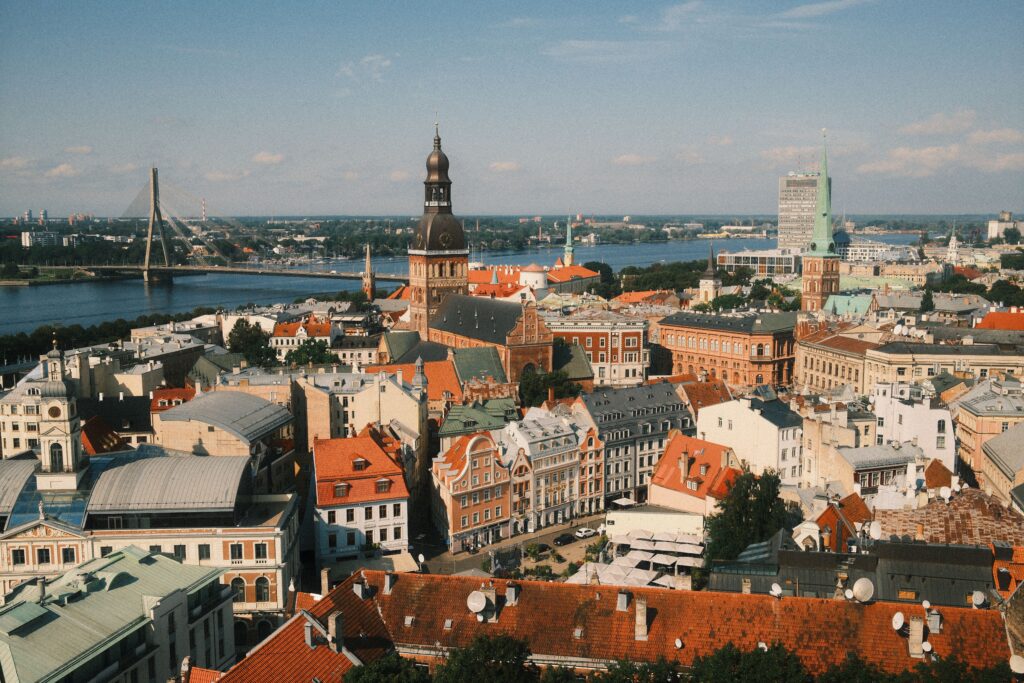
Latvia has also been working with cruise operators to bring passengers to Riga.
Cruise tourism can provide an immediate injection of visitors.
But there is a catch.
Cruise passengers generally spend only a limited amount of time in a destination.
A ship may bring thousands of people into a city, but many passengers leave again the same day.
For local tourism businesses, the greater prize is often the overnight visitor.
Someone who stays for two or three nights is more likely to spend money on:
- hotels;
- restaurants;
- museums;
- local tours;
- nightlife;
- transportation;
- shopping;
- and cultural experiences.
That is why Latvian officials say they are looking beyond short cruise visits toward longer-term tourism development.
The Numbers Show a Wider European Problem
Latvia is not alone.
Data cited by the article from the UN tourism system showed that in 2022, Latvia received 38% fewer tourists than in 2019.
Over the same period:
- Slovenia recorded a 42% decline;
- Finland recorded a 36% decline.
The comparison is particularly revealing because these countries have very different tourism profiles.
It suggests that the economic consequences of geopolitical disruption can extend beyond the immediate battlefield.
The Finland Question
Finland is especially interesting because it has long marketed itself around nature, lakes, forests and outdoor experiences.
Those are precisely the qualities increasingly sought by travelers looking for cooler, quieter destinations.
Yet Finland’s proximity to Russia creates a different challenge.
Even when a destination is peaceful, travelers may perceive a country sharing a border with a major conflict zone differently from one located farther away.
This is one reason the frontline countries want Brussels to recognize security-related tourism impacts as a legitimate regional-development issue.
The European Commission Already Recognizes the Economic Damage
The request is not occurring in isolation.
The European Commission’s latest cohesion reporting acknowledges that Russia’s war against Ukraine has caused declines in investment, trade and economic activity in some regions, alongside job losses and new economic barriers.
Tourism is included among the affected sectors.
That gives the seven countries a stronger argument.
They are essentially asking Brussels to translate that recognition into financial support.
What Kind of Funding Could Help?
The seven governments have not simply presented tourism as an ordinary marketing problem.
Their request points toward broader regional resilience.
Potential support could be used for areas such as:
Tourism marketing
Frontline destinations may need international campaigns to reassure travelers that they remain open and accessible.
Infrastructure
Better roads, rail connections, airports and digital infrastructure can make destinations more competitive and reduce their dependence on a narrow visitor base.
Business financing
Small tourism companies may need easier access to loans and investment after losing revenue.
Product diversification
Regions could develop new attractions around:
- nature;
- wellness;
- culture;
- food;
- cycling;
- hiking;
- heritage;
- and rural tourism.
Crisis communication
Destinations need systems capable of responding quickly when security incidents generate negative headlines.
Workforce retention
Tourism downturns can cause workers to leave for other regions or industries, making recovery more difficult when visitor numbers eventually return.
Why the EU Budget Matters
The EU’s long-term budget determines how billions of euros are distributed across the bloc.
The proposed next financial framework is expected to cover the period from 2028 to 2034.
For the seven countries, getting tourism recognized during this process could be crucial.
A short-term tourism grant can help a hotel survive a bad season.
A multi-year regional-development program can potentially transform the economic structure of an entire destination.
That is the difference between crisis relief and resilience planning.
Tourism Policy Is Also Becoming Security Policy
The request highlights an emerging reality in European policymaking:
Tourism can no longer be treated as completely separate from geopolitics.
Airspace violations, drone incidents, border closures, energy shocks and military conflicts can all influence where people choose to travel.
The European Parliament has also identified repeated airspace violations and hybrid threats as part of Europe’s deteriorating security environment.
For tourism officials, this creates a new responsibility.
They must understand not only consumer behavior and destination marketing, but also crisis management and geopolitical communication.
The Psychological Cost of Security Incidents
One drone incident can potentially have a much larger economic impact than its physical footprint suggests.
Imagine a tourist preparing to travel to an eastern European destination.
They see a headline about an unidentified drone entering the country’s airspace.
Even if:
- airports remain open;
- hotels operate normally;
- public transport is unaffected;
- attractions remain open;
- and authorities say there is no danger to tourists,
the traveler may still cancel.
This is because tourism decisions are often driven by risk perception rather than statistical risk.
That distinction is critical.
The Challenge of Rebuilding Confidence
Getting a traveler to book a trip is only half the battle.
Destinations must also convince:
- airlines;
- tour operators;
- cruise companies;
- hotel investors;
- conference organizers;
- travel agencies;
- and international event planners
that the market is stable enough to justify long-term investment.
This is why the seven countries are emphasizing investor confidence as well as visitor numbers.
Without investment, tourism destinations can fall behind even after demand begins recovering.
Europe Could Face a New Tourism Divide
The situation raises a broader question about Europe’s tourism geography.
Climate change is pushing some travelers toward cooler northern destinations.
Overtourism is encouraging visitors to seek alternatives to famous Mediterranean hotspots.
Yet security concerns could push some tourists in the opposite direction—toward countries perceived as farther from geopolitical risk.
That could create an unusual divide:
climate pressures may push tourists north, while security concerns could push some of them west or south.
The winners may be destinations that can offer both climate comfort and a strong perception of safety.
Frontline Regions Have an Opportunity, Too
Despite the difficulties, eastern Europe’s tourism sector is not without advantages.
Many frontline regions possess assets that modern travelers increasingly value:
- pristine forests;
- lakes;
- national parks;
- low-density rural landscapes;
- historic towns;
- authentic local culture;
- affordable accommodation;
- and relatively low levels of overtourism.
If governments can overcome the perception problem, these destinations could appeal strongly to travelers searching for alternatives to Europe’s crowded tourism capitals.
Sustainable Tourism Could Become Part of the Solution
The seven countries have also expressed willingness to work with the European Commission on its future strategy for sustainable tourism.
That creates an opportunity to combine two objectives.
Instead of simply trying to restore visitor numbers to prewar levels, frontline regions could build more resilient tourism economies.
That could mean:
- attracting higher-spending visitors;
- encouraging longer stays;
- spreading tourism across seasons;
- reducing dependence on one or two nationalities;
- developing rural destinations;
- strengthening local supply chains;
- and investing in environmentally responsible tourism.
In other words, the goal should not simply be more tourists.
It should be better tourism economics.
The EU Has a Difficult Balancing Act
Brussels now faces a tricky policy question.
If the EU provides special support to frontline tourism regions, other countries may argue that their own tourism industries also face serious problems—from climate change and extreme heat to overtourism, energy costs and changing consumer behavior.
The Commission will therefore need criteria for deciding:
- what qualifies as a frontline tourism region;
- how losses should be measured;
- whether funding should go directly to businesses or through governments;
- how long support should last;
- and how to prevent subsidies from simply maintaining uncompetitive businesses.
Those details could determine whether the initiative becomes meaningful or merely symbolic.
The Commission Has Not Yet Committed to a Funding Package
The European Commission has confirmed that it received the seven countries’ letter.
A spokesperson said the Commission would respond in due course and noted that tourism challenges—including those facing frontline regions—are already being considered in preparatory work on the EU’s future tourism strategy.
That means the request is currently a political proposal rather than an approved funding program.
The next stage will be negotiations over the EU’s long-term budget and tourism strategy.
What Happens Next?
The seven countries are likely to push for several things during the budget negotiations.
First, they will want frontline tourism impacts explicitly recognized.
Second, they will likely seek flexible financing that can respond to sudden disruptions.
Third, they will want tourism included alongside broader cohesion, infrastructure and regional-development measures.
And finally, they will need to demonstrate that investment can produce measurable results.
For Brussels, the challenge will be turning a compelling political argument into a workable funding mechanism.
Why This Story Matters Beyond Eastern Europe
The tourism crisis in Europe’s frontline regions offers a warning for destinations everywhere.
Travel is remarkably vulnerable to events that tourism businesses cannot control.
A war, pandemic, terrorist attack, natural disaster, extreme weather event or political crisis can destroy demand almost overnight.
The lesson is that tourism destinations need resilience, not simply marketing.
A region dependent on one country for most of its international visitors is vulnerable.
A region dependent entirely on summer tourism is vulnerable.
A region without alternative transportation options is vulnerable.
And a region that cannot communicate effectively during a crisis is vulnerable.
The New Tourism Economy Will Be Built Around Resilience
The next generation of European tourism policy may therefore look very different from the old model.
Instead of measuring success only through arrivals and overnight stays, governments may increasingly look at:
- market diversification;
- length of stay;
- business survival;
- investment levels;
- workforce stability;
- climate resilience;
- transportation connectivity;
- and crisis preparedness.
For frontline regions, those measures could be the difference between permanent decline and eventual recovery.
Final Thoughts
The request from Bulgaria, Estonia, Latvia, Lithuania, Poland, Romania and Slovakia is more than a plea for tourism subsidies.
It is a test of whether the European Union views tourism as part of its economic resilience strategy.
The war in Ukraine has demonstrated that security problems can spread far beyond military targets. They can affect investment decisions, consumer confidence, transportation networks and local businesses.
Tourism is particularly exposed because travelers can simply choose somewhere else.
That is why the seven countries want Brussels to acknowledge a simple reality:
A peaceful hotel in a frontline region can still struggle if potential guests believe the destination is unsafe.
The solution will not come from advertising alone.
It will require coordinated investment, better infrastructure, diversified visitor markets, stronger crisis communication and a long-term strategy for making vulnerable regions economically resilient.
For eastern Europe’s tourism industry, the stakes are much bigger than one difficult season.
They are about whether these destinations can remain competitive in a Europe where security, climate and travel are becoming increasingly intertwined.
5 Frequently Asked Questions
1. Which EU countries are asking Brussels for tourism funding?
The seven countries are Bulgaria, Estonia, Latvia, Lithuania, Poland, Romania and Slovakia. Their tourism and finance ministers have asked the European Commission to consider support for tourism businesses and regions affected by their proximity to Russia, Belarus and Ukraine.
2. Why has tourism been affected in Europe’s frontline regions?
The countries say geopolitical uncertainty and security concerns linked to Russia’s war against Ukraine have reduced visitor flows and investor confidence. Incidents such as drone incursions can also trigger cancellations even when tourist infrastructure continues operating normally.
3. How badly has Latvia’s tourism industry been affected?
The situation varies by region. In eastern Latvia’s Latgale region, a survey of 94 tourism and hospitality businesses found that 72% reported lower turnover and visitor numbers in June 2026 compared with June 2025. Around one-fifth reported losing at least half of their revenue over that period.
4. What kind of help are the seven countries seeking?
The countries want the EU’s next long-term budget to recognize the special economic challenges facing frontline tourism regions. Potential assistance could support tourism businesses, regional development, infrastructure, marketing, investment and economic diversification, although no specific funding package has yet been approved.
5. Will Brussels actually provide the requested tourism funding?
That remains uncertain. The European Commission has confirmed receiving the countries’ request and said that challenges facing frontline tourism regions are being considered as part of preparations for the EU’s future tourism strategy. The final outcome will depend on negotiations over the next long-term EU budget and related tourism policies.
Sources Euro News

