
Greece is welcoming more international travellers, attracting higher spending and extending its appeal beyond the traditional summer holiday season. But behind the impressive figures lies a more complicated question: can the country turn its tourism boom into lasting economic benefits without putting excessive pressure on its islands, cities and local communities?
The latest figures suggest that Greece’s tourism industry is heading towards another exceptionally strong year. According to provisional data from the Bank of Greece, travel receipts reached €21.96 billion between January and September 2026, representing a 9.7% increase compared with the same period in 2025.
The country also recorded approximately 34.2 million inbound travellers, an 8.3% increase year on year. While higher visitor numbers contributed to the revenue growth, increased spending per trip also played a role.
Germany, the United Kingdom, Italy and the United States remained important source markets, although their contributions developed differently. Some markets generated more revenue despite relatively modest arrival growth, while others experienced declining visitor numbers or spending.
The figures highlight Greece’s continued importance as one of Europe’s leading tourism destinations. They also raise important questions about seasonality, infrastructure, environmental sustainability and how the economic benefits of tourism are distributed across the country.
1. Greece Generates Almost €22 Billion in Tourism Revenue in Nine Months
Greece’s tourism industry maintained strong momentum throughout the first nine months of 2026.
The Bank of Greece reported that travel receipts reached €21,958.1 million between January and September, compared with approximately €20,024.3 million during the corresponding period of 2025.
That represents an additional €1.93 billion in tourism revenue within a single year.
The increase was supported by two main factors:
- More international visitors: Inbound traveller numbers increased by 8.3%, reaching approximately 34.2 million.
- Higher spending: Average expenditure per trip increased by 1.5%.
The figures demonstrate that Greece is benefiting from both a larger international visitor market and a modest improvement in the amount travellers spend during their holidays.
However, the distinction between arrivals and revenue is important. A country can attract millions of additional visitors without necessarily generating proportional economic benefits if those visitors stay for shorter periods or spend relatively little.
Greece’s 2026 performance suggests that revenue growth is currently outpacing the increase in arrivals.
The country’s travel-services balance also recorded a substantial surplus of approximately €18.81 billion, compared with €17.44 billion during the first nine months of 2025.
This surplus reflects the difference between money received from international travellers visiting Greece and money spent by Greek residents travelling abroad.
2. Germany Remains One of Greece’s Most Valuable Tourism Markets
Germany continued to be one of the most important contributors to Greece’s international tourism revenue.
Between January and September 2026, German visitors generated approximately €3.57 billion in travel receipts, an increase of 13.5% compared with the previous year.
Arrivals from Germany increased by 8.5%, reaching approximately 5.26 million travellers.
Germany’s importance reflects several factors, including its established travel connections with Greece, strong demand for Mediterranean holidays and the popularity of Greek islands and coastal destinations among German holidaymakers.
The United Kingdom also remained a major source market.
British visitors generated approximately €3.19 billion in tourism receipts during the nine-month period, representing a 1% increase year on year. Arrivals increased by 2.2%, reaching approximately 4.15 million.
Although revenue growth from the UK was relatively modest compared with Germany, the British market remains strategically important because of its established airline connections, package-holiday industry and long-standing relationship with Greek destinations.
Italy delivered one of the strongest performances.
Receipts from Italian visitors increased by 26.2%, reaching approximately €1.45 billion. Arrivals rose by 17.3%, reaching around 2.29 million.
This suggests that Greece benefited from both a significant increase in Italian visitor numbers and higher overall spending.
The American market also produced an interesting result.
Tourism receipts from the United States increased by 15.2%, reaching approximately €1.67 billion. However, arrivals from the US declined by 4.7%, falling to around 1.21 million.
This difference suggests that American visitors who travelled to Greece generated greater average revenue during the period, although the aggregate figures alone cannot explain whether this resulted from longer stays, higher accommodation prices, more expensive travel arrangements or changes in visitor spending patterns.
France, meanwhile, recorded a weaker performance. Receipts declined by 7.5% to approximately €1.09 billion, while arrivals fell by 6.7%, reaching around 1.59 million.
Greece’s leading source markets, January–September 2026
| Source market | Tourism receipts | Year-on-year change |
|---|---|---|
| Germany | €3.57 billion | +13.5% |
| United Kingdom | €3.19 billion | +1.0% |
| United States | €1.67 billion | +15.2% |
| Italy | €1.45 billion | +26.2% |
| France | €1.09 billion | -7.5% |
3. European Travellers Account for More Than Half of Tourism Revenue
European visitors remain the backbone of Greece’s international tourism industry.
During the first nine months of 2026, travellers from European Union countries generated approximately €12.19 billion in tourism receipts, an increase of 11.5% compared with the same period in 2025.
Visitors from countries outside the EU generated approximately €8.90 billion, representing an increase of 7.8%.
The eurozone was particularly important. Receipts from eurozone residents increased by 16.6%, reaching approximately €10.05 billion.
However, revenue from EU countries outside the eurozone declined by 7.3%, falling to approximately €2.14 billion.
These differences show that Greece’s tourism performance is not uniform across international markets.
European travellers benefit from relatively convenient geographical access, established flight networks and, for many visitors, the convenience of travelling within the European single market.
For Greece, maintaining strong demand from European countries is particularly important because these markets provide a substantial and relatively established source of tourism business.
At the same time, international diversification remains valuable. Demand from the United States and other long-haul markets can help hotels, airlines and tourism operators reach visitors with different travel preferences and spending patterns.
4. September Shows Why Visitor Spending Matters More Than Arrivals Alone
One of the most revealing details in the 2026 figures concerns September.
Greece generated approximately €3.76 billion in travel receipts during September 2026, an 11.1% increase compared with September 2025.
Yet inbound traveller numbers increased by only 0.6%, reaching approximately 5.72 million.
The difference was driven largely by a 10.2% increase in average expenditure per trip.
This is an important development because it demonstrates that tourism revenue can rise significantly even when visitor numbers remain relatively stable.
For hotels, restaurants, transport operators and local businesses, the amount visitors spend can be just as important as the number of people arriving.
However, higher average expenditure does not automatically mean that local businesses or residents receive a proportionate benefit. Some spending may be absorbed by international booking platforms, airlines, overseas tour operators and imported goods.
The September figures also revealed significant differences between nationalities.
Receipts from German visitors increased by 48.6%, reaching €714.1 million. Arrivals from Germany rose by 10.1%, reaching approximately 1.05 million.
In contrast, receipts from British visitors declined by 15.2% to €522.3 million, while receipts from American visitors fell by 15.1% to €198.1 million.
The French market also weakened, with receipts declining by 3.8% to €158 million. Italian receipts slipped by 0.4%, reaching €194.6 million.
These figures illustrate why tourism authorities and businesses need to examine individual markets rather than relying exclusively on national arrival totals.
A destination attracting more visitors is not necessarily generating more money from every market.
5. Greece Is Attracting More Visitors Through Road and Air Travel
Another important development is the increase in visitors entering Greece through land borders.
Between January and September 2026, air arrivals increased by approximately 5%, while arrivals through road border crossings rose by 17.7%.
This is significant because Greece’s tourism industry is not exclusively dependent on international flights.
The country shares land borders with Albania, North Macedonia, Bulgaria and Türkiye, making road travel an important part of its tourism market.
Travellers from neighbouring countries can reach northern Greece by car or coach, supporting destinations that may not depend as heavily on international airport connections.
The wider regional market also creates opportunities for short breaks, family holidays and repeat visits.
The data show that Greece received approximately 20.5 million travellers from EU countries during the first nine months of 2026, an increase of 8.5%. Arrivals from other countries reached approximately 13.72 million, up 7.9%.
September was more subdued. Air arrivals increased by 2.2%, while road arrivals declined by 5.8%.
This contrast suggests that different transport markets can experience different seasonal patterns.
For Greece, improving airport capacity, road infrastructure and border-crossing facilities will remain important as the country seeks to accommodate growing international demand.
6. Tourism Is a Major Economic Engine for Greece
Tourism is not simply an important industry for Greece. It is one of the foundations of the country’s wider economy.
Its influence extends far beyond hotels and holiday resorts.
The industry supports airlines, ferry operators, restaurants, cafés, travel agencies, tour guides, museums, retail businesses, agricultural suppliers and construction companies.
The OECD’s Tourism Trends and Policies 2026 report provides useful context.
According to the OECD, tourism directly contributed approximately €15.1 billion to Greece’s economy in 2024, equivalent to 7.3% of total gross value added.
The sector directly employed approximately 613,900 people, representing 14.4% of total employment.
These figures demonstrate how strongly tourism is connected to Greek employment and business activity.
The wider economic contribution is even greater when indirect effects are considered.
For example, a hotel purchases food from agricultural producers, hires cleaning and maintenance companies, uses local transport providers and employs workers who spend their wages in the surrounding economy.
A successful tourism season can therefore generate economic activity across several industries.
The latest revenue figures are particularly important because tourism receipts also help Greece earn foreign income.
The Bank of Greece reported that net receipts from travel services covered 75.4% of the country’s goods trade deficit during January–September 2026.
This illustrates how international tourism helps offset the money Greece spends importing products from other countries.
Nevertheless, tourism’s economic importance also creates vulnerabilities. A major disruption to international travel, an economic downturn in important source markets, geopolitical instability or extreme weather could affect a substantial part of the country’s business activity.
7. Greece Is Trying to Extend Its Tourism Season Beyond July and August
For decades, Greece has been associated with summer holidays.
The country’s islands, beaches, coastal resorts and Mediterranean climate make July and August particularly attractive to international visitors.
However, relying heavily on a short summer season creates several challenges.
Hotels and restaurants may experience intense demand during peak months but struggle to maintain business during the quieter winter period.
Seasonal workers may face uncertain employment, while transport operators and local infrastructure must accommodate substantial fluctuations in visitor numbers.
Greece is therefore increasingly interested in extending its tourism season.
April, May, September and October are becoming more important periods for international travel.
Several factors support this trend:
- Travellers may find lower accommodation prices outside the busiest summer months.
- Popular destinations can be less crowded during spring and autumn.
- Some visitors prefer milder temperatures for sightseeing and outdoor activities.
- Airlines and tourism operators are expanding opportunities to serve destinations beyond the traditional summer peak.
- Cultural tourism, gastronomy, wellness and outdoor experiences can attract visitors throughout the year.
The changing climate may also influence travel preferences.
Extreme summer temperatures across parts of the Mediterranean could encourage some visitors to choose spring and autumn holidays instead.
Greece has an opportunity to use its historical attractions, food culture, archaeological sites and natural landscapes to attract travellers throughout the year.
Athens, Thessaloniki, Meteora, Delphi and several mainland destinations can offer experiences that are not dependent on beach weather.
The challenge is ensuring that attractions, hotels, restaurants and transport services remain available outside the traditional summer season.
8. Popular Greek Islands Face Growing Pressure From Overtourism
The growth of Greek tourism brings economic opportunities, but it also creates pressure on popular destinations.
Islands such as Santorini, Mykonos, Crete and Rhodes have become internationally recognised holiday destinations.
Their popularity supports hotels, restaurants, ferry operators, tour companies and local shops.
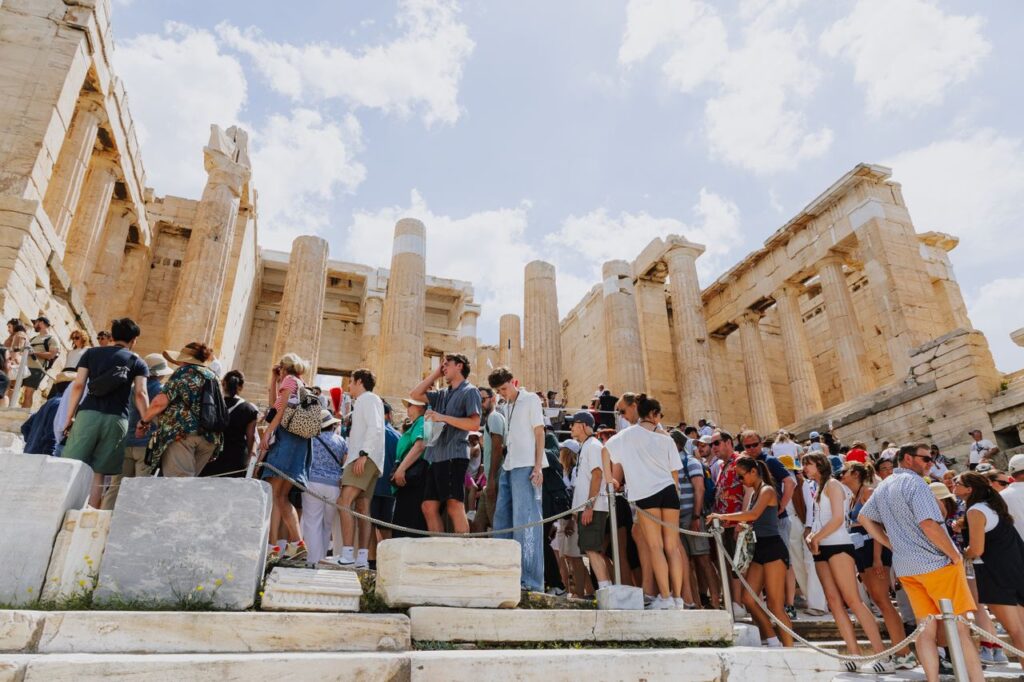
However, large visitor numbers can place considerable pressure on local infrastructure.
Overtourism can contribute to:
- Traffic congestion and overcrowded public spaces.
- Higher housing costs and competition for residential accommodation.
- Pressure on waste collection and sewage systems.
- Increased demand for electricity and water.
- Environmental damage to beaches, coastlines and fragile ecosystems.
- Greater competition for workers and local services.
Water scarcity is particularly concerning.
In July 2026, Reuters reported that seven Greek Aegean islands had declared drought emergencies as rising temperatures, irregular rainfall and increased summer demand placed pressure on water supplies.
On Astypalaia, the population was reported to increase from approximately 1,400 residents to around 7,000 during the summer season.
This creates a substantial challenge for a relatively small island with limited water infrastructure.
Authorities approved temporary desalination facilities and allocated funding for measures including water tanks and improvements to local supply systems.
The problem is not limited to one island. Climate change and tourism demand are combining to create a difficult long-term challenge for several Mediterranean destinations.
The European Commission has also identified Greece as one of the EU’s most water-stressed countries, highlighting the need for investment in water infrastructure and climate resilience.
For tourism to remain economically successful, destinations must have enough resources to support both visitors and permanent residents.
9. Greece Needs to Distribute Tourism Revenue More Evenly
Another challenge is the uneven geographical distribution of tourism.
Some destinations attract enormous numbers of international visitors, while other parts of Greece receive considerably less attention.
Athens, Santorini, Mykonos, Crete and Rhodes are internationally recognised names. Smaller islands, inland villages and less-developed mainland regions may have difficulty attracting the same level of international demand.
This imbalance matters because tourism revenue does not automatically reach every community.
A hotel investment in a major resort may create employment and business opportunities in that area, while a nearby rural region receives relatively little benefit.
Greece could strengthen its tourism industry by promoting a broader range of destinations.
Potential opportunities include:
Cultural and historical tourism: Archaeological sites, museums, Byzantine churches and historic towns can attract visitors interested in Greece’s long history.
Food and wine tourism: Local cuisine, olive oil, vineyards, traditional markets and regional agricultural products can provide additional income for smaller communities.
Mountain tourism: Destinations such as Zagori, Metsovo and Mount Olympus offer opportunities for hiking, nature experiences and winter activities.
Rural tourism: Traditional villages, farm stays and local festivals can help visitors discover a different side of Greece.
Wellness tourism: Thermal springs, spa facilities and health-related travel can support demand outside the summer holiday season.
The OECD has identified diversification, sustainable destination management and improved tourism data as important priorities for Greece.
A more balanced tourism model could help reduce pressure on the most crowded islands while creating employment opportunities in areas that have not benefited equally from international tourism.
10. Can Greece Maintain Its Tourism Growth in 2027?
Greece enters the next tourism season from a position of strength.
The first nine months of 2026 delivered almost €22 billion in travel receipts, while international visitor numbers increased by more than 8%.
However, maintaining this momentum will depend on several factors.
International economic conditions
Germany, the UK, Italy and the United States are important markets for Greek tourism.
Economic weakness, higher household expenses or reduced consumer confidence in these countries could affect holiday spending.
Airline capacity and travel costs
International connectivity is essential for Greece’s island-based tourism economy.
Airline operating costs, fuel prices, aircraft availability and changing travel demand can influence the number of flights and the affordability of holidays.
Climate and infrastructure
Water supply, waste management, electricity, transport and coastal protection will become increasingly important.
Without adequate investment, popular destinations may struggle to accommodate additional visitors.
Tourism quality and value
Greece must continue offering experiences that justify the cost of travelling there.
Accommodation standards, customer service, food quality, cultural experiences and environmental protection all influence whether visitors return.
Diversification
The country’s long-term prospects may improve if tourism demand becomes less concentrated in a handful of destinations and the busiest summer months.
The strongest tourism strategy is not necessarily to attract the largest possible number of visitors. It is to generate sustainable economic benefits while protecting the qualities that make Greece attractive in the first place.
Conclusion: Greece’s Tourism Boom Is Impressive, but Sustainability Will Determine Its Future
Greece’s tourism industry has delivered another impressive performance in 2026.
Travel receipts reached €21.96 billion between January and September, increasing by 9.7% compared with the previous year. International arrivals rose by 8.3%, while average spending per trip also increased.
Germany, the United Kingdom, Italy and the United States remained important source markets, although their individual performances varied.
The figures confirm that tourism continues to play a central role in Greece’s economic development, supporting employment, businesses and foreign income.
But financial growth is only part of the story.
Water shortages, overcrowding, climate change, regional inequalities and dependence on seasonal demand present serious challenges. Greece must ensure that tourism expansion does not undermine the communities and natural environments that attract visitors.
Its next chapter should focus not simply on welcoming more tourists, but on encouraging longer stays, higher-quality experiences, stronger local businesses and more responsible travel.
The real measure of Greece’s tourism success will be whether it can turn record-breaking visitor spending into lasting prosperity for the entire country.
Frequently Asked Questions (FAQs)
1. How much tourism revenue did Greece generate in 2026?
Greece generated approximately €21.96 billion in travel receipts between January and September 2026, representing a 9.7% increase compared with the same period in 2025. The figures are based on provisional data published by the Bank of Greece.
2. How many tourists visited Greece in the first nine months of 2026?
Greece recorded approximately 34.2 million inbound travellers between January and September 2026. This represented an 8.3% increase compared with the corresponding period in 2025.
The Bank of Greece’s inbound travel figures do not capture all cruise passenger activity independently, so they should not be interpreted as a complete count of every tourist entering Greece.
3. Which countries contribute the most tourism revenue to Greece?
Germany and the United Kingdom were the two largest contributors among the markets highlighted in the 2026 figures.
Between January and September, German visitors generated approximately €3.57 billion, while British visitors contributed around €3.19 billion. Italy and the United States were also important markets.
4. What is the best time to visit Greece?
The best time depends on the type of holiday.
- April and May: Suitable for sightseeing, cultural attractions and outdoor activities with generally milder weather.
- June: A popular period for beach holidays before the busiest part of summer.
- July and August: Ideal for traditional summer holidays, although popular destinations can be crowded and hot.
- September and October: Often attractive for visitors seeking warm weather, fewer crowds and opportunities to explore cultural and coastal destinations.
Travellers should check local transport schedules and seasonal business opening dates, particularly when visiting smaller islands outside summer.
5. What are the biggest challenges facing Greece’s tourism industry?
Greece faces several important challenges, including overtourism, water shortages, extreme summer temperatures, environmental pressure, seasonal employment and unequal tourism development between regions.
Maintaining reliable infrastructure while protecting local communities and natural attractions will be essential to the industry’s long-term success.
Sources Euro News