
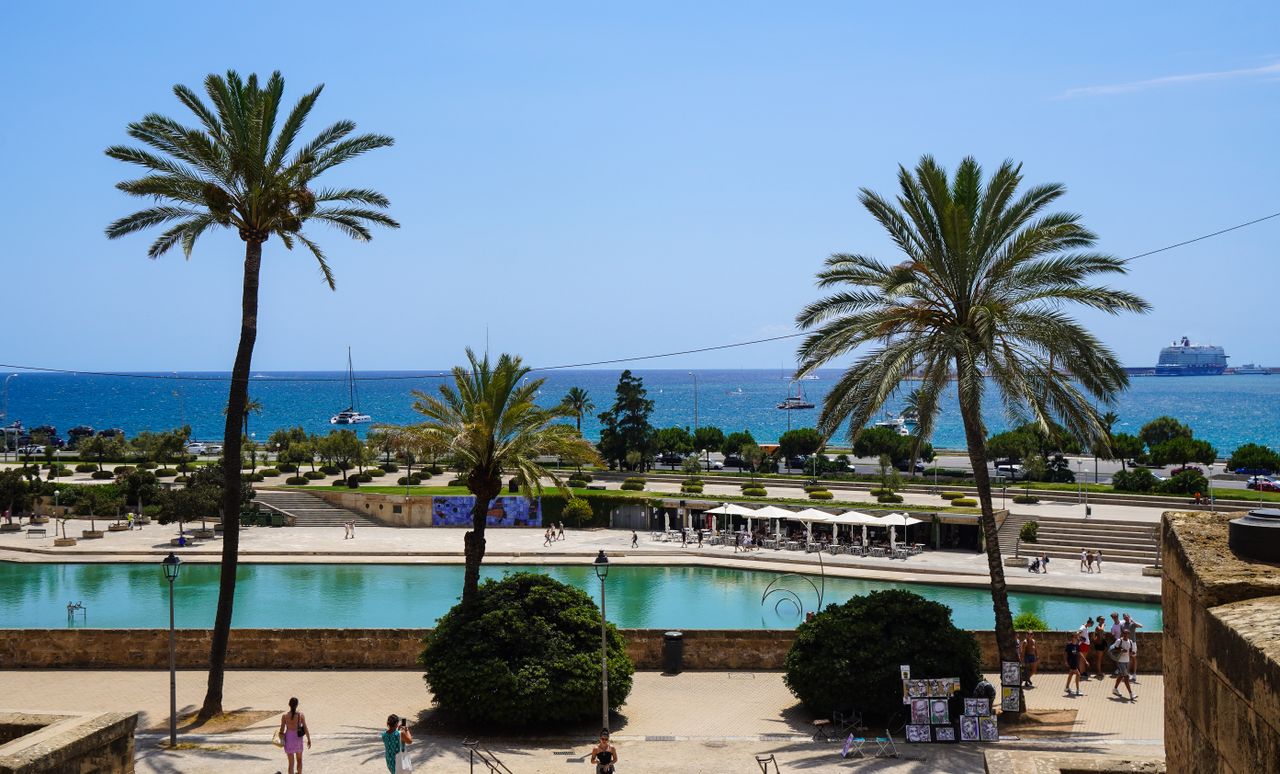
Mallorca has a tourism problem that sounds almost impossible to complain about: too many visitors, too much money and too much international attention.
The Spanish island is one of Europe’s most recognizable holiday destinations, famous for turquoise coves, dramatic mountains, historic villages, Mediterranean cuisine and the nightlife of resorts such as Magaluf. Tourism has transformed the island into an economic powerhouse.
But success has come with a price.
Residents increasingly complain about crowded roads, packed beaches, pressure on water and infrastructure, rising housing costs, short-term rentals and the loss of space for everyday life. Authorities are now considering how to change Mallorca’s tourism model rather than simply attracting more visitors.
One of the most striking ideas is to pursue fewer tourists who spend more and American travelers have emerged as an especially attractive market.
According to a recent Fox News report, Palma tourism officials have specifically highlighted wealthier American visitors as the type of traveler Mallorca would like to attract. The strategy is partly based on spending behavior: American tourists in Spain reportedly spent around $410 per day in July, compared with approximately $240 for German visitors and $260 for British visitors. American visits to Mallorca also reportedly increased sharply during 2026, helped by stronger air connectivity.
But there is an important catch.
Mallorca’s problem is not simply that some tourists spend too little. The island has a capacity problem. Replacing one group of visitors with another may improve the amount of money generated per traveler, but it does not automatically free up housing, roads, beaches, water supplies or public spaces.
That distinction will determine whether Mallorca’s new tourism strategy succeeds.
Why American Tourists Have Become So Attractive
American travelers are not traditionally Mallorca’s largest tourism market.
Visitors from Germany and the United Kingdom have long played much larger roles in the Balearic tourism economy. Americans, however, have been growing rapidly from a much smaller base.
In 2025, about 333,561 visitors from the United States traveled to the Balearic Islands, putting the U.S. among the archipelago’s important individual source markets. Mallorca received roughly 211,453 American visitors that year, while Ibiza experienced particularly rapid growth.
The appeal extends beyond visitor numbers.
American travelers are often associated with longer-haul trips, higher accommodation budgets and spending on upscale hotels, restaurants, experiences and transportation. For an island attempting to increase tourism revenue without continuing to expand visitor numbers, that profile is attractive.
The shift also fits another trend already visible in the Balearics.
In 2025, the islands recorded approximately €23.4 billion in total tourist spending, a record. Tourist arrivals increased much more slowly than expenditure, while average spending reached about €1,228 per tourist and €198 per person per day.
That is essentially the economic argument behind the “quality over quantity” model.
Mallorca does not necessarily need to make every year a race for another million visitors.
It could instead try to earn more from the visitors it already receives.
Mallorca Is Already Moving Toward Higher-Value Tourism
The transformation is not merely a marketing slogan.
Across the Balearic Islands, tourism growth has increasingly been measured in terms of value rather than visitor volume. Official regional data show that the islands received about 19.1 million tourists in 2025, up around 1.8%, while tourism spending increased considerably faster. Spending reached approximately €23.4 billion.
Hotel investment is also moving upward.
A 2026 analysis of the Balearic hotel market found that hotel capacity grew only modestly in 2025, while hotel prices and revenue per available room increased substantially. In Mallorca, average daily hotel rates rose 8.1% during 2025.
That creates an unusual tourism equation:
Fewer additional hotel beds + stronger demand + higher prices + higher visitor spending = greater tourism value without necessarily increasing physical capacity at the same rate.
For tourism planners, this can look like an ideal solution.
But residents may see the same numbers differently.
Higher hotel prices do not necessarily make an island more affordable for the people who live there.
The Real Question: Who Benefits From Tourism Growth?
This is where Mallorca’s debate becomes more complicated than the phrase “rich Americans versus party tourists.”
A tourism economy can generate record revenue while ordinary residents experience rising living costs.
The Balearic Islands saw housing prices rise dramatically over the past two decades. Data cited in local reporting show the average housing price increasing from around €2,207 per square meter in 2005 to approximately €4,062 in 2025. Over the same period, annual tourist numbers increased by millions and tourist accommodation capacity also expanded.
For residents, the question is therefore not simply:
“How much does each tourist spend?”
It is:
“Can local people still afford to live here?”
That is a completely different measure of tourism success.
A wealthy visitor staying at a five-star hotel may spend much more than a budget traveler. But if that visitor also contributes to demand for luxury apartments, vacation properties, restaurants, private transportation and premium real estate, the economic impact can extend beyond traditional hotels.
Luxury tourism is still tourism.
It consumes roads, airports, beaches, electricity, water, labor and public space.
Overtourism Is About Volume—Even When the Visitors Are Wealthy
The strongest criticism of Mallorca’s strategy is straightforward.
If the problem is overcrowding, why would attracting wealthier tourists solve it?
It might not.
Local attitudes toward tourism show that many residents support concrete measures to control total visitor pressure. A survey reported in April 2026 found majorities supporting limits on visitor numbers, cruise ships, rental cars, tourist accommodations and holiday rentals.
That is significant because it suggests the public concern is broader than the behavior of British partygoers.
A quieter American couple staying at an expensive resort can still contribute to congestion.
A luxury traveler still needs an airport transfer.
They may rent a car.
They may visit Palma.
They may use the same beaches.
They may book the same popular restaurants.
And their accommodation still occupies a physical space.
The environmental and infrastructure footprint does not disappear because the visitor has a larger travel budget.
Why British and German Visitors Are Part of a Sensitive Debate
Mallorca’s traditional European markets remain enormously important.
British and German travelers have contributed decades of demand, investment and employment. Entire parts of the island’s tourism infrastructure were developed around these markets.
The recent push toward American visitors has therefore generated an unusual conversation about the “ideal tourist.”
Some officials and tourism professionals portray higher-spending Americans as quieter and more interested in culture, food, nature and premium experiences than the party-tourism image associated with certain Mediterranean resorts. Fox News quoted tourism officials and a luxury travel adviser making that case.
But treating an entire nationality as one type of traveler is risky.
There are quiet British travelers.
There are wealthy German travelers.
There are budget-conscious Americans.
There are American visitors who want nightlife.
Tourism behavior depends on age, income, travel purpose, season, accommodation and destination not simply nationality.
For Mallorca, the more useful distinction may therefore be between different types of tourism rather than different passports.
The Visitor Mallorca Really Wants
The ideal traveler for Mallorca’s new strategy is probably not simply “American.”
It is a traveler who stays longer, spends more locally, travels outside the busiest weeks, values local businesses and is willing to experience the island beyond the most crowded tourist zones.
That could include an American couple staying for ten days rather than four.
It could be a British visitor traveling in October instead of August.
It could be a German family spending money on local restaurants and cultural attractions rather than an all-inclusive package.
It could be a Spanish traveler visiting during the shoulder season.
This approach is much more sustainable than simply substituting one nationality for another.
The Rise of Experience-Based Luxury
Mallorca is particularly well positioned for the experience-driven luxury market.
The island offers far more than beaches.
Visitors can explore the Tramuntana mountain range, historic villages, wineries, olive farms, sailing routes, cycling trails, art galleries, architectural sites and local food traditions.
Luxury tourism increasingly means paying for access, expertise and personalization rather than simply paying for an expensive room.
A traveler might spend money on a private cooking class, a guided hiking excursion, a sailing trip, a wine experience or an extended stay in a rural property.
That kind of spending can distribute tourism revenue more widely than conventional mass-market resort tourism.
It also creates opportunities for smaller local businesses.
But even experiential tourism requires careful management.
A thousand luxury cars traveling into a mountain village can still create traffic.
A popular hiking trail can still become overcrowded.
A famous restaurant can still become inaccessible to residents.
Sustainability depends on managing the flows, not simply upgrading the price tag.
Mallorca Is Also Trying to Control Cruise Tourism
Cruise ships provide one of the clearest examples of why visitor numbers matter.
Palma has experienced intense cruise activity, with thousands of passengers arriving on some days and concentrating large numbers of visitors in the capital over a short period.
In June 2026, the Balearic government, Palma city authorities and the cruise industry renewed an agreement that will introduce limits from 2027 through 2029. The arrangement provides for a maximum of three cruise ships per day and reduces the permitted number of passengers during the main season from 8,500 to 7,500 per day.
This is a different strategy from attracting richer tourists.
It is direct capacity management.
Instead of asking how much each passenger spends, officials are asking how many people can arrive simultaneously without overwhelming the city.
That could become an increasingly important part of Mallorca’s tourism model.
Short-Term Rentals Are Another Major Pressure Point
Housing is perhaps the most politically sensitive issue.
Tourists need somewhere to sleep, and when demand for accommodation rises, housing can become increasingly valuable.
Short-term rental platforms have become a major part of the debate across Europe. In September 2026, the European Commission proposed an EU-wide framework for evaluating restrictions on short-term rentals in areas experiencing housing shortages. The proposal reflects increasing concern that tourism-related accommodation can intersect with housing affordability.
The debate is complicated because holiday rentals are not the only cause of housing shortages.
Local authorities, businesses and housing organizations disagree about the precise balance between tourism demand, housing supply, planning restrictions, construction costs and investment.
That means Mallorca cannot solve its housing problem simply by collecting more tourist taxes.
It needs long-term housing policy as well.
The Tourist Tax Is Already Producing More Revenue
Mallorca and the other Balearic Islands already have a tourism tax known as the Sustainable Tourism Tax.
The revenue can be used for projects connected with environmental protection, tourism infrastructure and sustainability.
During the first six months of 2026, the Balearic government collected approximately €39.5 million in tourist-tax revenue, up 6% from €37.1 million during the same period of 2025. Tourist numbers increased by about 2.3% during the same period.
The fact that tax revenue is rising faster than visitor numbers is another indication of the region’s move toward higher-value tourism.
But the critical question is where that money goes.
Residents are much more likely to tolerate tourism when they can see tourism revenue improving everyday life—better public transportation, waste management, water systems, housing initiatives, public spaces and environmental protection.
Without visible benefits, even successful tourism policies can deepen resentment.
Water May Become an Even Bigger Constraint
Mallorca’s tourism debate cannot be separated from climate and natural-resource pressures.
The island has a Mediterranean climate and experiences periodic drought concerns. Millions of additional visitors increase demand for water not only through hotels but also through pools, golf courses, landscaping, restaurants and household use.
This makes the idea of unlimited visitor growth increasingly difficult.
A hotel may be able to build another wing.
An island cannot simply manufacture a new coastline.
A city can add restaurants.
It cannot easily widen every historic street.
Tourism management on islands therefore involves limits that mainland destinations can sometimes postpone.
American Tourists Could Help—But They Cannot Be the Whole Strategy
There is a legitimate economic case for Mallorca attracting more American tourists.
American visitors may spend heavily.
They can help diversify Mallorca’s source markets.
More direct flights can strengthen connectivity.
Long-haul travelers may be interested in longer stays and higher-value experiences.
And luxury tourism can generate employment and tax revenue.
But none of those advantages automatically eliminate overtourism.
A successful strategy should therefore have two separate goals:
Increase economic value per visitor.
Reduce pressure on the island’s limited resources.
Those goals overlap, but they are not identical.
A wealthy visitor is still a visitor.
The Best Solution May Be “Fewer Peak Tourists,” Not Simply “Fewer Tourists”
Mallorca may ultimately discover that the most important variable is not annual visitor numbers but when and where those visitors arrive.
The island’s own tourism data already point toward a promising development: visitor growth during the middle and lower seasons has been stronger than during the peak period. In 2025, the Balearics recorded a 6.1% increase in visitors during the shoulder and low seasons, while stays in four- and five-star hotels also increased.
That suggests another path forward.
Instead of trying to eliminate tourism, Mallorca could spread tourism across the calendar.
That would reduce seasonal pressure on roads and beaches, improve employment stability, encourage hotels and restaurants to remain open for more months and potentially make housing and infrastructure planning easier.
It would also offer visitors a better experience.
A Mallorca without peak-season crowds may actually be a more attractive destination.
What Should Tourists Do?
The responsibility cannot fall entirely on governments.
Visitors can make decisions that reduce pressure.
Traveling outside July and August can help.
Choosing locally owned restaurants can spread tourism income.
Using public transportation or shared transfers where practical can reduce congestion.
Staying longer instead of making a short, intensive trip can increase local spending without necessarily increasing the number of annual arrivals.
Respecting residential neighborhoods is equally important.
Tourists should remember that Palma is not an outdoor theme park. Villages are not photo sets. Beaches are not private event spaces. The people serving visitors live on the island.
The more Mallorca becomes a premium destination, the more important that attitude becomes.
A New Definition of the “Perfect Tourist”
The most interesting thing about Mallorca’s strategy may be what it says about the future of mass tourism.
For decades, destinations measured success by arrivals.
More visitors meant more hotels, more flights, more restaurants and more revenue.
Now, many destinations are discovering that unlimited growth can eventually undermine the very qualities that made them popular.
Mallorca’s officials appear to be trying something different.
Instead of asking:
“How many tourists can we attract?”
they are increasingly asking:
“How much value can tourism create without exceeding the island’s capacity?”
That is a much harder question.
It requires balancing hotels with housing, tourism with local life, visitors with infrastructure, and economic growth with environmental limits.
American travelers may play an important part in that transition.
But Mallorca’s future will not be decided by whether the next tourist speaks English, German or Spanish.
It will be decided by whether the island can create a tourism economy in which visitors generate enough value to justify their footprint—and residents still have enough space, housing, resources and quality of life to call Mallorca home.
5 Frequently Asked Questions
1. Why does Mallorca want more American tourists?
American visitors are attractive because they are considered a relatively high-spending and growing market. The Wall Street Journal, cited by Fox News, reported that Americans in Spain spent about $410 per day in July, compared with approximately $240 for German tourists and $260 for British tourists. American tourism to Mallorca has also been growing rapidly.
2. Is Mallorca trying to get rid of British and German tourists?
Not literally. British and German visitors remain enormously important to Mallorca and the wider Balearic tourism economy. The strategy is better understood as an attempt to attract a different mix of visitors—particularly travelers who spend more, stay longer, travel in quieter periods and show greater interest in culture and local experiences.
3. Can wealthy tourists actually solve Mallorca’s overtourism problem?
Not by themselves. Higher-spending tourists can increase tourism revenue without requiring the same level of visitor growth, but wealthy visitors still use roads, airports, beaches, water, accommodation and public infrastructure. Mallorca also needs capacity-management policies covering cruise ships, cars, holiday rentals, accommodation and peak-season crowds.
4. Why are Mallorca residents protesting tourism?
Residents’ concerns include overcrowding, housing affordability, traffic, pressure on natural resources, holiday rentals and the feeling that some areas have become difficult to use as ordinary places to live. Data show that housing prices in the Balearics have increased substantially over the past two decades while tourism activity and accommodation capacity have also expanded.
5. What can tourists do to visit Mallorca more responsibly?
Travel during the shoulder season, stay longer rather than taking short high-intensity trips, support locally owned businesses, use public transportation or shared transfers when practical, respect residential neighborhoods and natural areas, and avoid contributing to overcrowding at already saturated attractions. The goal should not simply be to spend more money, but to create more economic value while placing less pressure on local communities and resources.
Sources Fox Business