

What if the ability to speak, tell stories, and form complex thoughts didn’t begin with modern humans—but was inherited from a much older ancestor?
Recent research suggests that modern humans and Neanderthals may share genetic regions linked to complex language, offering new insight into one of the most defining traits of our species. Rather than being a uniquely human innovation, language may be part of a deeper evolutionary legacy shared across ancient human relatives.
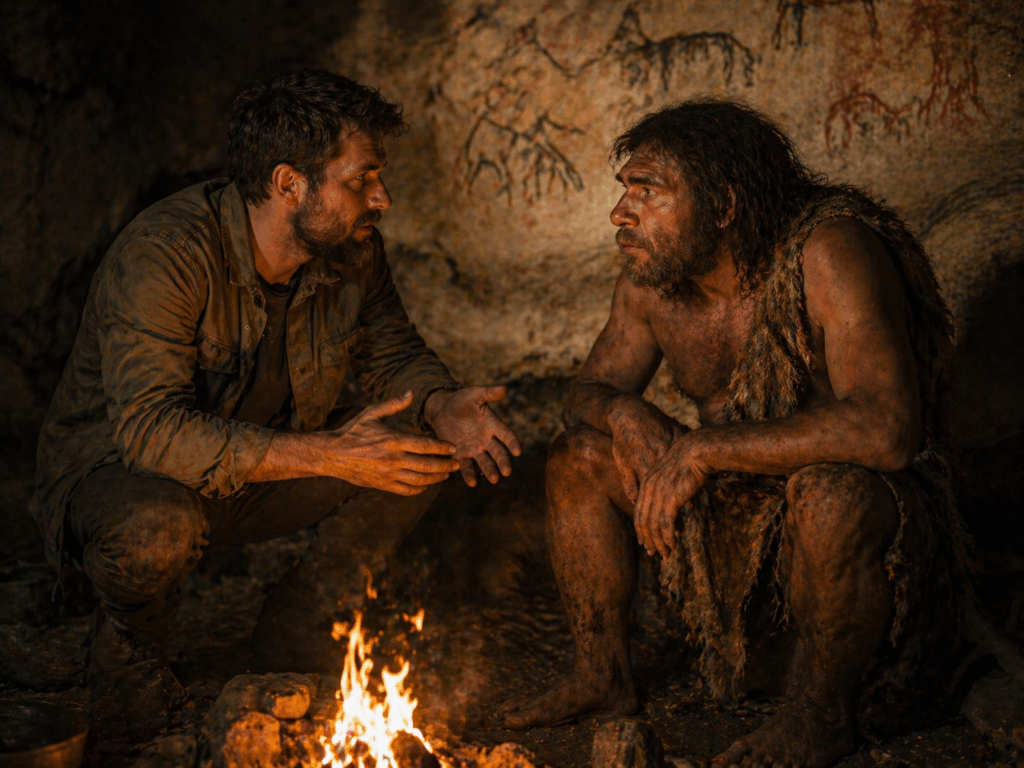
Language: More Than Just Words
Language is not simply about speaking—it’s a highly complex system involving:
- Grammar and syntax
- Symbolic thinking
- Memory and learning
- Social interaction
For years, scientists believed this level of complexity was exclusive to Homo sapiens. But genetic discoveries are now challenging that assumption.
The Genetic Connection Between Humans and Neanderthals
Modern humans and Neanderthals share a common ancestor that lived hundreds of thousands of years ago. During that time, certain genetic regions associated with brain development and communication began to evolve.
What researchers have found:
- Both species share segments of DNA linked to neural processing and language-related functions
- These regions influence how the brain organizes and interprets information
- The similarities suggest that the foundations of language were already present before the species split
This doesn’t mean Neanderthals spoke exactly like we do—but it strongly indicates they had the biological capacity for complex communication.
Beyond FOXP2: A Network of Language Genes
While the FOXP2 gene is often highlighted, language is not controlled by a single gene.
Instead, it involves a network of genes responsible for:
- Brain structure development
- Neural connectivity
- Auditory processing
- Motor control for speech
The discovery of shared genetic regions reinforces the idea that language evolved as a system, not a single mutation.
Did Neanderthals Actually Speak?
This remains one of the most intriguing questions in science.
Evidence in favor:
- Similar genetic makeup related to language
- Brain structures comparable to modern humans
- Archaeological signs of culture (tools, art, burial practices)
Unanswered questions:
- Did they use grammar and syntax?
- How large was their vocabulary?
- Could they express abstract ideas?
Most researchers now agree that Neanderthals likely had some form of structured communication, even if it differed from modern language.
The Brain’s Role in Language Evolution
Language depends heavily on the brain’s architecture.
Key regions include:
- Broca’s area: Speech production
- Wernicke’s area: Language comprehension
- Neural pathways connecting sound, meaning, and memory
Fossil evidence suggests that Neanderthals had brain regions similar in size and placement, supporting the idea of shared communication abilities.
A Gradual Evolution, Not a Sudden Breakthrough
The traditional view of language as a sudden “human invention” is being replaced by a more gradual model.
Likely progression:
- Basic vocalizations
- Symbolic sounds with meaning
- Structured communication
- Complex language with grammar and storytelling
This evolutionary pathway aligns with genetic findings that show incremental development over time.

What This Means for Human Identity
If language predates modern humans, it changes how we see ourselves.
Key implications:
- Language is a shared evolutionary trait, not uniquely human
- Intelligence developed across multiple human species
- Cultural exchange between species may have been more advanced than assumed
It suggests that the roots of human creativity and communication run deeper than previously thought.
What the Original Coverage Didn’t Fully Explore
1. Interbreeding and Genetic Exchange
Modern humans and Neanderthals interbred, meaning some of these language-related genes may still exist in people today—especially those of Eurasian descent.
2. The Role of Social Complexity
Language likely evolved alongside:
- Group living
- Cooperation
- Shared problem-solving
The need to communicate effectively may have driven genetic changes.
3. Comparisons With Other Species
Some animals demonstrate:
- Vocal learning (birds, dolphins)
- Symbolic communication (primates)
This suggests that language may exist on a spectrum rather than as a strictly human trait.
4. Cultural vs. Biological Evolution
Even if the biological capacity existed early, culture shaped language into what it is today:
- Storytelling traditions
- Symbolic art
- Written language systems
The Limits of What We Can Know
Despite advances in genetics, there are limits:
- DNA cannot reveal exact speech patterns
- Fossils cannot capture sound or conversation
- Interpretations rely on indirect evidence
Still, each discovery brings us closer to understanding how language emerged.
Frequently Asked Questions (FAQs)
1. Did Neanderthals have language like humans?
They likely had some form of structured communication, but it may not have been as complex as modern human language.
2. What genetic evidence supports this idea?
Shared DNA regions linked to brain function and communication suggest a common foundation for language.
3. Is FOXP2 the only language gene?
No. Language involves multiple genes working together in a complex system.
4. Can we know what Neanderthals sounded like?
Not exactly. Scientists can infer capabilities but cannot reconstruct precise speech.
5. Why is this discovery important?
It challenges the idea that language is uniquely human and reshapes our understanding of evolution.
6. Do modern humans still carry Neanderthal language genes?
Yes, some people carry Neanderthal DNA, which may include regions linked to brain function.
7. Does this mean animals could develop language?
Some animals show early forms of communication, but human-level language remains unique in complexity.
Final Thoughts
Language has long been considered the defining feature of humanity—but its origins may be far older and more shared than we once believed.
The idea that Neanderthals and modern humans share genetic foundations for language doesn’t diminish what makes us human. Instead, it deepens the story—revealing that our ability to communicate, imagine, and connect may be part of a legacy that stretches back hundreds of thousands of years.
In every conversation we have today, there may be echoes of voices from a distant past—reminding us that language is not just a human invention, but an evolutionary inheritance.

Sources Discover Magazine

